
Why is Indonesia important for India amid China’s increasing influence? Know 8 big reasons. Why Indonesia Is India’s Key Partner Amid China’s Growing Influence

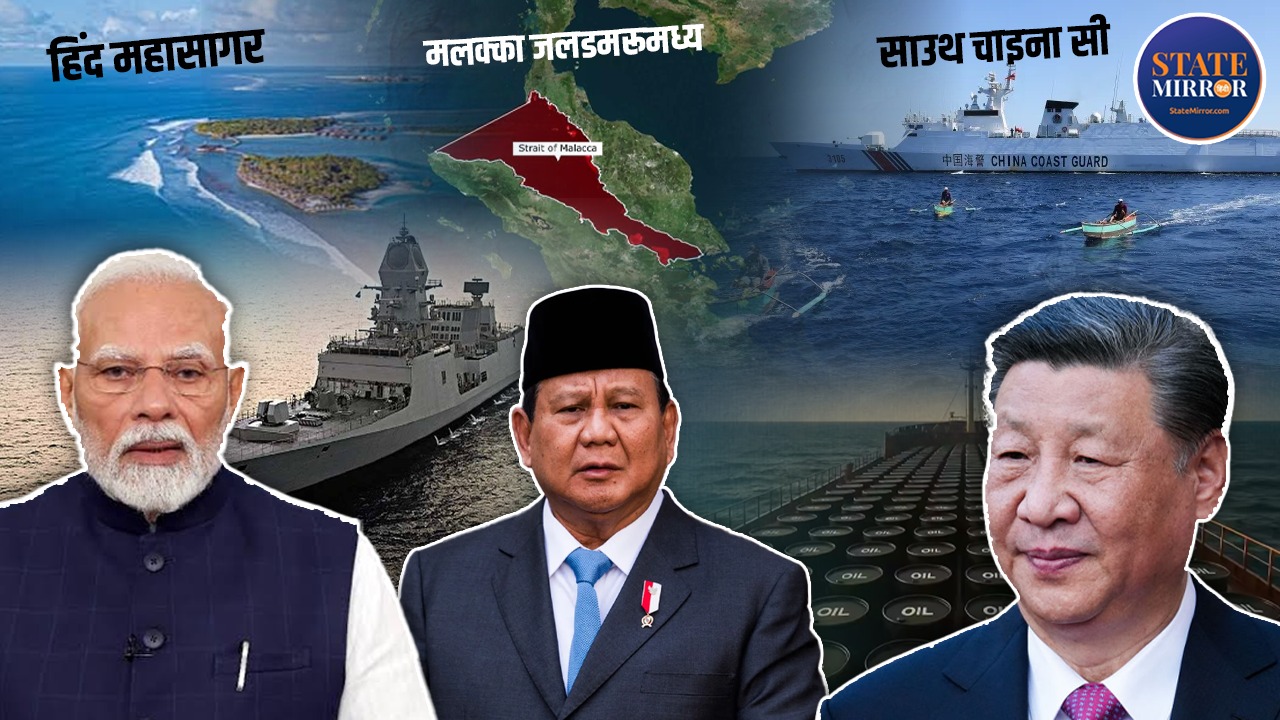
China’s increasing aggression from the Indian Ocean to the South China Sea has changed the strategic picture of Asia. On one hand, India is facing Chinese pressure on the LAC, while on the other hand, Indonesia is constantly alert about Beijing’s claims in the Natuna Sea. In such a situation, the question arises whether China’s expansionist policy has brought India and Indonesia closer than before? After all, what is it that is making Indonesia the new ‘key partner’ of India, and how important is this partnership to balance China’s growing influence in the Indo-Pacific?
1. Why is Indonesia a strategic partner?
Indonesia’s biggest strength is its geographical location. It is the largest island country in the world, which has more than 17,000 islands and its maritime border is about 54,700 kilometers long. Most importantly, global sea routes like Malacca Strait, Sunda and Lombok Straits are around Indonesia. About 25 to 30% of the world’s seaborne trade and more than 60% of seaborne oil trade passes through the Strait of Malacca.
Most of India’s maritime trade with East Asia, Japan and South Korea also takes place through this route. If the influence of any one power increases on these routes, it can have a direct impact on India’s energy security and trade.
2. How important is it for India on the trade front?
India and Indonesia Bilateral trade between the two has reached a level of more than $30 billion in recent years. India imports palm oil, coal, rubber and nickel in large quantities from Indonesia. More than 40% of the world’s nickel reserves are in Indonesia. Nickel is the main raw material for batteries of electric vehicles (EV).
Whereas India exports petroleum products, medicines, automobiles, steel, machinery and agricultural products to Indonesia. Indonesia is emerging as an important option in India’s strategy to reduce the supply chain that is highly dependent on China.
3. Why is it important to control China’s influence?
Indonesia is the largest country of ASEAN. The total population of ASEAN is about 68 crores and Indonesia alone is its most influential member with a population of more than 28 crores. India’s strategy in the Indo-Pacific region is based on the fact that no single country can dominate the sea routes.
China has been expanding military bases, artificial islands and naval activities in the South China Sea over the past decade. In such a situation, along with countries like India, Japan, Australia and America, Indonesia is also a supporter of rules-based maritime order. Samudra Shakti naval exercise and maritime security cooperation between India and Indonesia are part of this strategy.
4. Big factor between China and India
There is a border dispute between India and China on the approximately 3,488 km long Line of Actual Control (LAC). After the Galwan Valley clash of 2020, there was great tension in the relations between the two countries. After this, both the countries deployed thousands of soldiers, tanks, missiles and air defense systems in eastern Ladakh.
On the other hand, China is continuously increasing its naval presence in the Indian Ocean region. China’s first foreign naval base is in Djibouti.
Apart from this, its presence in ports like Gwadar in Pakistan, Hambantota in Sri Lanka and Kyaukphyu in Myanmar increases India’s security concerns. India considers it part of China’s long-term strategy in the Indian Ocean.
5. What is the dispute between Indonesia and China?
Indonesia does not have a formal land border dispute with China, but there is a major dispute around the Natuna Islands in the South China Sea. China claims about 90% of the sea on the basis of its Nine-Dash Line. This claim also conflicts with part of Indonesia’s Exclusive Economic Zone (EEZ).
In 2016, 2019, 2020 and several times thereafter, Chinese coast guard and fishing vessels arrived in the Natuna area, after which Indonesia sent warships, fighter aircraft and additional troops. Indonesia also strengthened military bases and surveillance systems in this area.
However, in 2016, the Permanent Court of Arbitration (PCA) declared China’s Nine-Dash Line claim in the Philippines case legally baseless, but China did not accept this decision.
6. What is China’s strategy from Indian to South China Sea?
China is building a network of ports and maritime infrastructure to Asia, Africa and Europe through the Belt and Road Initiative (BRI) and Maritime Silk Road projects. India is concerned that many ports may also be used for military use in the future.
On the other hand, in the South China Sea, China has deployed airstrips, missile systems and radars by creating artificial islands in the Spratly and Paracel Islands.
For this reason, many countries including America, Japan, Australia, Philippines, Vietnam and Indonesia have become more active regarding maritime security.
7. How is it important for Indonesia to be a ‘key partner’?
India and Indonesia adopted Shared Vision on Maritime Cooperation in the Indo-Pacific in 2018. The distance between India’s Andaman-Nicobar Islands and Indonesia’s Sabang port is very short. India gaining access to Sabang port strengthens surveillance and logistics cooperation at the entrance to the Strait of Malacca. Both countries are increasing partnership in regular naval exercises, coast guard cooperation, Maritime Domain Awareness, anti-terrorism cooperation and defense industry.
In fact, for India, Indonesia is not just a trading partner but also a strategic link between the Indian Ocean and the South China Sea. While on one hand China maintains pressure on India on the LAC and on the other hand makes aggressive claims in the South China Sea, Indonesia is also cautious about Chinese activities in the Natuna area.
The concerns of the two countries are not entirely identical, but common interests such as free and rules-based maritime order, secure trade routes, supply chain diversification and balancing China’s growing influence make them natural partners. This is the reason why in the changing geopolitics of the Indo-Pacific, relations between India and Indonesia are becoming more important than before?

Comments are closed.