
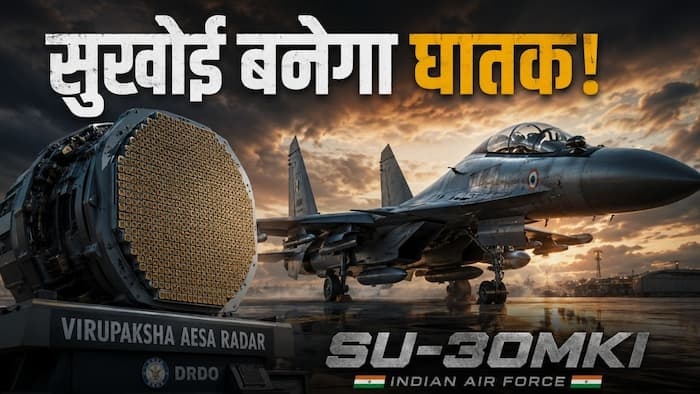
‘Virupaksha’ will become the era of China-Pakistan’s stealth fighter J-35: ‘Super Sukhoi’ will create new history by being equipped with indigenous AESA radar

The Indian Air Force (IAF) has taken a very strategic and big step to counter Pakistan which is trying to show India an eye on the basis of China’s new stealth fighter jet J-35. Sukhoi (Su-30MKI), the backbone of the Indian Air Force and one of the most powerful fighter planes, is now going to become more deadly and accurate than ever. The main reason for this mega-upgrade is the ‘Virupaksha AESA Radar’ being developed completely indigenously in India. This is being considered the most important and revolutionary part of the ‘Super Sukhoi’ upgrade program. Once this indigenous radar is fitted to the Sukhoi, India’s ability to detect, track and accurately target enemy aircraft from extremely long ranges will increase manifold. What is Virupaksha AESA radar and its technology? Virupaksha is a state-of-the-art Gallium Nitride (GaN) based Active Electronically Scanned Array (AESA) radar. Who made it: It is being prepared by LRDE (Electronics and Radar Development Establishment), a famous Bengaluru-based lab of the Defense Research and Development Organization (DRDO) working under the Ministry of Defense. What will it replace: This new indigenous radar will replace the old Russian origin N011M Bars (Passive Electronically Scanned Array) radar currently installed in Sukhoi. Functioning: Advanced digital electronic scanning technology has been used in it, due to which it can detect multiple targets in the blink of an eye and with great accuracy as compared to the old radar. Sukhoi will become a mini-AWACS: Keeping an eye on the enemy up to 400 KM According to the report of news agency ANI, the GaN-based advanced technology used in Virupaksha radar and its high transmit-receive module (TRM) calculation capability puts it in the line of the best radar systems in the world. Will catch stealth planes: Due to this technology, this radar will easily detect even sophisticated semi-stealth (radar-evading) fighter jets like China’s J-35A at very long BVR (Beyond Visual Range – beyond the reach of eyes) distance. Huge Range: It can easily detect any enemy fighter jet, cruise missile or drone coming within a large air radius of about 300 to 400 kilometers. Anti-Jamming: The radar’s advanced electronic scanning, long range and excellent anti-jamming capabilities (blocking enemy signals in electronic warfare) alone position the Sukhoi fighter jet as a ‘mini-AWACS’ (Airborne Warning and Control System). Know why Gallium Nitride (GaN) technology is special? The Gallium Nitride (GaN) technology used in the Virupaksha radar is considered more powerful and efficient than the older generation Gallium Arsenide (GaAs) systems. More power, less heating: GaN technology allows the radar to generate much more radio energy (waves), yet the system heats up much less. Long Performance: Due to low heat dissipation the radar can continuously perform at its best for a very long time on the battlefield without any technical failure or interruption. This is the reason why GaN based AESA radar is now being adopted in the new generation 5th generation fighter jets of America and Europe. A look at the current strength of Sukhoi (Su-30MKI) Sukhoi is the most reliable and heavy-duty multi-role fighter aircraft of the Indian Air Force: Crew and Engine: It is a twin-seater fighter jet, which is equipped with two powerful AL-31FP engines. These engines are equipped with Thrust Vectoring technology, which gives Sukhoi the power to perform impossible acrobatics in the air. Speed and Range: It can fly at a maximum speed of 2,120 km/h (Mach 2). Its range with full fuel at a time is about 3,000 km, which can be increased manifold through mid-air refueling. Weapon carrying capacity: Sukhoi can carry up to 8,000 kg (8 tons) of nuclear weapons, guided bombs and lethal missiles, including the BrahMos supersonic missile. What benefits will ‘Super Sukhoi’ get from Virupaksh radar? Long Range Strike: After installation of Virupaksha radar, Sukhoi will be able to spot enemy fighter jets and attack missiles much before their attack range. Multi-targeting capability: Through Virupaksha, the pilot will be able to simultaneously track (lock) many different targets floating in the air and fire missiles at them simultaneously. Dominance in electronic warfare: This radar will work with 100% accuracy without any deviation even amidst intense electronic jamming by enemy countries. Precise use of indigenous missiles: The combination of Virupaksha radar with India’s own long-range air-to-air ‘Astra’ missiles will prove to be extremely lethal and accurate. ‘Super Sukhoi’ mega upgrade program and blow to Dragon-Pak This upgrade is the main focus of the billion-dollar ‘Super Sukhoi’ program of the Indian Air Force. Phased upgrade: In the initial phase, some selected squadrons of the Air Force will be upgraded. However, under the main future plan, the Air Force will equip more than 200 Su-30MKI aircraft in its fleet with this indigenous radar, new electronic warfare (EW) suite and advanced computer avionics. Strategic edge: China has recently made a deal to sell its J-35 fighter jet to Pakistan as part of its ‘two-front war’ strategy against India. Due to fear of India, poor Pakistan has bought this jet by taking a new loan of crores of dollars. In such a situation, our ‘Super Sukhoi’ equipped with ‘Virupaksha’ radar will completely destroy the joint air challenge of both China and Pakistan and give India a one-sided strategic edge in the sky.

Comments are closed.