
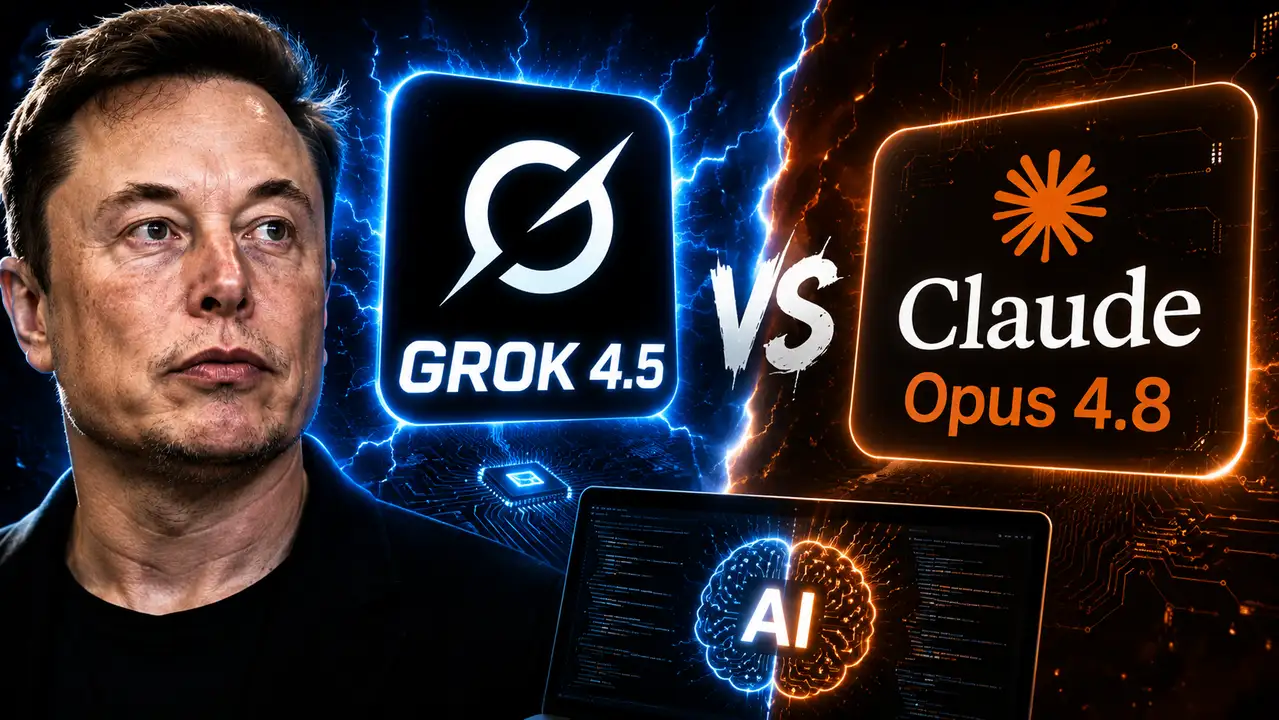
SpaceXAI’s Grok 4.5 Arrives As A Cost-Cutting Challenger To Claude And GPT With 4x Better Token Efficiency

Elon Musk’s SpaceXAI released Grok 4.5 on July 8, 2026, its first major model release since going public, and positioned it as the cost-effective alternative to Anthropic’s Claude Opus and OpenAI’s GPT families. Grok 4.5, built on the 1.5-trillion-parameter V9 mixture-of-experts architecture and trained with data from Cursor, the AI code editor acquired by SpaceX for approximately $60 billion in June, is designed to handle coding, agentic tasks, research, writing, and knowledge work at a fraction of the cost of competitors.
“Based on strong positive feedback from customers in our beta test program, SpaceXAI will make Grok 4.5 available to the public tomorrow. It is an Opus-class model, but faster, more token-efficient and lower cost,” Musk wrote on X. He later narrowed the comparison: “Our internal assessment is that Grok 4.5 is roughly comparable to Opus 4.7, but much faster.”
“It is an Opus-class model, but faster, more token-efficient and lower cost. Our internal assessment is that Grok 4.5 is roughly comparable to Opus 4.7, but much faster. The combination of capability, faster speed and lower cost is what makes it competitive.”~Elon Musk
The Price Case: 75% Cheaper Than Opus 4.8 On Output Tokens
The most appealing feature of Grok 4.5’s introduction is not the capabilities claims, but the cost. SpaceXAI has set Grok 4.5 at $2 per million input tokens and $6 per million output tokens. Claude Opus 4.8, Anthropic’s current flagship, costs $5 per million input tokens and $25 per million output tokens. OpenAI’s most expensive model, Sol, runs at $5 input and $30 output. At the output level where most enterprise AI costs accumulate, Grok 4.5 is over 75% cheaper than Opus 4.8 and 80% cheaper than GPT Sol.
Beyond the list price, SpaceXAI argues the real-world cost advantage is even steeper. The company says Grok 4.5 offers twice the token efficiency of competing models meaning it completes the same task using approximately half the tokens. Independent testing by Artificial Analysis measured Grok 4.5 using roughly 15,954 output tokens per agentic task versus 67,020 for Claude Opus 4.8, a 4.2x efficiency advantage. At that ratio, the effective cost per unit of work done is considerably lower than the headline pricing gap alone suggests.
“SpaceXAI releases Grok 4.5, which Elon describes as an ‘Opus-class model’ — faster, more token-efficient and lower cost. Priced at $2/$6 per million tokens vs Opus 4.7’s $5/$25. The model is available in Grok Build, Cursor, and the SpaceXAI console.”~TechCrunch
Built With Cursor Data And A New Asynchronous Training Method:
The Cursor connection in Grok 4.5’s development is more than just a distribution agreement. SpaceX’s $60 billion acquisition of the AI code editor provided direct access to real developer session data, including workflows, multi-file diffs, debugging interactions, and iterative problem-solving patterns that developers utilize in production. Unlike training on public code repositories, Cursor session data reveals how engineers think and work on large, difficult assignments.
Along with Grok 4.5, xAI introduced asynchronous learning as a new training methodology, allowing multi-hour agentic training runs to occur simultaneously with ongoing model training rather than sequentially, a structural improvement that is expected to pay compounding dividends in future model releases. The V9 foundation finished its initial training run on May 26, 2026, and Cursor data was added as supplemental training later.
Grok 4.5 scores fourth on the Artificial Analysis Intelligence Index with a score of 54, beating every open-weight model and all Gemini models while trailing Fable 5, GPT-5.5, and Opus 4.8. SpaceXAI does not claim benchmark leadership; rather, it claims the best price-to-performance ratio in the frontier tier.
“SpaceXAI launches Grok 4.5 — its smartest model yet and first major release since going public. Musk pitches it as ‘Opus-class, but faster, more token-efficient and lower cost.’ Available in Grok Build, Cursor, and the SpaceXAI console. Not yet available in the EU.”~Axios
Where Grok 4.5 Is Available And What Comes Next?
Grok 4.5 is available immediately through Grok Build where it is now the default model across all Cursor plans, via the SpaceXAI API console, and on grok.com and the X app for X Premium+ and SuperGrok subscribers. A notable gap at launch is the European Union, where regulatory compliance review has delayed availability to mid-July 2026. SpaceXAI has also signalled that the current performance ceiling is not permanent. The company has not yet deployed its internally developed C/C++ inference stack that maps directly to the GB300 hardware, and Musk expects speeds to double or more once that stack is live. A further model release is signalled for August 2026 as part of what SpaceXAI has described as a plan to ship a new foundation model every month through the end of the year.
This model generates substantial competitive tension. Grok 4.5 was trained on computational resources leased by SpaceXAI to both Anthropic and Google. As SpaceXAI’s AI ambitions increase, it will have to decide whether to use that capacity for its own models or continue to lease it as an income stream – a decision that will impact the competitive dynamics of the AI infrastructure market through the second half of 2026.

Comments are closed.