
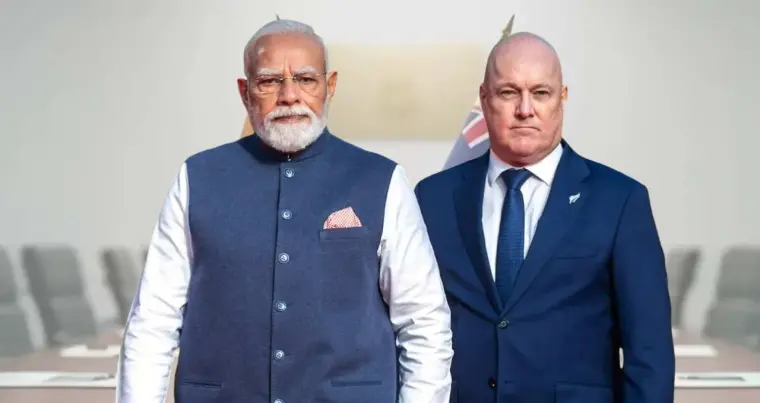

Today is the second day of Prime Minister Narendra Modi’s visit to New Zealand. During this, he was formally welcomed in Auckland, after which he was given a guard of honour. New Zealand Prime Minister Christopher Luxon was also present on this occasion.
Auckland: The second day of Prime Minister Narendra Modi’s visit to New Zealand was important for the bilateral relations between India and New Zealand. Prime Minister Modi was formally welcomed in Auckland, where he was given a guard of honour. After this he held a delegation level bilateral meeting with New Zealand Prime Minister Christopher Luxon. The two leaders discussed a range of important topics including trade, investment, economic cooperation and regional partnership.
This visit is also being considered historic because after almost four decades, an Indian Prime Minister has reached New Zealand on an official visit. Experts believe that this visit can prove to give a new direction to the strategic, economic and trade relations between the two countries.
India-New Zealand free trade agreement becomes a major topic of discussion
During the bilateral talks, the India-New Zealand Free Trade Agreement (FTA) was described as an important achievement in the relations between the two countries. Prime Minister Narendra Modi said that this agreement is not limited to just trade cooperation, but it is also a symbol of trust, partnership and long-term economic cooperation between the two countries.
He said that this visit has brought an opportunity to give new momentum to the relations between India and New Zealand. Prime Minister Modi also expressed happiness that an Indian Prime Minister is visiting New Zealand after almost 40 years, which signals a new beginning in the growing cooperation between the two countries.
Expressing gratitude to the New Zealand Government and Prime Minister Christopher Luxon, the Prime Minister said that his Government and the entire team played a remarkable role in finalizing the Free Trade Agreement in a short time. He described it as a “historic milestone” in the economic relations between the two countries.
Bilateral relations will get a new dimension
India and New Zealand have long been cooperating in areas such as education, agriculture, science, technology, tourism and people-to-people contacts. In recent years, both countries have paid special attention to further strengthening economic and strategic partnership. In the meeting of Prime Minister Modi and Prime Minister Luxon, issues like promoting investment, strengthening the supply chain, innovation, digital economy and cooperation in the Indo-Pacific region were also discussed.
FTA will give a big boost to trade
A free trade agreement was signed between India and New Zealand in April this year. The objective of this agreement is to ease trade between the two countries, increase investment and ensure better market access. After the implementation of the agreement, a provision has been made for reduction or abolition of import duty on about 95 percent of the products coming to India from New Zealand. At the same time, since the initial phase, arrangements have been made to provide duty-free access to about 57 percent of New Zealand’s exports.
On the other hand, there is also a provision for abolition of duty on most of the products sent from India to New Zealand, which is expected to provide competitive advantage to Indian exporters. However, keeping in mind the interests of its agriculture and dairy sector, India has kept dairy products, sugar, apples and some other sensitive agricultural commodities out of the scope of this agreement. Its objective is to protect the interests of domestic farmers and the agricultural sector.
Prime Minister Luxon expressed confidence in partnership
New Zealand Prime Minister Christopher Luxon welcomed Prime Minister Modi and described India as one of the largest and fastest growing economies in the world. He said that the growing partnership between India and New Zealand will play an important role in ensuring economic opportunity, prosperity and long-term security for the citizens of both the countries.
He also said that both countries are committed to pursuing a shared vision of democratic values, rules-based global order and free and fair trade.

Comments are closed.