
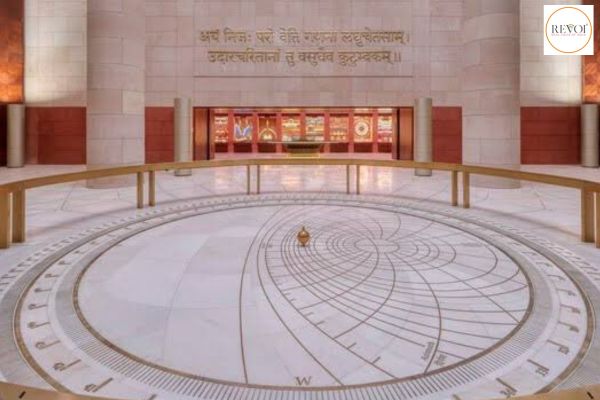
The pendulum installed in the Parliament of India proves that the Earth is continuously rotating.

- that one of thought symbol is that democracy, knowledge and scientist point of view with forward growing india to the universe to understand curiosity also keep is
India The new Parliament building contains many such structures and symbols, which together represent India’s culture, history and modern ideology. But amidst all this, a scientific structure has also been established, which proves that without any satellite, telescope or spacecraft, our Earth is continuously rotating on its axis. The name of this huge instrument is – Foucault Pendulum. It is named after the French physicist Leon Foucault. In 1851, for the first time, he publicly demonstrated through an experiment that the rotation of the Earth’s axis could not only be calculated but could also be observed directly.
india new Parliament HouseThis pendulum structure has been installed in the upper part of the room. A heavy round bob (ball) is hung on a string about 22 meters long, whose weight is approximately 36 kilograms. But this pendulum is not placed just for beauty. It is a live scientific experiment. In a normal pendulum, if a weight is hung on a string and pulled to one side and then released, it keeps swinging back and forth. After some time, it gradually stops due to air friction and other effects. Foucault’s pendulum is also basically a pendulum, but its design is special. In this, the string is kept very long and a heavy ball is placed at the bottom so that it remains swinging in the same plane for a long time.
Also read: Relationship between weather and body i.e. biometeorology
This system does not change direction, yet the visible change in direction occurs only due to the rotation of the Earth’s axis. The installation of this pendulum in the Indian Parliament is not just a scientific demonstration. It is a symbol of the idea that India, moving forward with democracy, knowledge and scientific outlook, also has the curiosity to understand the universe. This can be called a beautiful symbol of the scientific vision and commitment to knowledge shown in the Constitution. Today, this huge pendulum swinging in the Parliament House seems to remind us of one thing every moment that the Earth may appear stable to us, but our planet has not stopped even for a moment. It is continuously rotating on its axis.
The most interesting science starts from here. The pendulum of threads has been released to swing in the north-south direction. According to our common understanding, it should keep swinging in the same direction continuously. But after some time passes, it starts appearing to the observer that the direction of swing of the pendulum is gradually changing. Does the pendulum actually change its direction? The answer is – no. In fact, once the pendulum gets momentum, it tries to swing in the same plane as much as possible. But below it, the Parliament building, the city of Delhi and the entire earth are continuously rotating on its axis. For this reason, a person standing on the floor feels as if the direction of the pendulum is changing. In simple language, the pendulum remains almost stationary, but the earth beneath it is rotating.
Also read: Club YOUTH Upanishad wants to take the reading habit to a new height.
To understand this, take an example. Suppose you are standing on a rotating circular platform and something above you is moving back and forth in the same direction. If the stage starts rotating, you will feel that the object has changed direction, whereas in reality it is you who has rotated. In Foucault’s pendulum this rotating platform is our earth. Circular marks and directions are shown below the pendulum. With time, the swing position of the pendulum appears to change and gradually it appears to move towards new targets. If the Earth were absolutely stable, the pendulum would keep swinging on the same line for a long time.
But this change in direction shows that the Earth itself is rotating on its axis. This effect is usually explained by the Earth’s rotation and the Coriolis effect. The interesting thing is that the speed of changing direction of the pendulum is not the same everywhere. The speed which is in Delhi may not be the same in Ahmedabad, similarly the speed is different in Bangalore also. At the North or South Pole it completes a complete cycle in about 24 hours. Whereas such change is not visible on the equator. Since New Delhi is situated at approximately 28.6° North latitude, the pendulum installed in Parliament takes approximately 49 hours 59 minutes to make one complete visible change in its swing plane. This does not mean that the Earth rotates in 50 hours. The Earth completes one cycle in approximately 24 hours. This is the time of change only in the plane visible to the pendulum.
How does the pendulum keep swinging continuously?
The question arises that how does the pendulum keep swinging continuously? Any pendulum slowly stops due to air and friction. Therefore, in such large Foucault pendulums, a controlled electromagnetic system is kept, which keeps it swinging by supplying very little energy.
There is reason to discuss the Foucault pendulum now. A science pilgrimage is taking shape in Shankheshwar Puram near Palitana. Research work will be done here on science and religion. Here many models are to be created explaining the definition of science. Acharyashri Labdhi Chandra Surisagarji has entrusted this responsibility to me. As a preparation for this, I have first created the Foucault Pendulum. We faced a lot of hurdles in preparing its design. But I had a different experience with Indian scientists than with Foucault. Since its structure is not so simple, it is rarely seen in the planetarium of science centres. The first pendulum of this type was installed in India in 1991 at the Inter-University Center for Astronomy and Astrophysics (IUCAA) in Pune. P.R.L. This pendulum was also established in. This pendulum has also been constructed in the new Parliament in Delhi. Here all the components of the pendulum are made using gunmetal.
******


Comments are closed.