
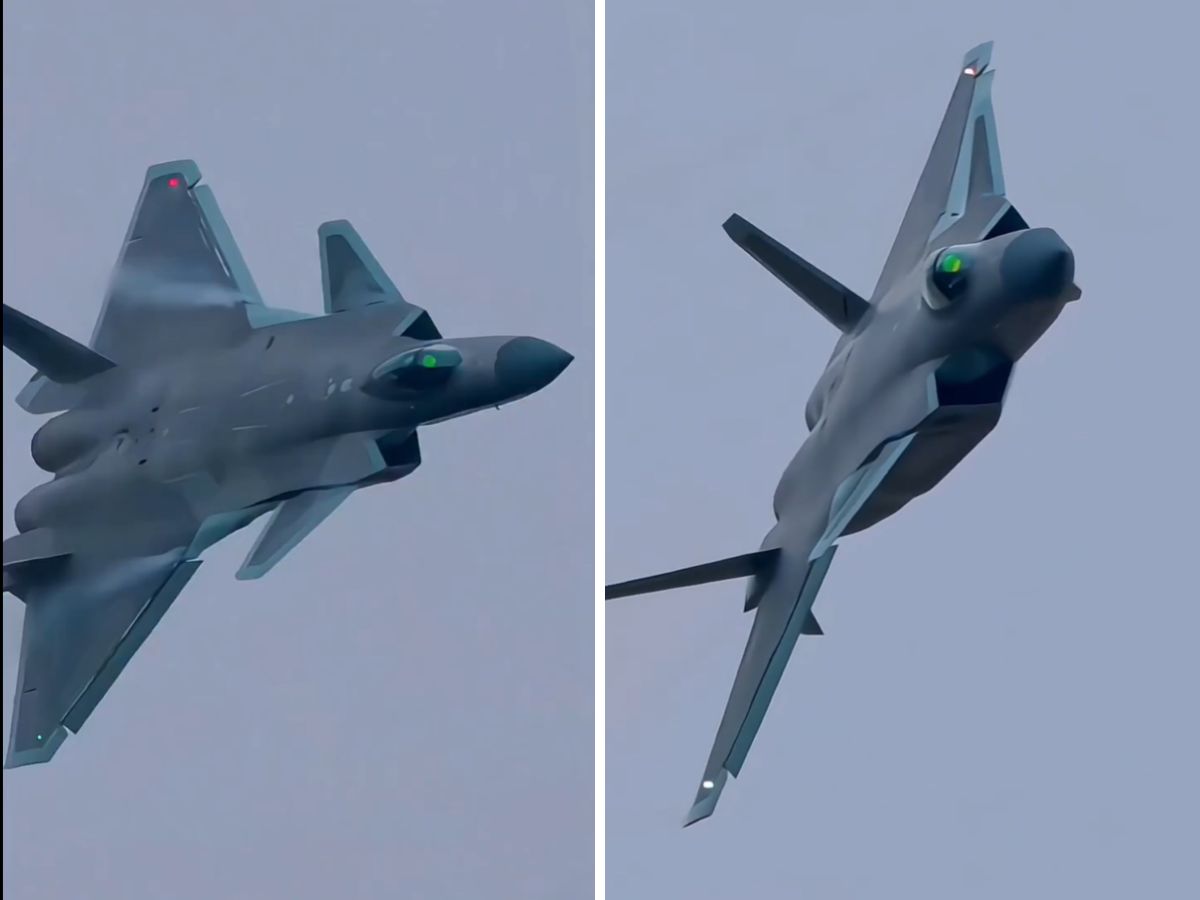
What Is China’s ‘Mighty Dragon’? Why Beijing Has Deployed J-20 Stealth Fighters Near LAC And What It Means For India

China has expanded the deployment of its J-20 Mighty Dragon stealth fighter jets at airbases facing India, a move that defence experts say reflects a major shift in the People’s Liberation Army Air Force’s (PLAAF) posture along the Line of Actual Control (LAC). Commercial satellite imagery sourced from Vantor and cited by NDTV showed 11 J-20 fighters positioned across two strategic airbases during late June and early July, raising fresh attention to China’s growing fifth-generation air combat capability and its implications for India’s border security.
The imagery showed seven J-20s at Hotan airbase in Xinjiang on July 9. The dual-use military and civilian base lies around 389 km northeast of Leh and just 245 km from the Indian Air Force’s Daulat Beg Oldie airfield in Ladakh. NDTV reported this is the largest concentration of J-20 stealth fighters seen at any Chinese airbase facing India. Another four aircraft were spotted at Damxung airbase in Tibet’s Lhasa prefecture, about 344 km from Tawang in Arunachal Pradesh.
🇨🇳China just massed 11+ J-20 stealth fighters at high-altitude bases facing India – the largest concentration ever seen there.
No border incident triggered the move. Instead, fifth-generation operations against India have simply become routine for the Chinese Air Force.… pic.twitter.com/wb8szSiSAr
— Global Strategy (@World_At_War_6) July 28, 2026
Mighty Dragon deployment signals routine fifth-generation operations
Defence expert and former fighter pilot Sameer Joshi said the deployment shows that operating advanced stealth fighters from high-altitude bases has become standard practice for the PLAAF. “Seven J-20s at Hotan and four at Damxung confirm that fifth-generation operations from high-altitude bases facing India are now routine for the PLAAF, not signalling,” Joshi told NDTV.
He further said, “For the IAF, a low-observable threat on the northern front is now the baseline and that sharpens the urgency of our counter-stealth sensors, integrated air defence and standoff strike capability.”
India currently does not operate a fifth-generation stealth fighter. The Indian Air Force flies 36 Rafale jets and more than 260 Su-30MKI aircraft, while the indigenous Advanced Medium Combat Aircraft (AMCA) remains years away from entering service.
Mighty Dragon features that make it China’s premier stealth fighter
The Mighty Dragon, officially known as the Chengdu J-20, is China’s first operational fifth-generation stealth fighter. Developed by the Chengdu Aircraft Industry Group, it is built for air superiority, long-range interception and deep-strike missions.
First flying in 2011, this aircraft was officially inducted into PLAAF in 2017. The Mighty Dragon was designed to go up against the American F-22 Raptor and the F-35 Lightning II. Instead of relying on close combat, the aircraft relies on stealth technologies, sensors, and long-range air-to-air missiles for long-range attacks.
Stealth characteristics of this aircraft include the combination of stealthy shaping, internal weapons bay and radar absorbing materials. Sensor fusion combines radar systems, infrared systems and electronic intelligence in one operation. Early models of this aircraft used engines based on Russian designs, while newer aircraft use the domestic WS-10C engine. Future models will use the more powerful WS-15 engine.
Mighty Dragon growth, strengths and what it means for India
According to figures cited by NDTV from The War Zone and the Royal United Services Institute (RUSI), China’s Mighty Dragon fleet has expanded from about 50 aircraft in 2019 to between 300 and 500 by mid-2026. RUSI estimates China could field nearly 1,000 J-20 fighters by 2030.
Retired Air Marshal Narmdeshwar Tiwari said China’s ability to manufacture around 125 fighter aircraft every year reflects the strength of its aerospace industry. “They are producing it almost like commercial aircraft, which can only happen when the supply chain is fully integrated, very exacting manufacturing tolerances are met by all suppliers and top-quality human resource is available to sustain this enterprise,” he said.
The Mighty Dragon offers stealth, long range and network-centric warfare capability, but it also has limitations. Its engines still trail the most advanced Western powerplants, it is less optimised for close-range combat, and it has not been tested in actual wartime operations. For India, the deployment underscores the need for faster investments in counter-stealth radar systems, integrated air defence, long-range missiles and electronic warfare, while adding urgency to the AMCA programme, expansion of the Rafale fleet and upgrades to the Su-30MKI.
Also Read: More US Aircraft At Risk? China To Equip Iranian Military With 400 Shoulder-Fired Missile System
Khalid Lateef is a Sub-Editor at NewsX Digital, specializing in Indian politics and global affairs. He also covers viral trending stories and major crime developments.
The post What Is China’s ‘Mighty Dragon’? Why Beijing Has Deployed J-20 Stealth Fighters Near LAC And What It Means For India appeared first on NewsX.

Comments are closed.