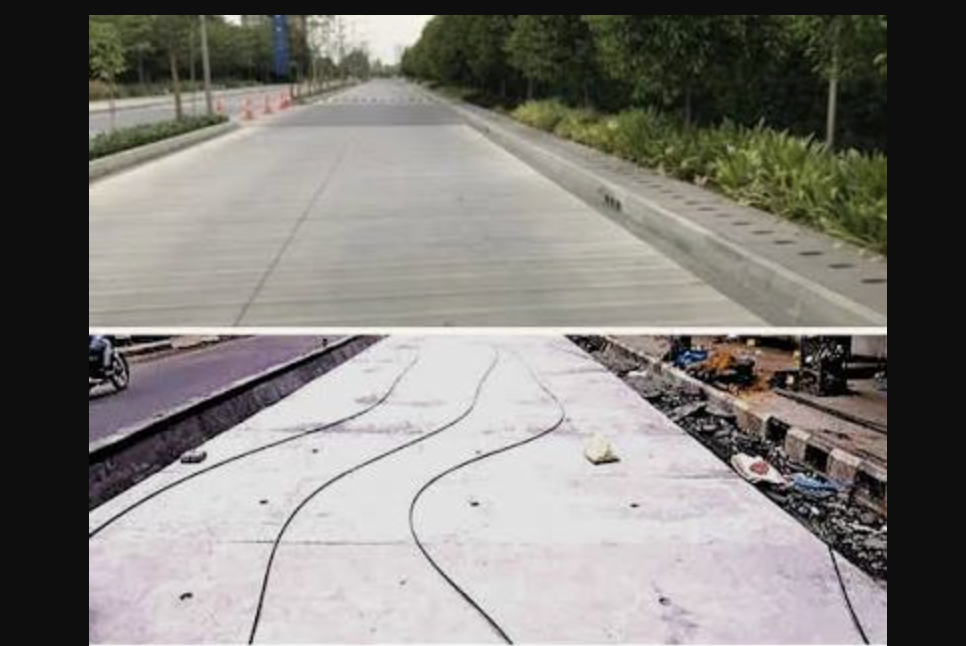
The Gujarat government has announced a major policy shift by deciding that all new internal roads in urban areas will be constructed using cement concrete (CC) instead of traditional asphalt (bitumen). The move aims to create stronger, longer-lasting roads that can better withstand heavy traffic, monsoon damage and rising maintenance costs.
The new policy will be implemented across municipal corporations and municipalities, with authorities expecting significant long-term savings despite the higher initial construction cost.
Why Gujarat Is Making The Shift
Bitumen roads often develop potholes, cracks and surface damage after heavy rainfall, leading to frequent repair work and higher maintenance expenditure.
Concrete roads, on the other hand, are significantly more durable and resistant to water damage. The government believes switching to cement concrete roads will reduce recurring maintenance while providing smoother and safer road infrastructure for urban residents.
The decision also aligns with Gujarat’s broader efforts to modernise urban infrastructure.
Implementation Across Cities
Under the new policy, all new internal urban roads will be built using cement concrete.
The state also plans to gradually expand the use of concrete roads in industrial areas and other locations where higher durability is required. Modern construction technologies will be adopted wherever necessary to improve road quality and speed up execution.
The rollout will be carried out in phases across cities and towns.
Higher Initial Cost, Lower Long-Term Expense
Concrete roads generally cost more to build than conventional asphalt roads.
However, officials believe the higher upfront investment will be offset by lower maintenance requirements over the road’s lifespan. Since concrete roads require fewer repairs and last considerably longer, the overall lifecycle cost is expected to be lower than that of bitumen roads.
This approach is also expected to reduce traffic disruptions caused by frequent road repair work.
Benefits For Urban Infrastructure
Apart from greater durability, cement concrete roads offer several additional advantages.
They are better equipped to handle heavy vehicle movement, are more resistant to waterlogging and remain structurally stable for longer periods. Their lighter surface also improves visibility at night by reflecting more light than black asphalt roads.
These benefits are expected to improve road safety while enhancing the overall quality of urban transport infrastructure.
Part Of A Larger Infrastructure Push
The new road policy forms part of Gujarat’s wider infrastructure development strategy focused on building resilient and sustainable cities.
With rapid urbanisation increasing pressure on road networks, the government aims to create infrastructure that requires fewer repairs, reduces long-term expenditure and delivers a better commuting experience for residents and businesses alike.
Summary
Gujarat has decided to construct all new internal urban roads using cement concrete instead of asphalt. The policy, which will be implemented across municipal corporations and municipalities, aims to build stronger roads that are more resistant to monsoon damage, require less maintenance and offer longer service life, even though their initial construction cost is higher.