By Alex Rivers
For years, artificial intelligence has transformed text, images, audio, and video at astonishing speed. One major frontier remained comparatively underdeveloped: 3D content creation. That is now changing, and recent developments suggest the industry may have reached an important turning point.
The clearest signal came from the funding market. AI 3D startup Meshy recently announced a Series B round of roughly $400 million at a $1.5 billion valuation, making it the largest funding round to date for a company built specifically around AI-powered 3D generation.
In a sector where investors have become increasingly selective, that scale of financing is notable not simply because of the number attached to it, but because it reflects growing confidence that AI 3D is evolving from an experimental niche into a significant technology category.
Funding alone does not create a category leader. What matters is whether a company is demonstrating meaningful adoption, usage, and commercial traction.
On that front, the numbers are equally striking: annual recurring revenue reportedly growing around 12 times year over year, more than 12 million registered users, and over 100 million 3D models created on the platform.
Those figures suggest something broader than investor enthusiasm. They indicate that a large community of developers, designers, creators, educators, and hobbyists is actively using AI-generated 3D tools in real workflows.
The Bottleneck AI 3D Is Starting to Remove
Traditional 3D production has long been one of the most time-intensive parts of digital content creation.
Building a usable 3D asset often requires specialised software, technical expertise, and significant manual labour. That has historically limited who could participate in creating games, simulations, virtual experiences, and product visualisations.
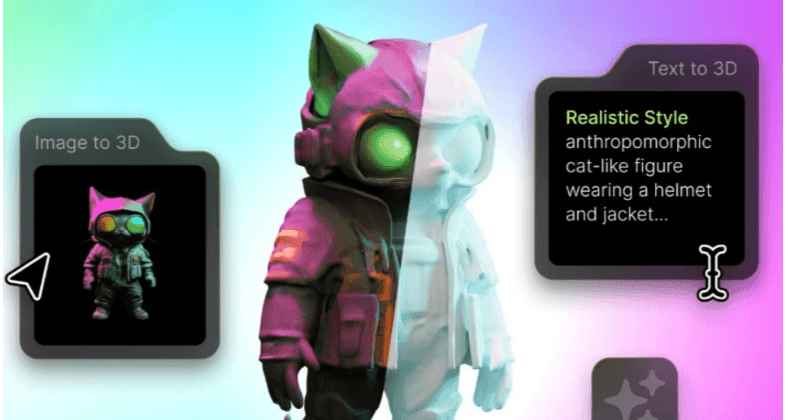
AI 3D tools aim to reduce that barrier by allowing users to generate models from text prompts, images, or other inputs in minutes rather than days.
The technology is not replacing professional 3D artists overnight, but it is expanding the number of people who can prototype ideas, iterate quickly, and create usable assets without mastering every aspect of traditional modelling software.
That shift mirrors what happened earlier in image generation: professionals remain essential, but the creative starting point becomes dramatically more accessible.
A Platform Moving Beyond Demos
One reason the market is paying attention to Meshy is that the company appears to be moving beyond novelty demonstrations toward practical deployment.
The generated models are designed to be usable directly in game engines and other production environments, which is a critical distinction.
Many AI outputs look impressive in screenshots but require substantial cleanup before they can be integrated into real projects.
Another emerging area is physical fabrication. AI-generated 3D models are increasingly being adapted for 3D printing, creating a bridge between digital creation and tangible objects.
That expands the potential addressable market beyond gaming and entertainment into education, prototyping, consumer products, collectables, and maker communities.
Why This Funding Round Matters
Meshy’s Series B is significant not just because of its size, but because it gives the company unusually strong resources to accelerate its lead in AI-generated 3D.
With roughly $400 million in fresh capital, Meshy can invest aggressively in model quality, faster generation speeds, improved texture and geometry output, and tighter integrations with tools such as Unity, Unreal Engine, and popular 3D design software.
The funding also strengthens Meshy’s ability to scale its infrastructure. Supporting millions of users and a rapidly growing library of generated assets requires substantial computing capacity, storage, and engineering investment.
A company with that level of capital can expand globally, improve reliability, and reduce the friction between generating a model and deploying it in a production workflow.
Just as important, the round positions Meshy to build a broader ecosystem around its platform. Better APIs, developer tools, enterprise features, collaboration capabilities, and educational resources can make the service harder to replace once teams incorporate it into their creative pipelines.
In other words, the financing is not simply extending Meshy’s runway; it is giving the company the means to deepen product capabilities, expand adoption, and strengthen the network effects that often determine long-term platform leadership.
The Broader Industry Implication
The more interesting question is not whether one company succeeds, but what its traction says about the broader market.
Game studios are under pressure to produce larger worlds with faster release cycles. E-commerce companies increasingly want interactive 3D product experiences.
Architects and industrial designers are adopting real-time visualisation workflows. Educators are exploring immersive teaching tools. Augmented and virtual reality applications continue to expand, even if adoption has been uneven.
All of these trends increase demand for 3D assets. If AI can reduce the cost and time required to create those assets, the overall volume of 3D content could grow dramatically, much as digital photography expanded the number of images created worldwide.
Challenges Still Remain
Declaring victory would be premature. AI 3D still faces meaningful technical and legal challenges, including geometric accuracy, topology quality, animation readiness, intellectual property considerations, and consistency across complex scenes. Professional production pipelines often require precision that automated systems do not yet consistently deliver.
There is also an important distinction between generating a single object and generating an entire production-ready environment with optimised performance characteristics.
However, category leadership is rarely established after every challenge has been solved. It is usually established when a company demonstrates that the direction of travel is clear and that adoption is accelerating despite the remaining imperfections.
The Inflexion Point
Taken together, the funding scale, revenue growth, user adoption, and production-oriented use cases point to a meaningful industry inflexion point. AI 3D is no longer just a research curiosity or a collection of viral demos. It is beginning to look like a foundational layer in the future of digital creation.
Whether Meshy ultimately becomes the long-term dominant platform remains to be seen; technology markets are notoriously competitive. But the company’s recent momentum provides strong evidence that AI 3D has entered a new phase, one defined not merely by possibility, but by measurable market demand.
That is why this moment matters. The story is not only about a record-setting funding round. It is about the emergence of AI 3D as a serious technology category, and the appearance of a company positioning itself at the centre of that transition.