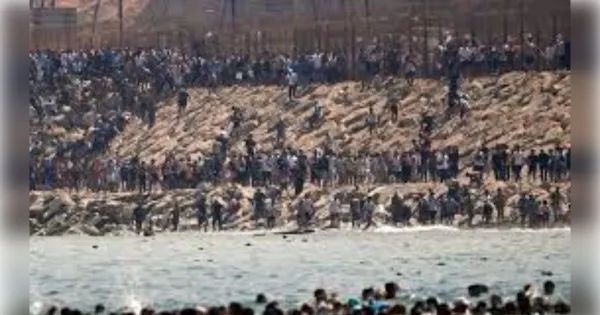
The migrant crisis trying to cross into Spain from Morocco has become even more dire. This week, at least 57 people died in the Spanish African city of Ceuta, where nearly 50,000 people attempted to cross the border.
Most people died by drowning or in stampedes at the border. The situation became so dire that Spanish Prime Minister Pedro Sánchez had to personally travel to Ceuta. Italy instituted temporary border checks on arrivals from Spain, and France also increased surveillance at its border.
According to the Spanish Interior Ministry, around 50,000 people crossed the border into Ceuta on Thursday morning, but by Friday evening, a significant number of people began returning to Morocco on their own.
Although they had no intention of returning, they were forced to do so. Many migrants reported that there was no food or shelter in Ceuta, leaving them no choice but to return.
Because Ceuta is far from the mainland of Spain, these people could not go to other parts of Europe.
According to the report, there are several reasons behind this influx. The biggest reason is rising unemployment among Morocco’s youth. According to official statistics, one in four young people aged 15 to 24 is neither employed nor engaged in any education or training.
Thousands of young people dreamed of starting a new life in Europe. But unemployment wasn’t the only reason. Recently, Spain’s Supreme Court ruled that migrants caught at sea cannot be sent back to Morocco without legal process.
Following this decision, rumors spread rapidly on social media that it was now easier to reach Spain. Human trafficking networks also amplified this message, prompting thousands of people to rush to the border.
Ayoub El Abyad, a 16-year-old Moroccan, said he saw other people crossing the border on Instagram and then made the 12-hour journey to Ceuta with his cousin.
“We wanted a better life. We thought we’d give it a try and leave the rest to God,” he said.
However, several young people later admitted that upon arriving in Ceuta, they found neither food nor shelter. One young man said, “I don’t understand why I came here, so I’m going back.”
Prime Minister Pedro Sanchez described the incident as a “violation of Spain’s territorial sovereignty.” He alleged that human traffickers had spread misinformation after the Supreme Court’s decision, encouraging people to cross the border.
Spain has made it clear that the process of sending back those who have entered the country illegally will be started as soon as possible.
The incident has sparked concern not just in Spain but across Europe. Italy has decided to implement additional border checks for a month to screen non-European citizens arriving from Spain.
France has also increased security at its borders. European Commission President Ursula von der Leyen said everyone entering the EU must follow established rules.