
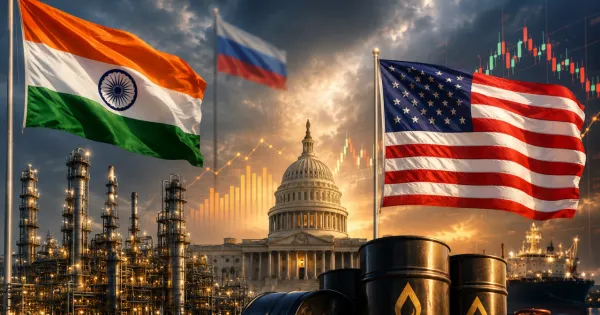
America’s new pressure on India to buy oil from Russia! Sanction bill introduced in Senate, proposal for tariff up to 100%

Digital Desk: The much-awaited bill related to stringent economic sanctions against Russia has been introduced in the US Senate. In this revised proposal, five countries including India and China have been mentioned, which may come under the ambit of tariff if they continue purchasing oil from Russia. Many lawmakers are also calling this proposal the “Lindsey Graham Russia Accountability Bill.”
On Tuesday, the bill was jointly introduced on Capitol Hill by Democratic Senators Richard Blumenthal and Jeanne Shaheen, along with Republican Senators Roger Wicker, Katie Britt and more than a dozen lawmakers from both parties.
Bill prepared on the initiative of Lindsey Graham
According to MPs, late Senator Lindsey Graham played an important role in drafting this bill. He worked on this proposal for almost two years. The initial draft suggested imposing a 500 percent tariff on countries purchasing oil from Russia.
However, in the revised version this maximum limit has been reduced to 100 percent.
Not just tariffs, Russia’s economy also hit hard
Lead Democratic sponsor Richard Blumenthal said the bill is not limited to just import tariffs. It also includes a provision to impose comprehensive sanctions on Russia’s energy, financial and defense systems, Russian industrialists and President Vladimir Putin.
Besides, it has been proposed to give the US administration the right to impose tariffs up to a prescribed limit on the countries that buy the most oil from Russia.
Five countries including India are within the scope
According to the amended bill, this provision may apply to the top five countries in the world purchasing oil from Russia. According to Blumenthal, this list includes India, China, Slovakia, Hungary and Azerbaijan.
Apart from this, there is a proposal to bring countries purchasing natural gas from Russia also under this ambit. However, a provision has been made to give exemption to countries whose gas import from Russia is less than 15 percent of their total requirement and which are taking steps towards reducing imports.
Who will decide the final rate of tariff?
No fixed rate of tariff has been fixed in the Bill. Instead, the authority to set the final rate will be given to the US Trade Representative.
Blumenthal said that his aim is to set such a rate that other countries buying oil and gas from India, China and Russia can be discouraged from this trade.
President Trump will get the power to give special exemption
The proposal also gives the President the power to grant exemption from tariffs in special circumstances. If the fee is reduced later, it will be mandatory to inform Congress about it.
Apart from this, Russia’s so-called A provision has also been added to take action against “shadow fleet” i.e. those oil tankers which are used to export oil by evading the existing sanctions.
The scope has been limited compared to before
MPs said that in the earlier draft, there was a proposal to bring about 63 countries under the ambit of tariff. In the revised version, it has been limited to only the major countries purchasing oil and gas from Russia.
Blumenthal said that this change has been made on the suggestion of the Trump administration and the administration has also given written support to this revised draft.
Tribute paid to Lindsey Graham
Several senators paid tribute to Lindsey Graham as the bill was introduced. Republican Senator Roger Wicker called it one of Graham’s greatest political achievements.
Senator Ted Cruz said Graham had discussed the terms of the bill directly with President Donald Trump before he died. The MPs also stressed the need to pass it soon.
Why did the pressure on India increase?
From 2022 onwards, India has increased crude oil imports from Russia at concessional rates. At present Russian oil has become an important part of India’s total imports.
India has consistently maintained that this purchase is necessary for the country’s energy security and the interests of consumers. New Delhi also argues that this helps keep global oil prices stable.
Legislative process is still long
This bill is currently in the process of the US Senate. After this it will also have to be passed by the House of Representatives. Only after getting the approval of both the houses, it will be sent to President Donald Trump for signature.
Earlier, a White House official had told ANI that the Trump administration supports this Russia sanctions bill.
Also read: India’s big claim in UNSC for 2028-29, What is SHANTI Mission; Jaishankar’s roar from American soil

Comments are closed.