
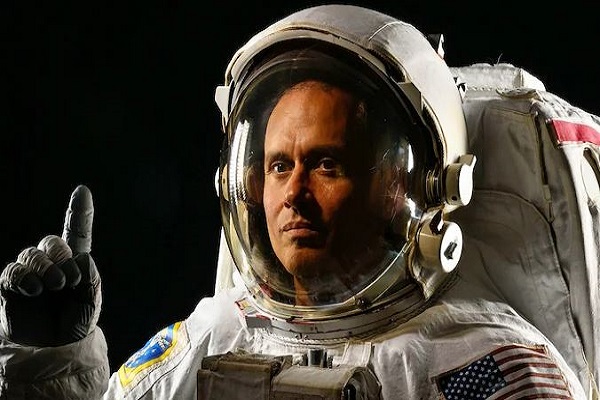
Indian-origin NASA astronaut Anil Menon reached the space station for the first time, went on an 8-month mission to ISS.

New Delhi, 15 July. Indian-origin astronaut Anil Menon, associated with the American National Aeronautics and Space Administration (NASA), has reached the International Space Station (ISS) as part of his first space mission of eight months. He safely reached the ISS after flying aboard Russia’s Soyuz MS-29 spacecraft, where he will take part in scientific research and technology experiments.
LIVE: Watch as the @Space_Station welcomed @astro_anil and the rest of the crew aboard. The spacecraft’s hatch opening is scheduled for 3:55pm ET (1955 UTC).
— NASA (@NASA) July 14, 2026
The Soyuz MS-29 spacecraft docked with the ISS’s Prichal module at 1:52 p.m. (EDT), completing a journey of nearly three hours and two orbits after launch from the Baikonur Cosmodrome in Kazakhstan. Menon was accompanied by Roscosmos cosmonauts Pyotr Dubrov and Anna Kikina to the orbital laboratory.
‘Astro-Anil’ welcomed to ISS!
Indian-origin NASA astronaut Anil Menon has reached the International Space Station (ISS) on his first space journey.
For the next 8 months, he will stay in the ISS and work on important missions like scientific research, technological experiments and AI based ultrasound. pic.twitter.com/48ZXWAWP9V
— MyGov Hindi (@MyGovHindi) July 15, 2026
 ‘Astro-Anil’ welcomed to ISS!
Earlier, the three astronauts had left Baikonur at 10.47 am (EDT) i.e. 7.47 pm local time. After their arrival at the ISS, the number of crew members at the station has increased to 10 for the next two weeks. Before the launch, Anil Menon had posted on social media platform ‘X’, ‘Proud to serve the United States Space Force and to fly to the International Space Station today in support of NASA and our international partners!’
Proud to serve the United States Space Force and fly to the International Space Station today in support of NASA and our international partners! pic.twitter.com/R286FUbJ2P
— Anil Menon (@astro_anil) July 14, 2026
Menon wrote in another post, ‘Excited to launch from Kazakhstan on Soyuz MS-29 and begin an eight-month mission in support of NASA and Expedition 74/75. I am grateful to the NASA community, friends, family and loved ones and am excited for tomorrow.
Excited to launch aboard Soyuz MS-29 from Kazakhstan and begin an eight-month mission supporting NASA and Expedition 74/75. Grateful for the NASA community, friends, family, and loved ones and excited for tomorrow – tune in July 14th 9:43 am central time. Photo credit: Robert… pic.twitter.com/DdPLlmMEGo
— Anil Menon (@astro_anil) July 13, 2026
NASA astronauts Jessica Meir, Jack Hathaway and Chris Williams; European Space Agency astronaut Sophie Adenot; And Roscosmos cosmonauts Sergei Kud-Sverchkov, Sergei Mikaev and Andrey Fedyaev welcomed the newcomers.
Welcome aboard the International Space Station, @astro_anil.
Your mission is just getting started. Wishing you and your crewmates a successful expedition as you advance research and inspire millions back here on Earth. pic.twitter.com/Vp9ceT1Ea5
— NASA Administrator Jared Isaacman (@NASAAdmin) July 14, 2026
Menon, Dubrov and Kikina April, 2027 Will remain in Orbital Laboratory till
Regarding this mission, NASA said that Menon, Dubrov and Kikina will remain in the Orbital Laboratory till April 2027. This is Menon’s first trip to space and the second mission for both Dubrov and Kikina. During the mission, Menon will conduct a series of scientific research and technology demonstration experiments aimed at advancing human space exploration and benefiting life on Earth. They will conduct research to improve the production of semiconductor crystals in space, which can enable large-scale manufacturing of components needed for high-performance computers, artificial intelligence systems and advanced medical devices.
Menon will also perform ultrasounds using augmented reality and artificial intelligence methods, which may eliminate the need for medical support from Earth in future space missions. NASA said Menon will also serve as a test subject in studies that look at how blood flow changes in space. Additionally, they will test bioprinting vascular constructs in microgravity to better understand the aging process and develop new treatments.
NASA said ‘Expedition 75’ will launch on July 26, following the departure of Williams, Cudd-Sverchkov and Mikaev after completing their eight-month science mission at the orbital outpost. A handing over ceremony will take place on July 25, in which command of the station will be handed over from Kud-Sverchkov to Jessica Meir.
Human presence has remained on ISS for the last 25 years
There has been a continuous human presence on the International Space Station for more than 25 years. Because of microgravity it serves as a unique laboratory for scientific research, where many experiments are possible that are difficult or impossible to conduct on Earth. Research conducted here leads to advances in fields such as medicine, engineering, biology and materials science and also helps prepare for future manned missions to the Moon and Mars.

Comments are closed.