
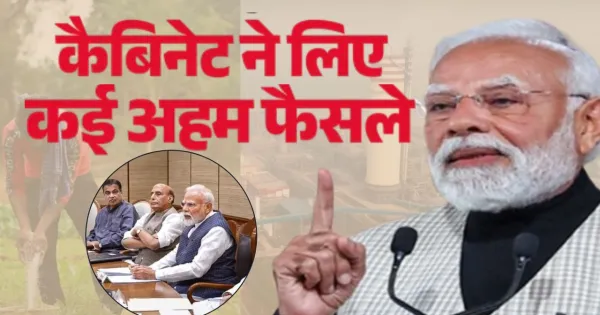
Cabinet: 8-9 new urea plants will be set up in the country, National Investment Policy to increase production by 10 million tonnes approved, know the important decisions of the Cabinet

New Delhi. The Central Government has taken a big decision towards making the country self-reliant in terms of urea production. The National Investment Policy-2026 was approved in the Union Cabinet meeting chaired by Prime Minister Narendra Modi. Under this policy, one crore tonne additional urea production capacity will be developed in the country.
8-9 new urea plants will be established
Under the new investment policy of the government, 8 to 9 new urea plants based on natural gas will be set up. After the commissioning of these plants, India will take a big leap towards meeting its urea needs through domestic production. After the meeting, Union Information and Broadcasting Minister Ashwini Vaishnav said that six new urea plants were established in the last decade, which has reduced the dependence on imports. Now the target has been set to make the country completely self-reliant through new plants.
Demand for urea is increasing every year
According to the government, the demand for urea in the country is increasing at the rate of about 5 percent every year. At present, about 30 million tonnes of urea is produced in India, while the total demand is about 40 million tonnes. To meet this shortage, about 1 crore tonnes of urea has to be imported every year. After the implementation of the new policy, it is being considered a big step towards ending dependence on imports.
Three key features of the new investment policy
With the aim of making the National Investment Policy-2026 more attractive for investors, three major provisions have been made,
Separate calculation of subsidy based on fixed and variable costs.
Assured returns of 12 to 16 percent to companies operating urea plants.
Arrangements to reduce foreign exchange risk
The new plan is an extension of the 2012 policy.
The government clarified that the new National Investment Policy-2026 is an expanded version of the New Investment Policy (NIP)-2012. It aims to promote investment, expand domestic production capacity and ensure long-term self-sufficiency in the fertilizer sector.
Farmers and agriculture sector will benefit
Experts believe that the new policy will improve the availability of urea, reduce import expenses and will help in providing timely fertilizer to farmers. Also, increasing domestic production is expected to give impetus to investment, employment and industrial growth in the fertilizer sector.
boost semiconductor manufacturing
The central government on Wednesday approved ‘Semicon 2.0’ with a budgetary provision of Rs 1.27 lakh crore to boost semiconductor manufacturing in the country. The proposal related to this was approved in the Cabinet meeting held here on Thursday under the chairmanship of Prime Minister Narendra Modi. After the meeting, Union Information and Broadcasting Minister Ashwini Vaishnav said that ‘Semicon 2.0’ has been approved with a total budgetary provision of Rs 1,27,500 crore over the next six years for the development of the country’s semiconductor design and manufacturing ecosystem.
‘Semicon 2.0’ worth Rs 1.27 lakh crore approved
It aims to further strengthen the government’s commitment to give the country an important place on the global semiconductor map. He said that from missile to drone, from cannon to ship, from computer to camera and from X-ray to cinema, the power of chip is behind everything. A total investment of Rs 4 lakh crore is expected in Semicon 2.0. An annual production of Rs 2 lakh crore and export of Rs 1 lakh crore is expected.
Semicon 2.0 will build on early successes in chip design. Currently 105 startups are engaged in chip development. Under this scheme, a target has been set to develop intellectual property, chip design and system design. Under the new scheme, incentives will be given to companies involved in making machines required for semiconductor manufacturing, research and development, and production of essential materials, chemicals and gases. With the first semiconductor fab likely to be operational by 2028, global confidence in the country’s semiconductor strategy has increased.
More and more companies will be encouraged to come to India and set up fabs for chip manufacturing. This will include silicon fab, compound semiconductor fab, discrete component fab, display fab etc. The release said that after the success of ATMP (Assembly, Testing, Marking and Packaging) units, India has now emerged as an attractive option for setting up ATMP/OSAT (Outsourced Semiconductor Assembly and Test) units globally.
The Government will actively encourage these units and pay special attention to bringing state-of-the-art ATMP technologies into the country. SEMICON 2.0 will focus on the development of more advanced nodes and cutting-edge technologies. For this, cooperation will be done with leading research and development institutions of the country and abroad. The government has said that training in complex chip design through latest EDA tools is being imparted in 315 universities. Around 68,000 students have been trained so far. Now this training will be further expanded.
Besides, with the active participation of the industry, training in clean room, fab construction and other related areas will also be strengthened. A total of 12 manufacturing units have been approved so far in SEMICON 1.0, in which a cumulative investment of more than Rs 1.64 lakh crore is proposed. Production has started in three of these plants.
Micron, Kanes and CG Semi have started commercial production and another unit is likely to start production in 2026. Apart from this, 24 semiconductor design projects of startups and micro, small and medium enterprises (MMME) have been approved for financial assistance. Additionally, 105 startups and MSMEs have been provided access to industry-standard electronic design automation tools.
Gift of Rs 3,907 crore in Odisha-Jharkhand
The Union Cabinet has approved two multi-tracking projects of Indian Railways costing Rs 3,907 crore in four districts of Odisha and Jharkhand which are targeted for completion by 2030-31. Proposals to this effect have been approved on Wednesday after the meeting of the Cabinet Committee on Economic Affairs (CCEA) held under the chairmanship of Prime Minister Narendra Modi.
Information and Broadcasting Minister Ashwini Vaishnav told a press conference here after the meeting that these projects of the Railway Ministry include doubling of Paradip-Haridaspur railway section and construction of the fourth line on Rajkharsawan-Dangoposi railway section. These projects will add approximately 145 kilometers to the Indian Railways network. He said that development of additional rail line capacity will increase operational efficiency, improve punctuality and reliability of service of trains and reduce congestion on the rail network. This will make the operation of passenger and goods trains more smooth and faster.
Two railway multi-tracking projects approved
The Union Minister said that these projects, prepared in accordance with the Prime Minister Gati Shakti National Master Plan, aim to strengthen multi-modal connectivity and logistics efficiency. Through these, better and uninterrupted connectivity will be available for the movement of people, goods and services. These projects will provide better rail connectivity to about 1,526 villages in four districts of Odisha and Jharkhand, which have a population of about 14 lakh. Also, access to major tourist places like Lalitgiri Buddhist Complex, Shri Baldevji Temple and Meghahatuburu Hills will also be easy.
According to Vaishnav, these railway routes are important for transportation of minerals like coal, iron ore, dolomite, limestone and gypsum. Upon completion of the projects, an additional 44 million tonnes (44 MTPA) of freight transportation capacity will be created per annum. According to the Railway Ministry, these projects will reduce the country’s logistics costs, save about six crore liters of oil import and reduce 29 crore kilograms of carbon dioxide emissions, which is equivalent to the environmental benefits of planting about one crore trees. The government says that this will boost the economic development of the area and also boost employment and self-employment opportunities.

Comments are closed.