
Modi cabinet approved 7 important proposals worth Rs 2.19 lakh crore: from new policy for urea to semiconductor.

New Delhi, 15 July. In the Union Cabinet meeting chaired by Prime Minister Narendra Modi on Wednesday, seven important proposals were approved to give impetus to the country’s infrastructure, manufacturing and agriculture sectors. Under these, a total of projects and policies worth Rs 2 lakh 19 thousand 353 crore were flagged off. Union Information and Broadcasting Minister Ashwini Vaishnav, while addressing the media, gave detailed information about the decisions of the cabinet.
These decisions include major policy steps like Semiconductor Mission 2.0 (Semicon 2.0), Mobile Phone Manufacturing Scheme (MPMS) and National Investment Policy for Urea-2026 to make India self-reliant in urea production.
Varanasi city will get relief from jam : Two big elevated corridors approved
Union Minister Ashwini Vaishnav said that today’s first two major decisions are related to a new approach for the development of infrastructure in the religious city of Varanasi. To free the city from traffic jams, two big elevated corridors have been approved: –
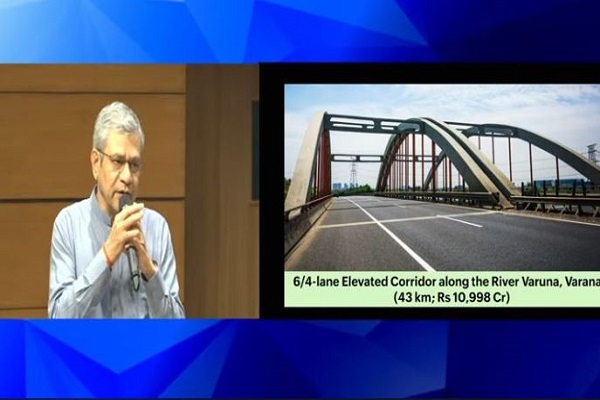
- on the banks of river Varuna 6/4-Lane Elevated Corridor: The Cabinet has approved the construction of a 6/4-lane elevated corridor along the banks of Varuna river at a cost of Rs 10998 crore.
With the expansion of connectivity in Uttar Pradesh, we are determined to make the darshan of Baba Vishwanath in Varanasi more accessible and convenient. In this direction, today our government has approved the construction of a 6/4-lane elevated corridor on the banks of river Varuna. This project is not only our…
— Narendra Modi (@narendramodi) July 15, 2026
- Elevated corridor along the banks of river Ganga: Along with this, green signal has also been given for the development of a 6-lane elevated corridor along the banks of river Ganga at a cost of Rs 14,448 crore.
We are committed to developing world class infrastructure in Kashi. In this series, today we have approved the construction of a 6-lane state-of-the-art corridor along the banks of Ganga. This will further improve access to major religious, educational and cultural places of the city. Along with this, traffic on the road network…
— Narendra Modi (@narendramodi) July 15, 2026
Semiconductor 2.0 And a big boost to mobile manufacturing
To make the country a global hub of electronics manufacturing, the government has made two biggest financial allocations in this cabinet meeting: –
- Semiconductor Mission 2.0: The Cabinet has approved ‘Semiconductor 2.0’ with a huge budget of Rs 1 lakh 27 thousand 500 crore to strengthen the semiconductor ecosystem. This decision of the government is considered very important.
India’s semiconductor journey gets even more vibrant!
The Cabinet has approved Semicon 2.0 with an outlay of Rs. 1,27,500 crore, reaffirming our long-term commitment to making India a global center for semiconductor design, manufacturing and innovation. Powered by our youth,…
— Narendra Modi (@narendramodi) July 15, 2026
- Mobile Phone Manufacturing Scheme (MPMS): Taking the second major decision related to the manufacturing sector, the government has approved the Mobile Phone Manufacturing Scheme (MPMS). Rs 62500 crore has been allocated for this scheme.
A massive boost to ‘Make in India’ and our electronics manufacturing ecosystem!
The Cabinet’s approval of the Mobile Phone Manufacturing Scheme, with an outlay of Rs. 62,500 crore will scale up production, deepen domestic value addition, strengthen supply chains and create a…
— Narendra Modi (@narendramodi) July 15, 2026
New policy for self-reliance in urea production
Keeping in mind the agriculture sector and farmers, the government has taken a major policy decision. The Cabinet has given its approval to ‘National Investment Policy for Urea-2026’. The main objective of this policy is to make India completely self-reliant in the field of urea production. Ashwini Vaishnav clarified that this is a policy approval, hence no separate specific financial allocation has been recorded for it in the financial table of cabinet decisions.
Our government is leaving no stone unturned for the welfare of our farmer brothers and sisters across the country. In this series, the proposal of National Urea Investment Policy-2026 has been approved today. This will not only encourage investment in setting up new gas based urea production plants but will also…
— Narendra Modi (@narendramodi) July 15, 2026
Two big projects to strengthen railway infrastructure
The Cabinet has also approved two important projects related to the expansion of the rail network to improve logistics and connectivity. The Cabinet has approved the doubling work of Paradip-Haridaspur railway line at a cost of Rs 2542 crore. Apart from this, approval has also been given for the construction of the fourth railway line between Dangoaposi and Rajkharswan. An investment of Rs 1365 crore will be made in this.
A major boost to connectivity and economic growth in Odisha and Jharkhand!
The Cabinet has approved two important railway multitracking projects, the doubling of the Paradeep-Haridaspur line and the fourth line between Rajkharsawan and Dangoaposi. These projects will further…
— Narendra Modi (@narendramodi) July 15, 2026
Summarizing these decisions of the cabinet, Ashwini Vaishnav said that these 7 big decisions will prove to be a milestone in giving a new direction to the country’s infrastructure as well as making India self-reliant on the front of manufacturing and agriculture.

Comments are closed.