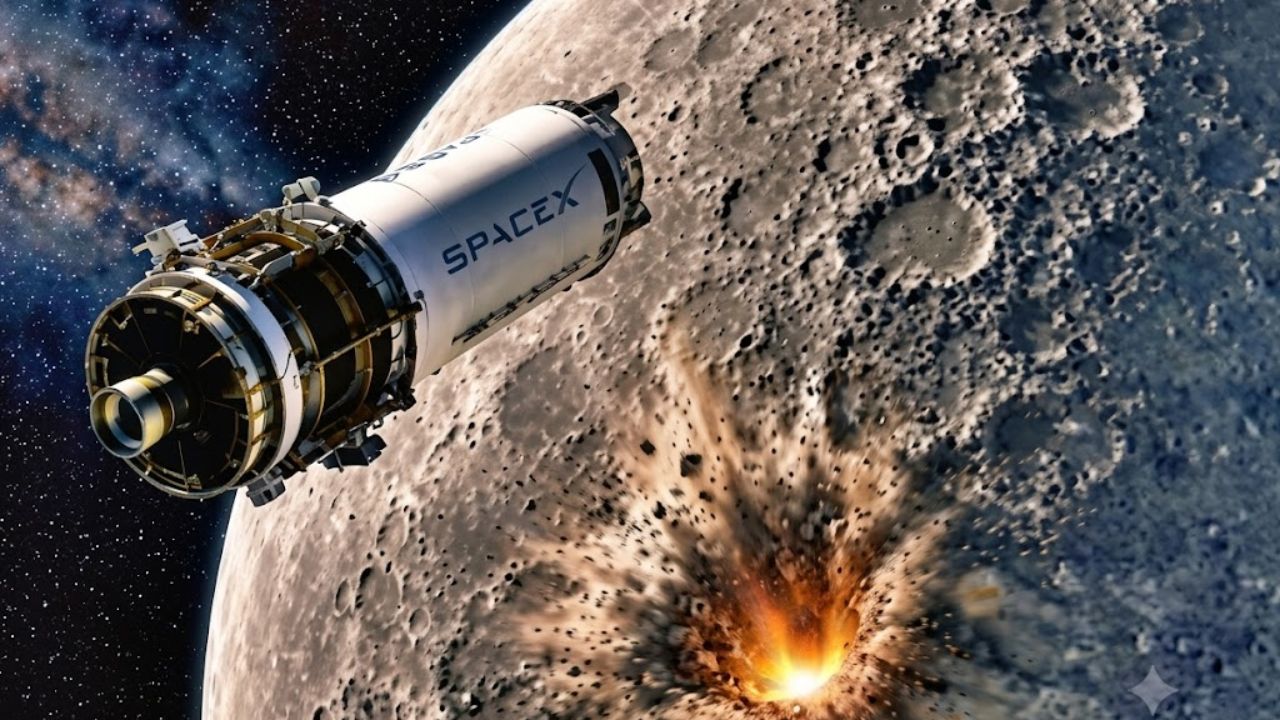
The upper stage, which has been wandering in space after the use of SpaceX’s Falcon-9 rocket, is now on track to hit the moon, and scientists have predicted that it will hit the Einstein Crater area on the west side of the moon on August 5. The impact will create a large crater on the lunar surface and send clouds of dust and rocks flying into space.
According to estimates by space tracking expert Bill Gray, the rocket will hit the moon at a speed of about 8,700 kilometers per hour. This speed is about seven times faster than the speed of sound. Although the impact will occur on the sunlit side of the moon, its light is very weak, so it will be difficult to see it with the naked eye from Earth. However, with the help of a telescope, the dust and debris cloud after the impact can be seen for a few minutes.
Possibility of a 27-meter-wide sinkhole
The impact is expected to create a crater on the moon about 27 meters (90 feet) wide and 5 meters (16 feet) deep. Although the crater will not be visible from Earth, it will be photographed by spacecraft orbiting the moon. NASA’s Lunar Reconnaissance Orbiter and South Korea’s Danuri Lunar Orbiter will take before-and-after photos of the impact. Danuri is expected to pass near the rocket’s likely impact site just two minutes before impact.
Such incidents have happened before.
This is not the first time that a man-made object has hit the moon. In 2022, the remains of a Chinese rocket crashed on the far side of the moon. Before that, NASA had deliberately crashed rocket parts onto the moon for research during the Apollo missions and during the 2009 Lunar Crater Observation and Surveying Satellite mission.
The dust will spread for several kilometers.
According to Benjamin Fernando, a scientist at Los Alamos National Laboratory, the low gravity and lack of atmosphere on the Moon will cause the dust and debris flying after the impact to spread for several kilometers. This event will be important for studying the potential risk of such space debris for future human missions to the Moon.