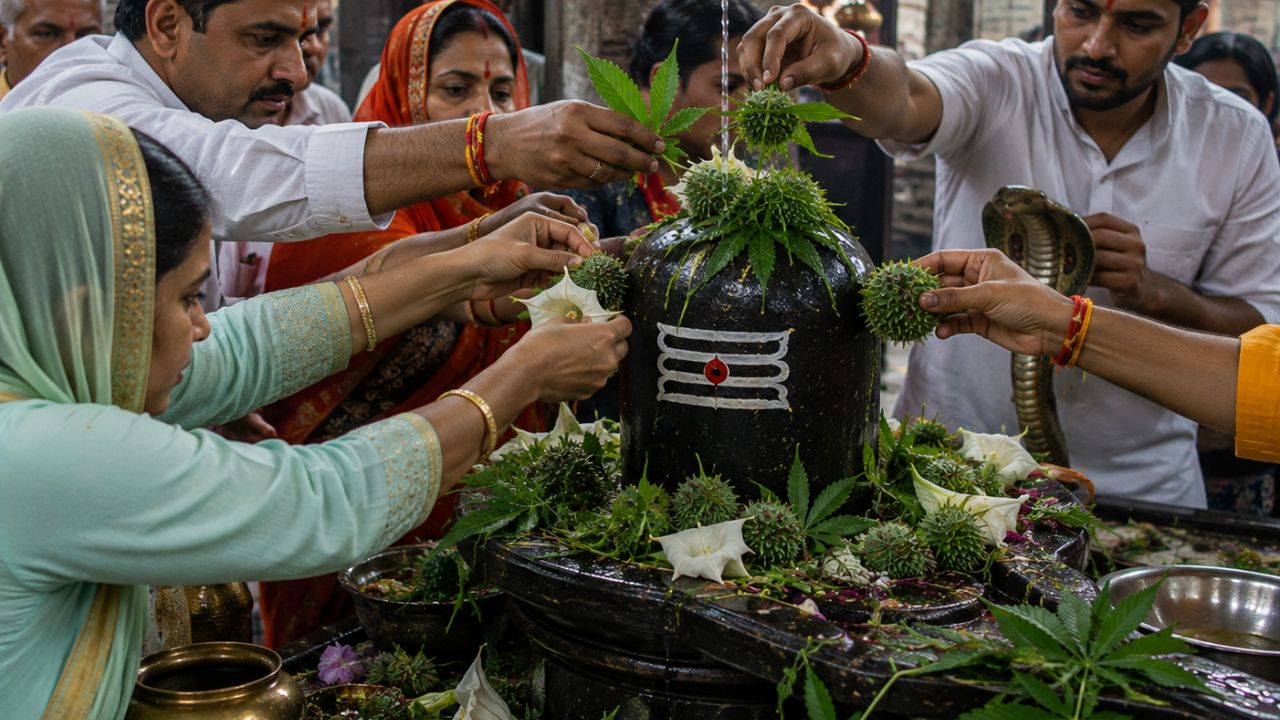
The holy month of Sawan has begun. According to Hindu belief, worshipping Lord Shiva during this sacred month fulfills desires. While offering milk, curd, Ganga water, flowers, sandalwood, etc., Datura and cannabis are also offered during Shiva’s worship.
It is believed that by offering Datura to the Lord, we are renouncing negative tendencies. Offering cannabis is considered a symbol of renouncing worldly desires and ego, and moving towards a spiritual life. Let’s find out the reason behind this and why offering these items to Lord Shiva is considered auspicious.
Is offering Datura a symbol of ego and anger?
It is believed that Lord Shiva held the poison (Halahal) that emerged during the churning of the ocean in his throat. Datura is considered a poisonous plant, so offering it to Shiva commemorates that event and symbolizes his sacrifice. Offering Datura is also considered a symbol of renouncing ego, anger, and negative tendencies and dedicating them to God. It is especially customary to offer Datura during the month of Sawan and Mahashivratri.
Datura grows in places where normal plants are difficult to grow. It is considered a symbol of simplicity, rigorous austerity, and detachment. All these qualities are associated with Lord Shiva. By offering Datura, devotees express the feeling that they are surrendering their inner anger, ego, and other negative qualities to Lord Shiva. In many Shaivite traditions and local religious beliefs, Datura, Belpatra, Aak flowers, and cannabis are given special significance in Shiva worship.
Keep in mind that Datura is a poisonous plant, so it is offered only in worship. It should not be consumed as food or used as medicine without qualified medical advice. Although Datura is considered a favorite offering of Shiva, the stories behind it are primarily based on religious beliefs and traditions, not on historically proven events.
Bhang is a symbol of faith, devotion, and unwavering devotion.
And when it comes to bhang, there’s a reason behind it. Offering bhang is considered a symbol of reverence, devotion, and unwavering devotion to Lord Shiva. Devotees offer it as a way of expressing their faith. According to popular belief, Lord Shiva drank the poison Halahal during the churning of the ocean. Therefore, bhang is offered to him as a symbol of a cool nature. This belief is prevalent in folk traditions.
Lord Shiva is considered a great yogi and an ascetic. Offering bhang is also considered a symbol of renouncing worldly desires and ego and moving towards a spiritual life. The tradition of offering bhang, bel leaves, dhatura, Ganga water, and milk to the Shivalinga on the days of Sawan, Mahashivratri, and Mondays is prevalent in many regions. It is believed that this pleases Lord Shiva and bestows his blessings on devotees.
According to the scriptures, true faith and unselfish devotion are most important to please Lord Shiva. If bhang is not available, Shiva worship can be performed with just water, Ganga water, Bel leaves, unbroken rice grains, flowers, or milk.
What Religious Beliefs Say
According to religious beliefs, offering Datura and Bhang to Lord Shiva is considered a symbol of devotion, renunciation, detachment, and surrender of negativity. However, these beliefs are primarily based on tradition and faith, and the method of their observance may vary slightly in different regions. According to religious beliefs, Bhang is considered dear to Lord Shiva, but the meaning behind it is not just a substance, but also has deep spiritual and symbolic significance.
Lord Shiva is considered a yogi, an ascetic, and a detached deity. Offering Bhang is considered a symbol of renunciation of worldly desires and complete surrender to God. In many regions of India, the tradition of offering Bhang on the occasion of Sawan, Mahashivratri, and other Shiva festivals has been going on for centuries. It is considered a traditional offering of faith and devotion.
Note: This information is based on general beliefs. State Mirror Hindi does not claim its complete accuracy or authenticity. Before adopting any remedy or information, please consult a relevant expert.