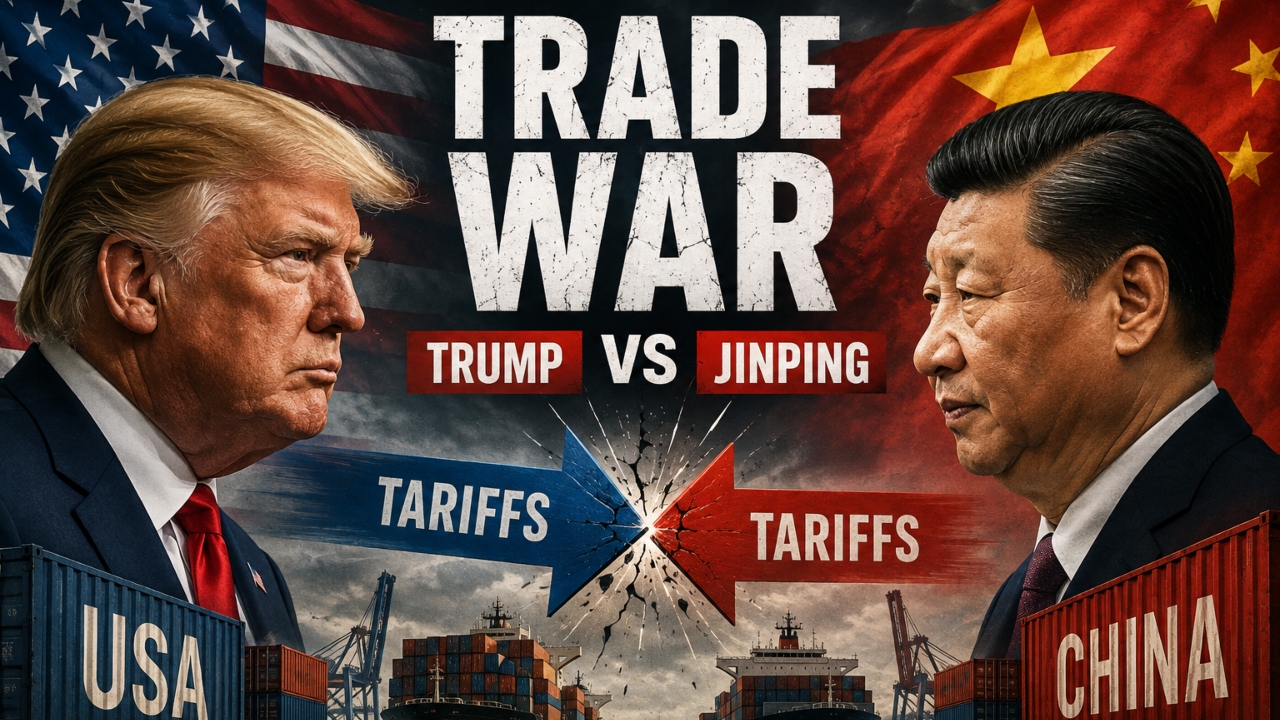
The US and China are trying to outdo each other economically, but the interesting thing is that a complete break from the relationship that both countries want to weaken is not easy. The US increases tariffs on China, tightens its grip on technology, and encourages companies to move production out of China. On the other hand, China responds to US market and technological pressure with its supply chain and export strength.
The question then is not just who will win the trade war, but the bigger question: who is more dependent on the US and China, and what is the biggest opportunity for India in this economic conflict?
Why does the US need China?
In 2025, the US imported goods from China worth approximately $308.4 billion, while US exports to China amounted to approximately $106.3 billion. This means that the total trade in goods alone between the two countries was approximately $414.7 billion, leaving the US with China with a goods trade deficit of approximately $202.1 billion. This deficit decreased by 31.6% compared to 2024.
This is precisely the reason Washington is trying to reduce its dependence on China. But dependence isn’t measured solely in dollar terms. China plays a significant role in the global supply chain for electronics, machinery, batteries, solar equipment, and many industrial products. For the US, abruptly halting imports from China wouldn’t be a mere trade decision, but could impact prices, production, and the supply chain.
This is why the US strategy has moved towards “China plus one” or supply-chain diversification. This means increasing production in alternative countries rather than completely eliminating China.
How dependent is China on the US?
The US consumer market is the primary basis of China’s dependence. The US is one of the world’s largest consumer markets, and China has long been a significant exporter there. However, in recent years, China has sought to diversify its export markets.
In 2025, US goods exports from the US to China totaled $106.3 billion. Meanwhile, America’s purchases from China were almost three times this. This doesn’t mean that China will stop without America. Rather, China has other markets like Europe, ASEAN, the Middle East, Latin America, and the Global South. However, losing the American market could impact Chinese companies, employment, and export-based industries.
The real battle goes beyond tariffs
The US-China trade war is no longer just a dispute over the price of steel, electronics, or toys. Semiconductors, AI, EVs, batteries, solar, rare minerals, and high-tech manufacturing have become central to it.
The US is using its advantage in technology and advanced chips as a strategic weapon, while China can leverage its strength in critical minerals and manufacturing capacity.
This means that the nature of their dependence is different: the US sources large quantities of manufactured goods and supply-chain capacity from China, while China benefits from the American market, technology, and its connection to the global financial system.
Where does opportunity open up for India?
This is where India’s biggest opportunity lies. If American companies are looking to shift some production out of China, India could be one of those options. India has a large domestic market, a growing manufacturing base, and a rapidly expanding trade relationship with the United States.
According to data from India’s Ministry of Commerce, the United States was India’s largest export market in 2025. India exported approximately $92.29 billion to the United States, while imports from the United States totaled approximately $50.30 billion. This means India has a merchandise trade surplus of approximately $41.99 billion.
But replacing China is not so easy. India still imports large quantities of machinery, electronic components, industrial goods, and other inputs from China. In 2024-25, India’s merchandise imports from China amounted to $113.45 billion, while exports were only $14.25 billion.
This means India is in an interesting position: it has the opportunity to increase exports to the United States, but Indian industry itself is dependent on Chinese inputs.
Benefit only if imports from China do not decrease.
India’s biggest opportunity lies not only in replacing China with its products, but also in becoming a part of China-dependent supply chains. As India expands its capacity in electronics, pharmaceuticals, auto components, batteries, solar, and engineering goods, its potential to become an alternative to China for American companies will increase.
Currently, India’s total merchandise and services exports are projected to reach $860.09 billion in FY 2025-26, the highest ever. India faces a third path: neither complete dependence on China nor the US; but rapidly increasing its share in the shifting global supply chain between the two.