The discipline behind the growth
For all the talk of global reach, Bhatia returned repeatedly to the principle he credits for IndiGo’s rise in the first place: an unwavering focus on cost.
“Because the day you lose control of that, in my mind at least, is the start of the beginning of the end,” he said.
He traced the philosophy back to the airline’s founding, when its first aircraft — ordered in 2005 — was delivered in 2006.
“The whole premise of the airline was and is built around cost leadership… then be able to extend that cost advantage to consumers by offering them affordable fares, then you open up a whole new market. So customers come on board, you fill up planes, then you order more planes. It’s like a flywheel that just keeps going,” he said.
A new captain for the next chapter
The anniversary also marks a leadership handover.
Willie Walsh — the veteran aviation executive who stepped down as Director General of the International Air Transport Association on July 31 — takes over as IndiGo’s CEO on August 3.
Bhatia described Walsh, a trained pilot who rose to lead Aer Lingus, British Airways and IAG, as uniquely suited to the moment.
“For Willie, this journey at IndiGo is not a stepping stone to something into the future,” Bhatia said. “I think he really is motivated to make a difference. And I can see that when I talk to him.”
He pointed to Walsh’s operational depth as a particular asset.
“In Willie, we have somebody who is very deep operationally. And I think that sort of stems from the fact that he started his life as a pilot. I think he will add an immense amount of value there. I think for us at IndiGo, culture is very important… the spirit and culture of a company differentiates it… that’s something we want Willie to hold on to fiercely,” Bhatia said.
Walsh’s experience straddling both low-cost and full-service carrier models, Bhatia added, makes him especially well-positioned to help shape IndiGo’s international build-out.
“In our journey into the international arena, I think he would be invaluable in putting all of that together… for a company like IndiGo to land someone like Willie Walsh speaks a little bit about IndiGo and more about the opportunity India offers,” Bhatia said.
Bhatia also offered a small but telling detail from the hiring process — that compensation was never a sticking point in their conversations.
“In fact, when we shook hands, he said to me, I just want to assure you that it will never come in the way of us working together. Which I think speaks volumes,” he said.
On the question of long-term succession and ownership structure, Bhatia struck a similarly steady note.
“Ownership has always had a soft touch. I don’t see that changing. So I believe that IndiGo will continue for a long period of time to be managed by the finest talent you can find on planet earth. Shareholders will have some oversight but that’s where I think it is today,” he said.
Betting on the next generation – patiently
Even as it builds out its current fleet plan through 2035, IndiGo is holding its next major aircraft order in reserve — a decision Bhatia frames not as hesitation, but as strategic patience.
“The reason we have taken a pause right now is because we want to see what happens with the next generation aircraft. Who will launch it and when? Whenever that new technology comes along, I think it will be our next bite of the cherry and decide the future of this company beyond the current generation aircraft,” Bhatia said.
The airline has already doubled its A350-900 order from 30 to 60 aircraft, with options for 40 more, and deliveries beginning in 2028.
Bhatia said the current order book gives IndiGo room to grow without rushing into a decision. “We will see how things evolve over the next few years. My own view is we are pretty well set till 2035,” he said.
He tied the eventual decision on new orders to the airline’s broader commitment to efficiency and environmental performance — a theme reflected in the fleet IndiGo already flies.
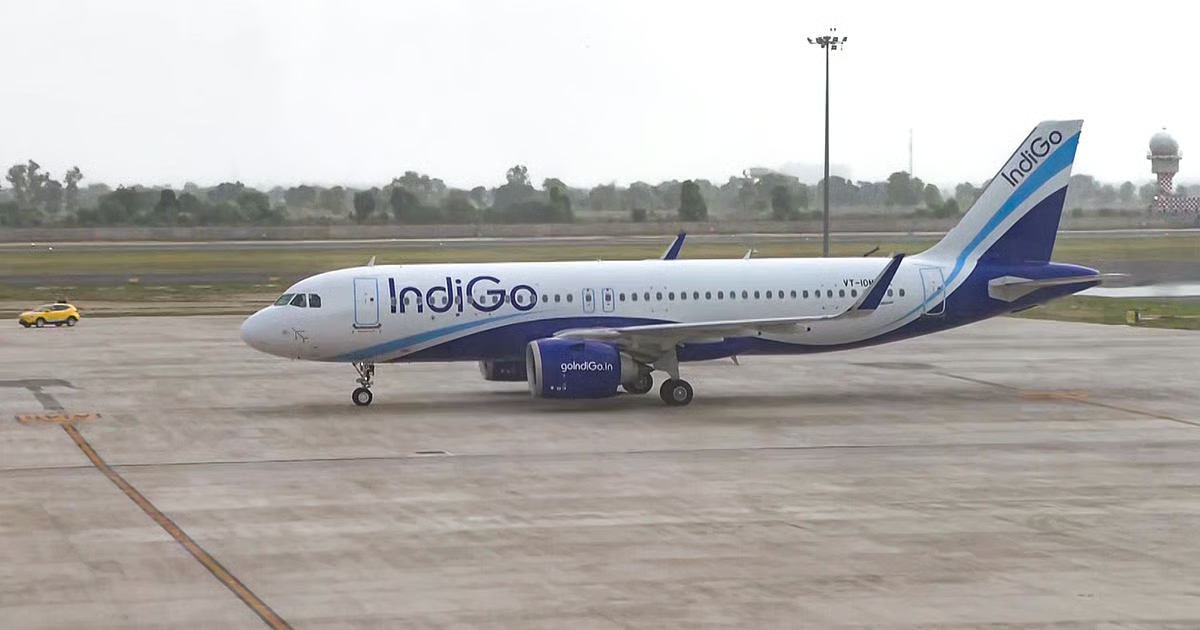
More than four-fifths of its aircraft are next-generation models, roughly 15 per cent more fuel-efficient than the previous generation, and the airline says its greenhouse gas emission intensity has fallen nearly 19 per cent since a 2016 baseline, with an average fleet age of under five years.
“We want to be the early entrance as new technology comes along. We want to embrace that, improve our cost structure and be a more environmentally friendly airline.”
On timing, he said a decision could come in the early 2030s, with existing options offering flexibility in the meantime.
“We have options for 40 A350s which we can convert… it will depend on how things evolve over a period of time… between now and when the new generation aircraft comes into service. Should we feel there is a need for a top-up order, we will do that,” Bhatia said.
Underscoring the logic, he added: “… what you don’t want to do is as new technology comes along, you don’t want to be saddled with a lot of older generation aircraft.”