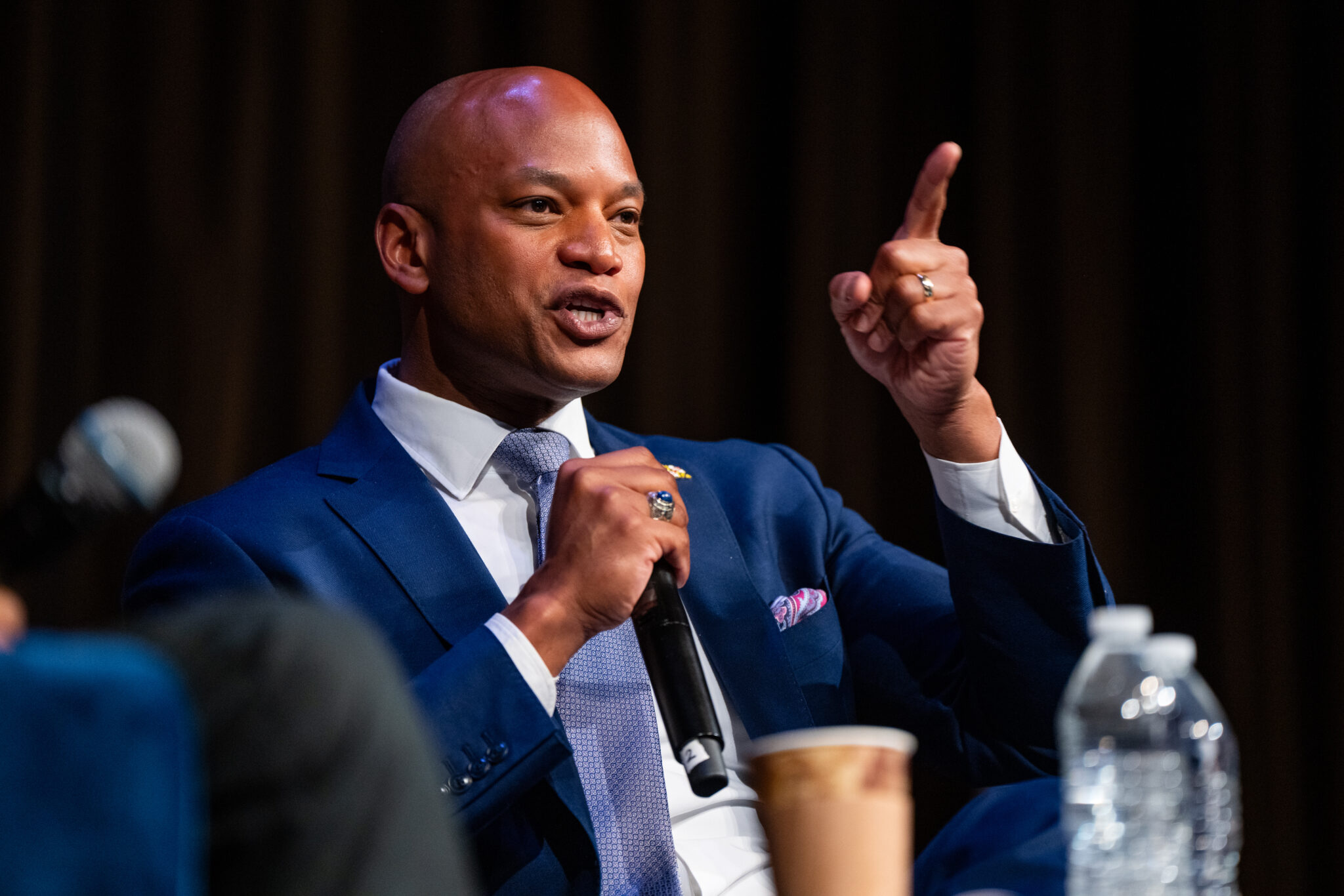
Maryland Gov. Wes Moore Says He Is ‘Very Concerned’ Trump Will Interfere in 2026 Midterms/ TezzBuzz/ WASHINGTON/ J. Mansour/ Maryland Gov. Wes Moore said he fears President Donald Trump will use federal authority to interfere with the 2026 midterm elections. As the new National Governors Association chair, Moore says the bipartisan organization should defend states’ constitutional responsibility for administering elections. The potential 2028 presidential contender is also launching a national service and apprenticeship initiative with $10 million in philanthropic support.
Quick Look
- Moore said he is “very concerned” about federal interference in the midterms.
- He cited Trump’s actions involving mail voting, voter data and possible federal deployments near polling places.
- Moore says states have constitutional authority to administer elections.
- The Maryland governor became National Governors Association chair Saturday.
- He denies plans to seek the presidency in 2028.
- Moore has traveled to early presidential states including South Carolina and Nevada.
- His “Service United” initiative begins with $10 million in private philanthropic support.
- Maryland announced a separate $5 million apprenticeship expansion.
- Oklahoma Gov. Kevin Stitt supports the apprenticeship component.
- Moore is seeking reelection as Maryland governor this fall.
- Democratic Gov. Josh Stein also expressed concern about federal election involvement.
- The White House urged Democrats to support the SAVE America Act.
- Stitt backed stricter voting rules but rejected federal control of state elections.
- Moore opposes abolishing police and prisons and rejects open borders.
- He said party voters, not political leaders, should choose Democratic nominees.
Deep Look
Wes Moore warns about federal election intervention
OKLAHOMA CITY — Maryland Gov. Wes Moore says he is increasingly worried that President Donald Trump will use the federal government’s authority to interfere with the midterm elections this fall.
Moore raised the concern as he assumed the chairmanship of the National Governors Association, a bipartisan organization representing the nation’s state and territorial governors.
The 47-year-old Democrat cited Trump administration efforts involving mail voting, access to state voter information and the possible deployment of federal troops or agents near polling locations.
“I don’t think that the president is trying to hide the ball on this,” Moore said. “It’s not even am I concerned about what the president could do? I’m concerned about what he’s already doing in broad daylight.”
The White House did not respond directly to Moore’s characterization of Trump’s actions.
Moore sees role for governors in protecting elections
Moore said the NGA should help ensure that states retain their constitutional authority to administer elections.
Election procedures in the United States are primarily managed by state and local governments, although federal laws establish certain national protections and requirements.
Moore is preparing to lead an organization that includes governors with sharply different positions on voter identification, mail-ballot deadlines, citizenship requirements and federal election oversight.
Republicans generally support tighter voting rules, while Democrats warn that some proposed restrictions could prevent eligible voters from participating.
Balancing those competing positions without damaging the NGA’s bipartisan character could become one of Moore’s most difficult leadership tests.
National role increases presidential speculation
Moore’s profile has expanded as he takes over one of the country’s most prominent bipartisan organizations.
Former Arkansas Gov. Bill Clinton held the same position before becoming president.
Moore is frequently discussed as a possible contender for the 2028 Democratic presidential nomination, although he continues to rule out a campaign.
He said he would not “get distracted” from the approaching November elections.
His visits to South Carolina and Nevada — states that traditionally play significant roles in presidential nomination contests — have nevertheless fueled speculation about his national ambitions.
Moore has also developed a reputation as an effective digital communicator who presents himself as a relative newcomer during a period when many voters are demanding political change.
“Service United” becomes centerpiece of NGA agenda
Moore’s principal initiative as NGA chair is a nationwide program intended to strengthen communities while connecting young people with career opportunities through public and community service.
The campaign, called “Service United,” begins with $10 million in philanthropic support.
It builds on programs Moore has promoted in Maryland, including a $5 million apprenticeship expansion announced during the same week.
“Service will save us as a society because I know service saved me,” Moore said, referring to his time in the Army.
The program could also provide Moore with a central domestic policy idea if he eventually seeks national office.
Program seeks career paths beyond college
Service United is intended to connect young people with apprenticeships, public service projects and workforce training.
Supporters say the approach could create career opportunities for people who do not attend four-year universities while also addressing shortages in essential industries and public services.
“It’s an opportunity to help people with a career path,” said Bechara Choucair, executive vice president and chief health officer at Kaiser Permanente.
Kaiser is developing a youth mental health corps through the initiative.
Dame Louise Richardson, president of the Andrew Carnegie Foundation, said she hopes national service eventually becomes a common part of young Americans’ career development.
She wants to “see the day when you meet somebody, they don’t just ask, ‘Where did you go to college?’ but they ask, ‘Where did you do your service year?’”
Republican governor supports apprenticeship model
The program has attracted some Republican support.
Oklahoma Gov. Kevin Stitt, the outgoing NGA chair, praised its emphasis on workforce experience.
“One of the things I like is the apprenticeship model and getting kids out of the classroom and into more workforce learning,” Stitt said. “So I think that’s brilliant.”
Stitt nevertheless warned against transforming the initiative into a “big government program.”
His response reflects the challenge Moore faces in maintaining bipartisan support while defining the government’s role in financing and coordinating the project.
Political divisions threaten bipartisan cooperation
The NGA remains one of the relatively few national political organizations that regularly brings senior Republicans and Democrats together.
Despite public expressions of cooperation, major policy and ideological divisions remain both between and within the two parties.
Moore said public officials have not responded adequately to rapid changes in the workforce, including the spread of artificial intelligence.
AI could reduce the availability of entry-level jobs that have traditionally helped young workers gain experience and begin building careers.
“We want to say that if a person goes on to a four-year college or chooses not to go to a four-year college, they still need to have pathways to long-term wages and wealth,” Moore said. “What we have seen from the federal government thus far has just been simply executive orders that have told the states to stay out of it.”
Moore’s relationship with Trump remains strained
Moore has repeatedly clashed with Trump.
Earlier this year, the president attempted to exclude Moore and Democratic Colorado Gov. Jared Polis from an NGA meeting at the White House.
Trump reversed course after Stitt intervened, but there is little evidence that his relationship with Moore has improved.
The dispute could resurface when the organization holds its traditional winter meeting in Washington in February.
Moore praised his working relationships with governors from both parties before criticizing Trump’s approach.
He said “the president of the United States seems to consistently take an ideological view when it comes to securing the future of this country.”
The White House did not comment on that characterization.
Moore faces challenges inside Maryland
Moore is seeking reelection as Maryland governor this fall while taking on a larger national role.
Despite governing a heavily Democratic state, he has sometimes struggled to win support from members of his own party in the state legislature.
Maryland lawmakers are scheduled to return next week to consider a constitutional amendment involving redistricting.
An earlier redistricting initiative supported by Moore failed to advance.
The outcome could affect his political standing in Maryland and his ability to present himself nationally as an effective coalition builder.
Democratic Party confronts ideological divisions
Moore is also entering national leadership as Democrats debate the party’s direction.
The Democratic National Committee is experiencing turmoil, while democratic socialist candidates have won primaries in cities including New York and Denver.
Those victories have triggered arguments over whether the party is moving too far left and whether progressive nominees could hurt Democratic prospects in competitive races.
Upcoming elections in Michigan and Wisconsin could further test those divisions.
Moore declined to align himself firmly with either the party’s progressive or establishment wings.
Moore says voters should select nominees
Asked whether democratic socialist candidates could threaten Democratic victories, Moore said voters should decide who represents the party.
“Party bosses shouldn’t be determining who members of the party are,” he said, without specifying whether he included Senate Democratic Leader Chuck Schumer in that description. “The people should be the ones to have a final say on that.”
Moore also separated himself from several positions associated with parts of the Democratic left.
“I know where I am on issues,” he said. “I don’t believe in abolishing the police. I don’t believe in abolishing prisons. I don’t believe in open borders.”
His comments position him as a Democrat willing to accept voter-selected progressive candidates while rejecting some of their most controversial policy proposals.
Josh Stein shares concerns about elections
North Carolina Gov. Josh Stein, a Democrat leading one of the country’s most competitive political states, echoed Moore’s concerns about possible federal involvement in the midterms.
North Carolina is holding a closely watched Senate election that could help determine control of Congress.
“I don’t think you can be a clear-thinking person and not be concerned because all the signals are very worrisome,” Stein said. “But that said, I have confidence that if the voters come out in droves and vote the way that they want to vote, that the government will represent their wishes.”
Stein’s comments reflect Democrats’ broader fear that changes to election rules or federal actions could influence voter participation.
White House promotes SAVE America Act
White House spokesperson Abigail Jackson rejected Democrats’ criticism by arguing that they should support stricter election-security legislation.
She said that “if Democrats really cared about securing our elections, they would pass the SAVE America Act.”
The stalled Senate bill would impose strict proof-of-citizenship requirements for voting.
Supporters argue that it would strengthen election integrity. Opponents warn that documentation requirements could create barriers for eligible voters who do not have easy access to citizenship records.
The debate is likely to intensify as the first midterm ballots are distributed.
Republican governor rejects federal election control
Stitt expressed confidence that states would administer the midterms without federal intervention.
Although he supports the SAVE America Act, he agreed with Moore on the basic principle that election administration should remain under state authority.
“States should control their own elections,” Stitt said.
That position could provide Moore with an opening to build bipartisan resistance if the federal government attempts to assume a larger operational role in the midterms.
Trump era changes Moore’s view of states’ rights
Moore said he once associated arguments about states’ rights with segregationists such as Bull Connor.
Connor, Birmingham’s public safety commissioner during the Civil Rights movement, became infamous for using police dogs and fire hoses against peaceful demonstrators.
Moore said the Trump era has changed his understanding of state authority.
He now views strong state leadership as an essential safeguard against federal overreach and emphasized “the importance of having actually strong governors.”
That argument is likely to shape his tenure as NGA chair as governors prepare for a politically divisive election and an uncertain relationship with Washington.
More on US News