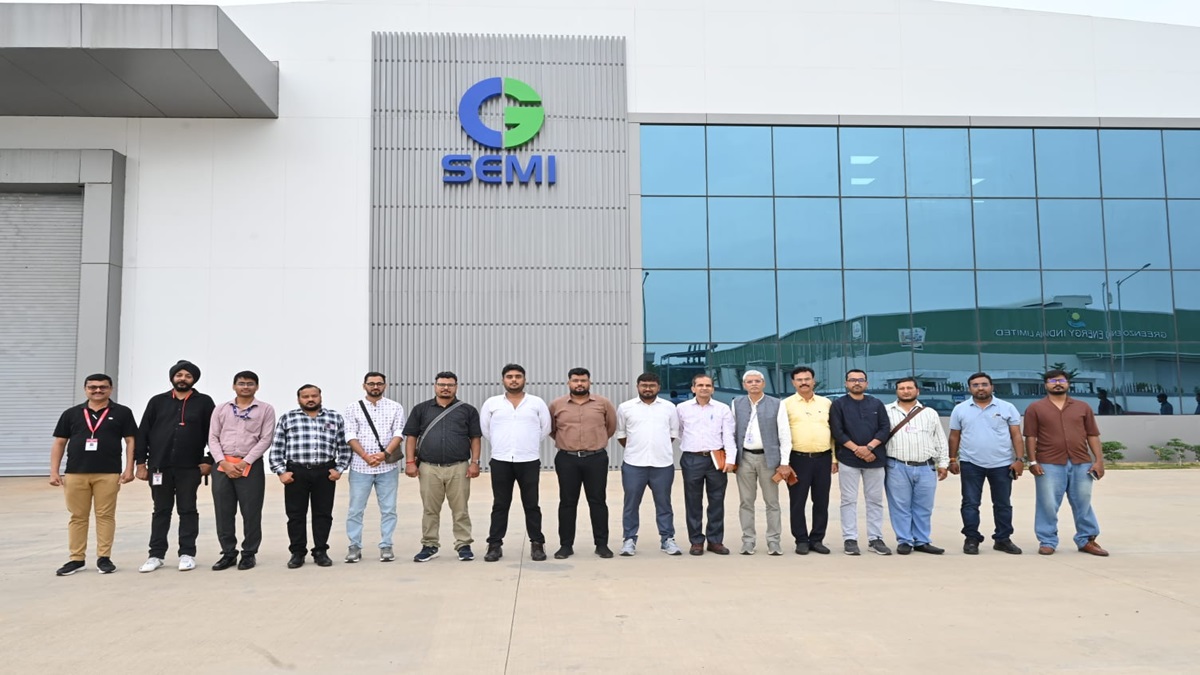
The simplicity of Gandhi’s thoughts at Sabarmati, the 4,500-year-old maritime heritage of Lothal, the cooperatives of Amul (Gujarat Study Tour) in Anand, the semiconductor industry of Sainand, the Mumbai-Ahmedabad high-speed rail project, and the global financial world of GIFT City—during a five-day Gujarat study tour, a media delegation from Chhattisgarh witnessed up-close an India that is writing a new chapter of modern development while preserving its historical heritage.
To understand a state, it’s not enough to simply look at its cities; one must also understand its development philosophy and its changes over time. Gujarat is one such state, where history and modernity go hand in hand. On one side are the thoughts of Mahatma Gandhi, and on the other, the global financial hub, GIFT City. On one side is the thousands-year-old Lothal, and on the other, there’s the semiconductor industry and futuristic projects like high-speed rail.
During a study tour organized by the Press Information Bureau, Raipur, journalists from Chhattisgarh had the opportunity to observe and understand these various dimensions of Gujarat. This five-day trip was not just a tourist destination, but an experience to understand the changing face of a developed India.
Sabarmati: Where Ideas Changed History Gujarat Study Tour
The tour began at the Sabarmati Ashram. The serene atmosphere of the Ashram still reminds us of the simplicity and self-confidence of Mahatma Gandhi’s thoughts. It was here that many important strategies of the freedom movement were formulated, and ideas like truth, non-violence, and self-reliance reached the entire country.
At the Kochrab Ashram, we had the opportunity to learn about Gandhiji’s early experiments. It was here that we realized that great changes do not always begin with large resources, but with strong ideas.
Anand: The Greatest Example of Cooperatives
The story of Amul in Anand is one of the most successful stories of India’s rural development. In a conversation with Dr. Preeti Shukla, we had the opportunity to understand how the participation of millions of dairy farmers made Amul a world-class brand.
Amul has proven that organized cooperatives can be an effective means of increasing farmers’ income and strengthening the rural economy. This movement, which began with small village milk societies, has now gained global recognition.
Lothal: A Historical Legacy of Maritime Power
History comes alive upon visiting Lothal. This ancient port of the Indus Valley Civilization, dating back approximately 4,500 years, reveals that India’s maritime trade was highly developed even thousands of years ago.
The National Maritime Heritage Complex being developed here is not just a center for archaeology, but an effort to present India’s maritime tradition, trade, and shipping history in a modern form. Lothal conveys the message that India’s maritime power is not a new concept, but a historical identity.
High-Speed Rail: The Speed of the Future
The Mumbai-Ahmedabad High-Speed Rail Project is one of India’s most ambitious infrastructure projects. The viaducts, tunnels, and modern engineering techniques under construction indicate that the country is moving towards a new revolution in transportation.
Thousands of engineers and technical experts are engaged in the construction of this project. It is not just a high-speed train, but also a symbol of India’s technological capabilities and modern engineering.
Sainand: India’s Emerging Semiconductor Hub
Sainand was the most important industrial stop on the study tour. The semiconductor units being developed here are a significant step towards establishing India’s new identity in the global chip manufacturing sector.
Almost all modern industries, such as mobile phones, automobiles, artificial intelligence, defense, communications, and electronics, rely on semiconductors. The growing production capacity in Sanand indicates that India is rapidly moving towards becoming a manufacturer, not just a consumer of technology.
GIFT City: India’s New Identity in Global Finance
Gujarat International Finance Tec-City (GIFT City) symbolizes modern India’s economic ambitions. International banking, fund management, insurance, capital markets, aircraft and ship leasing, and global financial services are rapidly expanding here.
During our interaction with Chief Executive Officer Avichal Khera and other officials, it became clear that GIFT City aims to bring international financial activities to India, which have previously been conducted abroad.
The International Financial Services Centres Authority (IFSCA) is playing a key role in making India a competitive global financial services hub.
Statue of Unity: A Message of Unity in the Midst of Development
The final stop of the tour was the Statue of Unity in Ektanagar. The 182-meter-tall statue of Sardar Vallabhbhai Patel is not just a tourist destination, but a symbol of India’s unity, administrative capability, and national resolve.
Standing in front of the statue, one feels that Gujarat’s development journey is not limited to economic progress, but is also rooted in national unity and strong leadership.
A Confluence of History and Future
This five-day study tour revealed a different picture of Gujarat. It boasts Gandhi’s ashram, high-speed rail, Amul’s cooperative, and the semiconductor industry. Lothal has both the ancient heritage and the global financial infrastructure of GIFT City.
Gujarat’s greatest strength is that it has maintained its historical identity while simultaneously accelerating modern development. Here, development is not just about