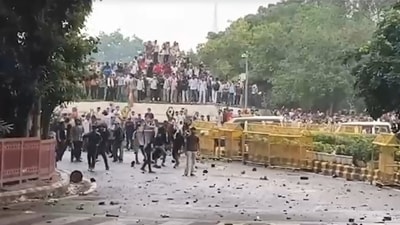
Stone-pelting and violence linked to the Cockroach Janta Party (CJP) protests continued for nearly six days after the July 20 Parliament march, according to security officials.
Authorities said law enforcement exercised restraint despite repeated incidents of violence, while fresh details have emerged about damaged government property, injuries and security challenges during the demonstrations.
Officials familiar with the developments said unrest continued until July 25, when the CJP called off its protest after the Centre accepted key demands, including the resignation of then Union Education Minister Dharmendra Pradhan. They claimed that security personnel avoided escalation despite repeated incidents of stone-pelting, barricade breaches and damage to public property.
According to officials, the protests began as demonstrations over the alleged NEET-UG paper leak but later witnessed the participation of individuals with political affiliations who allegedly incited violence. Authorities said these incidents complicated crowd management and heightened security concerns in central Delhi.
During the Parliament march on July 20, clashes erupted near high-security zones while Parliament was in session. Police responded with a lathi charge and tear gas after repeated warnings, officials said, maintaining that the use of force followed escalating aggression, including stone-pelting and attempts to breach barricades.
Documents accessed by Hindustan Times reportedly show that violence was concentrated within a two-kilometre radius around Parliament. Flashpoints included Gol Dak Khana, Tolstoy-Janpath Crossing, Rafi Marg near Rail Bhawan, Jantar Mantar, Connaught Place, Sansad Marg, Raisina Road and nearby intersections. Officials said stone-pelting incidents were reported at all these locations.
The document also listed significant damage to government property. A total of 110 barricades and 171 ropes were reported damaged or missing. Security equipment, including wireless communication sets, body-worn cameras, handheld metal detectors, public address systems, loudhailers, fire extinguishers, wire cutters and an X-ray baggage scanner, was also affected.
Protective gear such as helmets, body protectors, shields, torches, first-aid boxes and blankets was reported damaged or missing. Additionally, 29 official vehicles, including police cars, buses, motorcycles and tempos, along with a water tanker, a Delhi Transport Corporation (DTC) bus and another public vehicle, sustained damage during the protests.
According to the records, 244 police personnel and 209 civilians suffered injuries that were documented as Medico-Legal Cases (MLCs). Officials reiterated that police action was taken only after repeated provocations and attempts to maintain law and order peacefully.
Earlier, security agencies had stated that the police response was based on escalating violence, including attacks on personnel, damage to public property and repeated breaches of security arrangements. Officials also referred to an internal Delhi Police report claiming that facial recognition technology identified several individuals with serious criminal cases among those present during the protest.