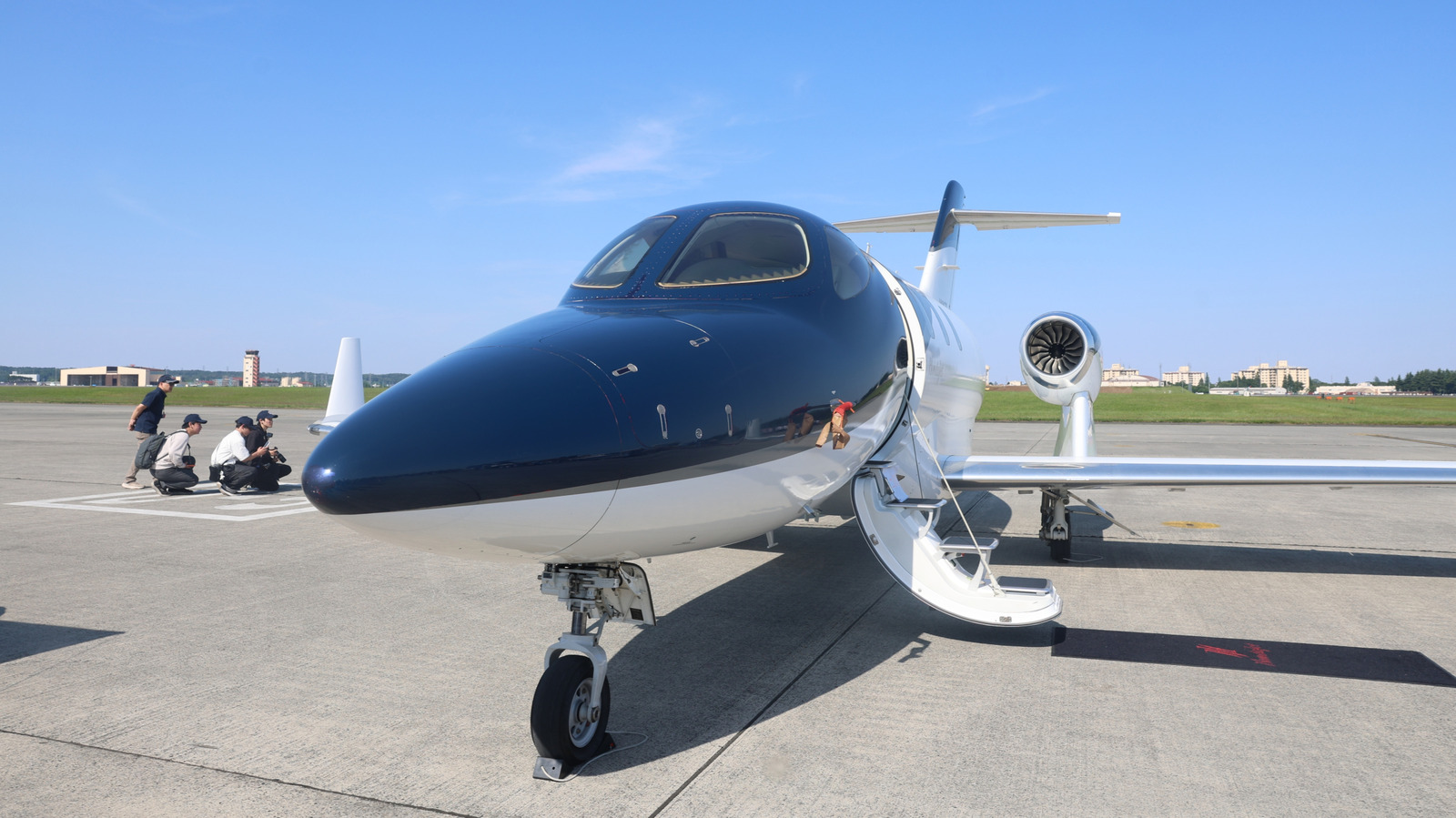
Think Honda, and the first thing that springs to mind is probably something like the Honda CR-V or Honda Civic. Nice cars, but hardly flying machines. Or maybe what comes to mind is the 2016 Honda NSX, one of the fastest Honda cars ever made, with a reported top speed of 191 mph. Or, for lovers of two wheels, maybe it’s the Honda CBR1000RR, one of the fastest motorcycles ever built by Honda. While these are undoubtedly impressive machines, in terms of performance they’re still rather lackluster when compared to some of the company’s other products — one of which can cruise along at a blistering 486 mph.
Of course, we’re not talking about cars (or lawnmowers!); what we are talking about are the jets manufactured by Honda’s aviation wing — Honda Aircraft Company. The company was established in 2006, and despite Honda’s Japanese roots, the aviation business is based in North Carolina. The HondaJet Elite II is one of the company’s aircraft, and it’s this jet that can cruise along at close to 500 mph. However, Honda has been dabbling in aviation since before this. The company began researching aircraft design in the 1980s and first flew an experimental aircraft in 1993 — a decade later, the first HondaJet took to the skies, and by 2015 commercial production had begun.
Let’s have a closer look at Honda’s aviation operation and the aircraft it manufactures.
The Hondas you won’t meet on the road
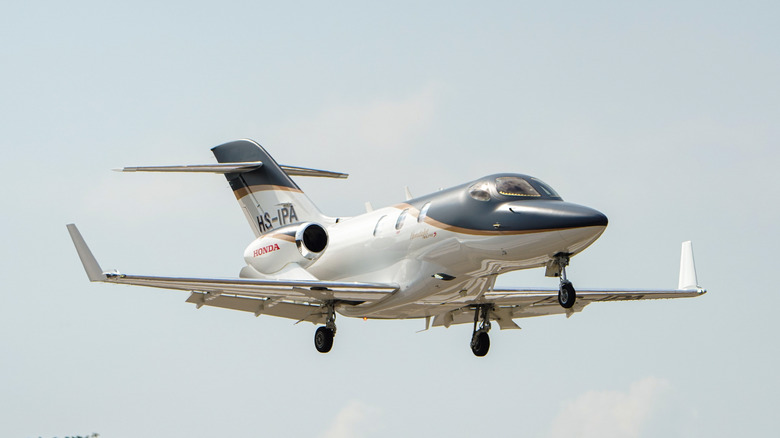
Since the first production HondaJet took to the skies, the company has focused on continual upgrades to its HA-420 HondaJet. The current model from this range is the HondaJet Elite II. One feature that has continued to define the aircraft throughout its evolutions is the over-the-wing placement of the engines. This configuration is more than just a design curiosity. Most business jets have the engines mounted at the rear of the fuselage. This is necessary to allow enough ground clearance, but it’s aerodynamically inefficient, reduces cabin space, and increases cabin noise.
There were serious engineering challenges to overcome for Honda’s approach to work; it was even once assumed that such a placement would reduce lift. However, Honda proved it was possible and, as of February 2024, the HondaJet remains the only production aircraft in its class to feature such engine placement. The engines themselves are GE Honda Aero Engines HF120, capable of producing over 2,000 pounds of thrust. As the name suggests, this engine is one of the many jet engines made by General Electric, although Honda was a development partner.
In terms of size, this is classified as a “very light business jet”. It can carry up to eight people including pilots and crew. Range-wise, the Elite II can cover around 1,800 miles with four people on board. Now, we get to the fun bit. What if you decided to trade in your old Civic for one of these jets? How much would you expect to pay? This will vary depending on the exact specification, but expect to pay somewhere in the region of $7 million for a new one.
What next for HondaJet?
Honda’s aviation aspirations don’t end with the Elite II. Although it has sold about 30 planes a year since it first came to market, Honda wants to increase this to about 60 aircraft by 2028. A large part of HondaJet’s future plans is built around the company’s new product — the HondaJet Echelon. With the distinctive over-the-wing engine configuration still present, it would be easy to mistake this as a mere stretching of the Elite II. This isn’t the case; the Echelon is a clean-sheet design that’s built to carry up to 11 people with a range of about 3,000 miles with five people on board.
The engines are also new. Replacing the HF120s are two Williams International FJ44-4C engines; these are substantially more powerful than the Elite’s engines and can deliver 3,450 pounds of thrust. Like its older sibling, the Echelon jet is also fitted out with a highly advanced aviation suite. This includes advanced steering & augmentation systems, stabilized approach alerts, and increased automation to reduce pilot workloads. In fact, the automation is such that the HondaJet Elite is certified for single-pilot operations, and although the Echelon hasn’t yet received type certification, it’s also been designed for single-pilot operation.
The Echelon is expected to take its first test flight sometime in 2026, and Honda has a type-certification target date of 2028.