
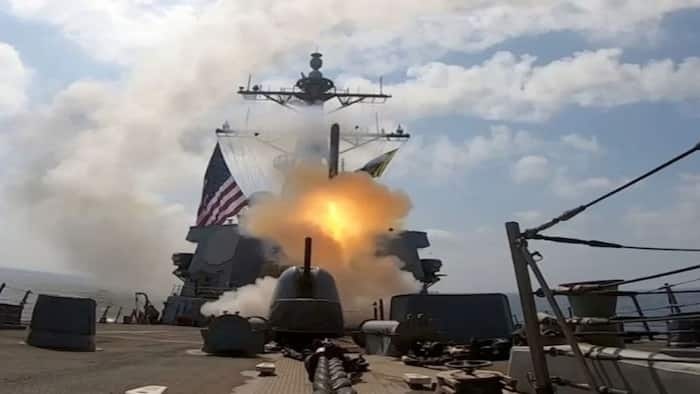
Unrestricted Warfare Threat: Iran Warns “No Political Border Safe” as US Hits Infrastructure in Night 7 Blitz:

The ongoing conflict between the United States and Iran has crossed a dangerous threshold, shifting from localised border skirmishes into an extensive, multi-front war. On Friday night, American forces executed their seventh consecutive night of targeted drone and missile strikes, prompting immediate, severe warnings from Tehran’s highest military command that the Islamic Republic is prepared to initiate total asymmetrical retaliation across the Middle East.
Total Target Expansion: Infrastructure Devastated Across Southern Coast
According to official briefings published by the US Central Command (CENTCOM), frontline naval and air assets deployed precision-guided weapons to degrade Iran’s strategic capacity systematically.
However, official statements from Iran’s state news agency, IRIB, paint a far more disruptive picture, accusing the US military of shifting targets from purely military nodes to essential civilian infrastructure. The documented strikes targeted:
Chabahar Port: A vital commercial shipping terminal where US Defence Secretary Pete Hegseth shared images confirming the collapse of a prominent port facility tower.
Civilian Transport Hubs: Direct missile impacts were reported at a regional airport and a primary railway hub.
Logistical Bridges: Two major transit bridges along the southern coast were completely disabled.
While US President Donald Trump had previously warned of crushing strikes against Iranian industrial assets, Washington has stopped short of formally confirming the deliberate targeting of non-military logistics. The expanding damage to infrastructure drew a sharp public rebuke from UN Secretary-General António Guterres, who characterised attacks on civilian logistics as completely unacceptable and urged immediate restraint.
The Timeline: How the Regional War Exploded
The current kinetic conflict is the result of months of compounding geopolitical friction that completely ruptured the regional security balance.
The Catalyst Strikes
February 28
The United States and Israel launch coordinated, massive preemptive strikes targeting Iranian nuclear infrastructure and defence research sites.
The Hormuz Chokepoint Lock
Early March
In direct retaliation, Tehran effectively shuts down the Strait of Hormuz, halting international oil transit and launching drone counter-attacks against US Fifth Fleet targets in the Gulf.
Continuous Strategic Bombardment
Mid-July
The US military enters a phase of uninterrupted nightly incursions, leading to the destruction of port nodes like Chabahar to break the maritime siege.
Iran Shifts Strategy: Unrestricted Operations Loom
The most alarming development comes from the supreme command channels within Tehran. Speaking to state media, Major General Mohsen Rezaei, a senior adviser to Iran’s Supreme Leader, delivered a definitive ultimatum. If American forces continue their heavy bombardment for another two to three days, the nation will permanently discard its policy of proportional containment.
Tehran Military Ultimatum: “Iran will no longer limit itself to retaliatory, like-for-like responses … and no political border will be safe,” Major General Mohsen Rezaei warned, indicating that proxy units across Iraq, Syria, Lebanon, and Yemen could be cleared to launch unrestricted strikes against Western assets.
Reinforcing this aggressive stance, Majid Mousavi, commander of the Islamic Revolutionary Guard Corps (IRGC) Aerospace Force, confirmed that specialised mobile missile divisions have been distributed across the country’s interior. Mousavi asserted that these units will maintain targeted long-range bombardments against regional US bases until Washington completely halts its naval operations along Iran’s southern coast.

Comments are closed.