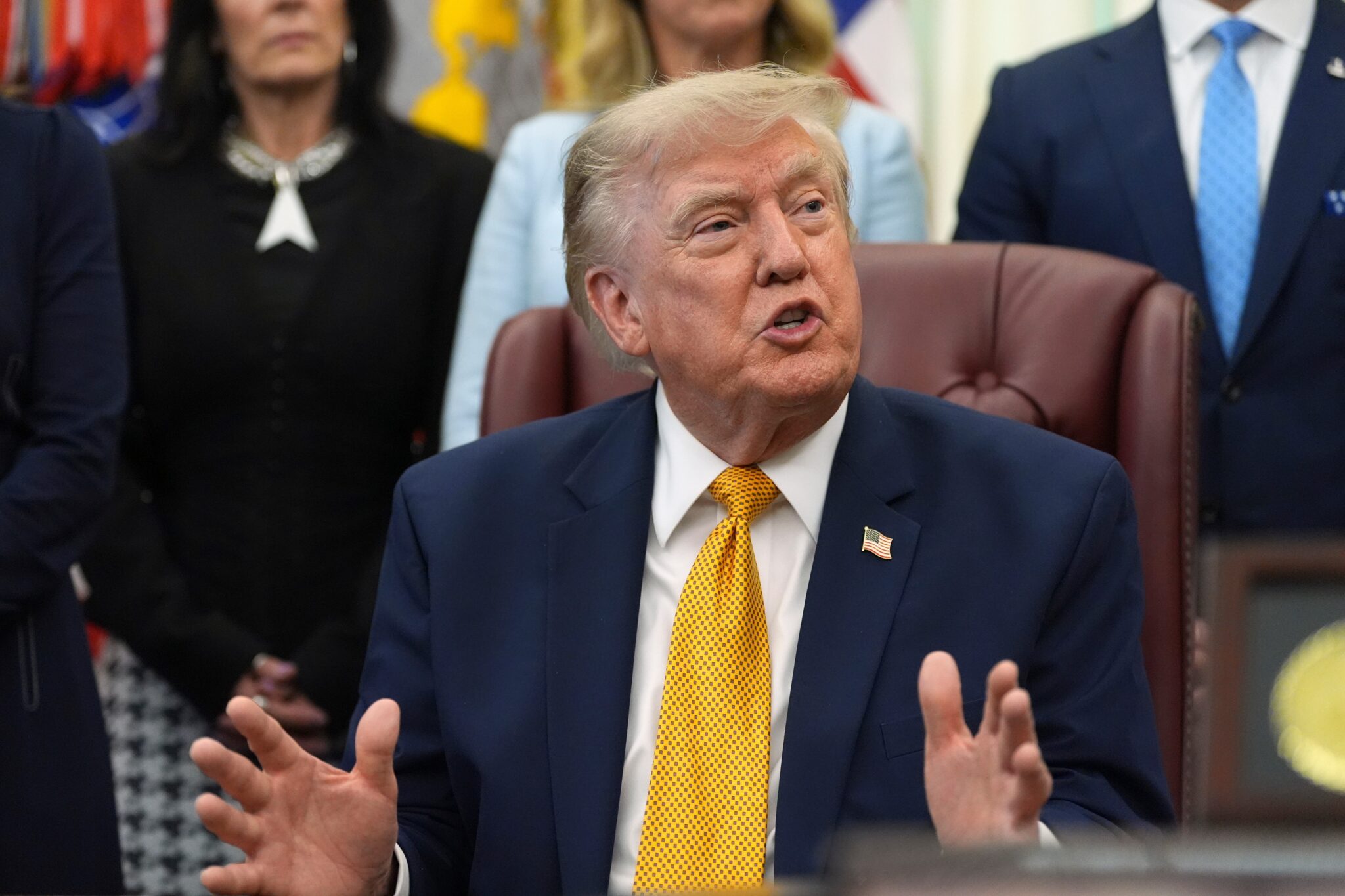
Trump Calls Iran Talks a ‘Last Chance’ to Avoid Massive U.S. Strikes/ TezzBuzz/ WASHINGTON/ J. Mansour/ President Donald Trump said new negotiations represent Iran’s “last chance” to reach an agreement and prevent a major escalation of U.S. military strikes. Trump said the first phase would reopen the Strait of Hormuz, followed by negotiations addressing Iran’s nuclear program. Iran publicly described its discussions as limited to maritime arrangements with Oman, while Trump insisted broader talks were already underway.

Quick Look
- Trump called the planned negotiations Iran’s “last chance.”
- He expects talks to begin within one or two days.
- Phase one would reopen the Strait of Hormuz.
- Phase two would address Iran’s nuclear program.
- Trump canceled a large U.S. attack planned for Sunday.
- He described it as potentially “the biggest attack since World War II.”
- Saudi Arabia, Qatar and the UAE urged Trump to allow diplomacy more time.
- Iran says its meetings with Oman concern only temporary safe navigation.
- Trump insists the U.S. and Iran are discussing a broader agreement.
- CENTCOM said it redirected 44 commercial vessels under the blockade.
- U.S. forces also reportedly disabled two vessels and boarded two.
- Trump previously delayed threatened attacks in April, May and June.
- About two-thirds of Americans say the Iran war has not been worthwhile.
- Approximately 37% of Republicans share that view.
- Sen. John Kennedy recommended maintaining the current approach for now.


Deep Look
Trump describes negotiations as Iran’s final opportunity
WASHINGTON — President Donald Trump said Monday that newly planned negotiations represent Iran’s “last chance” to reach an agreement and prevent a major escalation of American military operations.
Speaking in the Oval Office, Trump said he expected the talks to begin within the next day or two.
The negotiations would initially focus on reopening the Strait of Hormuz, a critical shipping route for global oil and natural gas supplies.
A second stage would address U.S. demands concerning Iran’s nuclear program.
“The first phase is the opening of the straits. The second phase will be the denuclearization,” Trump said. “And that will take a little while.”
Trump warns patience is running out
The president said he had postponed a major attack to give diplomacy another opportunity.
He warned, however, that Tehran must quickly accept an agreement.
“This the last chance for them to sign a good document,” Trump told reporters.
Trump did not provide a deadline or describe the precise conditions Iran would have to accept.
His remarks left open the possibility of renewed U.S. strikes if the talks fail or Iran rejects American demands.
U.S. military had prepared massive attack
Trump said American forces had been prepared to launch “the biggest attack since World War II” on Sunday.
He did not identify the planned targets or specify the number of aircraft, ships or weapons that would have participated.
Administration officials had previously considered attacks against Iranian energy infrastructure, power plants and bridges.
Such operations would have represented a significant escalation beyond strikes on military installations.
Trump said he canceled the mission after Gulf allies and unnamed Iranian officials requested more time for negotiations.
Gulf leaders urged restraint
Qatar, Saudi Arabia and the United Arab Emirates encouraged Trump not to launch the attack.
Saudi Crown Prince Mohammed bin Salman played a particularly important role in persuading the president, according to Trump and a person familiar with their discussions.
Gulf governments fear that Iran would retaliate against their oil facilities, ports, power systems and other infrastructure.
An attack on major Gulf energy producers could disrupt international supplies and drive oil and gasoline prices sharply higher.
Those governments support preventing Iran from obtaining nuclear weapons but also want to avoid a regional economic crisis.
Iran says talks concern only navigation
Iran’s public account of the diplomacy differs sharply from Trump’s.
The Iranian Foreign Ministry said its Monday meetings with Oman concerned only a temporary arrangement for safe navigation through the Strait of Hormuz.
Tehran denied that it was engaged in broader direct negotiations with Washington.
Oman has frequently served as an intermediary between the United States and Iran.
The contradiction raised questions about whether the two countries are participating in indirect negotiations, using different definitions of the talks or deliberately shaping public perceptions.
Trump accuses Tehran of duplicity
Trump reacted angrily to Iran’s denial.
Earlier Monday, he described the Iranian government as “unbelievably duplicitous.”
“They ask for a meeting, some would say ‘beg,’ talks begin, with more scheduled in the immediate future, and they say, openly and proudly, that they’re not having any discussions, that nothing is being talked about, and they’re only dealing with Oman,” Trump said.
He insisted that nuclear negotiations were taking place regardless of Tehran’s public position.
Trump said whether “Iran wants to admit it or not, we are, in fact, talking” about preventing it from developing nuclear weapons.
Trump says Iran requested negotiations
Trump later told reporters that discussions were continuing at Iran’s request and with support from Gulf countries.
“For some reason they, when they’re talking they don’t like saying that they’re talking,” Trump said. “So I say we’re in talks, big deal, we’re in talks. And they’ll sometimes deny it even thought they spend hours and hours together talking.”
The president said Iran had a history of publicly rejecting negotiations while privately participating in them.
“No, the talks are going on,” Trump asserted. “We’re talking and we’re talking at the request of Iran, backed by Saudi Arabia, backed by UAE and backed by Qatar in particular, but others also, many, many countries called, many. The leaders of many are friendly with a lot of them, almost all of them one way or the other. And they all wanted to give this a last chance. This is the last chance.”
Trump demands deal or “Total Surrender”
In a longer social media post, Trump accused Iran of misrepresenting the status of the discussions and exaggerating its control of the Strait of Hormuz.
“Iranian Leadership is unbelievably duplicitous! They ask for a meeting, some would say ‘beg,’ talks begin, with more scheduled in the immediate future, and they say, openly and proudly, that they’re not having any discussions, that nothing is being talked about, and they’re only dealing with ‘Oman,’” Trump wrote.
He said American naval forces already controlled the waterway through the blockade.
“They then go on to give their usual blather in saying, the Strait of Hormuz will be operated powerfully by them, when it is already completely controlled by the United States Navy and our ‘Blockade’ or, as some say, ‘The United States Wall of Steel!’ Nothing gets through to Iran, unless we want it to, and nothing will get through, unless a Deal, or Total Surrender, is accomplished. Whether Iran wants to admit it or not, we are, in fact, talking of a solution to a problem that they have caused, for decades. It is very simple, IRAN WILL NEVER HAVE A NUCLEAR WEAPON!” he added.
The language combined an offer of negotiations with a threat to continue economically and militarily isolating Iran.
CENTCOM reports blockade enforcement
U.S. Central Command said Monday that American forces were continuing to enforce Trump’s blockade.
“U.S. forces continue to strictly enforce the U.S. blockade against Iran. As of Aug. 3, CENTCOM has redirected 44 commercial vessels, disabled 2, and boarded 2,” CENTCOM said in a statement posted on X.
The command did not provide further details in the supplied report about the disabled or boarded vessels.
The blockade gives Washington leverage by limiting Iran’s ability to receive imports or move goods through regional shipping routes.
It also increases the risk of military encounters involving commercial ships.
Hormuz reopening would form first phase
Trump said reopening the Strait of Hormuz would precede the more complicated nuclear negotiations.
Before the war, approximately one-fifth of globally traded oil and natural gas passed through the strait.
Disruptions have raised energy prices, shipping costs and insurance premiums.
A safe-navigation agreement could quickly increase oil flows and relieve some inflationary pressure.
The nuclear phase would likely take longer because it would require agreement on enrichment, monitoring, inspections and enforcement.
Iran believes it can withstand pressure
The U.S. military has inflicted extensive damage on Iran’s leadership, air force and navy during the five-month conflict.
Iran appears to believe it can endure the pressure longer than Washington.
Tehran is aware that the United States has used substantial quantities of sophisticated munitions and missile-defense interceptors.
Iranian leaders are also watching American public opinion as Trump and congressional Republicans approach the November midterm elections.
The conflict’s financial and political costs could reduce Washington’s willingness to sustain an indefinite war.
Critics question Trump’s strategy
Trump could still conclude that military escalation is necessary.
Critics argue that his hesitation may reflect an internal recognition that American firepower alone cannot force Iran to surrender or produce a stable settlement.
Democratic Sen. Mark Kelly of Arizona, a member of the Senate Armed Services Committee, described Trump’s strategy as unpredictable.
“I think what we’re seeing here is a president who has an approach that’s just rather erratic,” Kelly said on CBS News’ “Face the Nation.” “At this point, he’s trying to get us back to February. And I think if he could — if he had a big reset button he could hit — he would certainly take that option.”
The administration maintains that military threats have helped create diplomatic openings.
April threats preceded temporary ceasefire
Trump has threatened major escalation before backing away several times during the war.
In early April, the United States and Iran announced a two-week ceasefire less than two hours before a presidential deadline.
Trump had demanded that Tehran capitulate or face attacks on bridges and power plants.
He warned that the strikes would mean “a whole civilization will die.”
The ceasefire prevented the immediate attack but failed to generate a lasting peace agreement.
May operation canceled amid talks
On May 18, Trump suspended another planned military strike.
He said “serious negotiations” were taking place and credited Gulf countries with persuading him to show restraint.
That diplomatic effort also failed to end the conflict.
Renewed attacks and mutual accusations later undermined the temporary progress.
The episode resembled the current situation, in which Trump has canceled military action while warning that negotiations may represent Iran’s final opportunity.
June threat focused on Kharg Island
Trump threatened another major operation in June.
He said the United States could strike Iran “VERY HARD” and seize the country’s energy base on Kharg Island.
Trump said such a move would allow Washington to “assume total control of their Oil and Gas Markets.”
He later canceled the operation after claiming that talks with senior Iranian leaders had advanced.
Taking and holding the island would likely have required American ground troops, a consequence Trump did not address publicly.
Ground operation carries major risks
A ground deployment inside Iran would be politically and militarily dangerous.
Trump campaigned on keeping the United States out of prolonged foreign conflicts.
He also criticized earlier administrations for committing American forces to wars without clear strategies for victory or withdrawal.
Seizing Iranian territory could require a long-term presence, expose troops to attacks and increase U.S. casualties.
Those risks make threats involving control of Iranian energy facilities far more difficult to execute than airstrikes.
Saudi leader warns of economic consequences
Mohammed bin Salman warned Trump that renewed escalation could severely harm the global economy, according to a person briefed on their call.
The person requested anonymity because the conversation was private.
Iran could retaliate by attacking energy infrastructure belonging to Saudi Arabia, Qatar or the UAE.
Saudi officials believe those countries can defend themselves against many threats.
They have cautioned that Kuwait may be more exposed to attacks from Iran-backed militias operating in Iraq.
Public opposition complicates Trump’s decisions
Trump insists that the approaching midterm elections are not influencing his Iran strategy.
Congressional Republicans are nevertheless concerned about the conflict’s political consequences.
An AP-NORC Center for Public Affairs Research poll found that approximately two-thirds of American adults believe the war has not been worthwhile.
That includes large majorities of Democrats and independents, along with about 37% of Republicans.
The results indicate that additional military escalation could create political problems within Trump’s own coalition.
Energy inflation worries Republicans
Republican Sen. John Kennedy of Louisiana warned that widening the war could cause another surge in energy prices.
He said escalation could produce “a lot of inflation for the American people.”
Kennedy argued that sanctions and continued pressure on Iran’s nuclear program may be preferable to a dramatically expanded military campaign.
“They’re all hellish choices,” Kennedy said. “But for the moment I’d maintain the status quo.”
His remarks show that even some Trump allies want the administration to avoid a major new operation.
Negotiations face immediate credibility test
The latest diplomatic effort begins with the two sides publicly disagreeing over whether broader negotiations are happening.
Trump says Iran requested the discussions and that nuclear issues are already part of them.
Tehran says its meetings concern only a temporary shipping route negotiated through Oman.
That gap could represent political messaging for domestic audiences, or it could reveal fundamental disagreement about the talks’ scope.
Trump has now labeled the process Iran’s final opportunity, increasing the risk that failure could quickly trigger the strikes he postponed Sunday.
More on US News