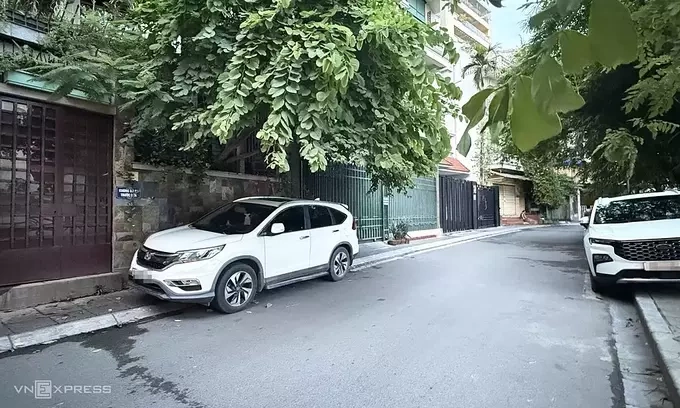
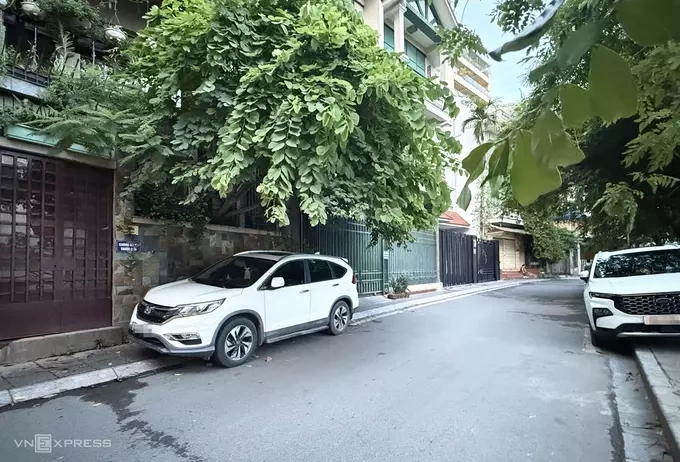
Vu Xuan, who lives on Truong Han Sieu Street in central Hanoi, recently returned from picking up her child from school to find an unfamiliar car blocking the only entrance to her home. Unable to locate the driver or find a contact number, she and her child were left waiting outside for more than 30 minutes until the owner returned, explaining he had briefly parked there to collect documents before driving away without apologizing.
For Xuan, such incidents are common despite paid parking facilities being located nearby. Many motorists continue to leave their vehicles along the street, sometimes overnight, causing repeated inconvenience to residents.
|
An unidentified car blocks the only entrance to Vu Xuan’s home on Truong Han Sieu Street in Hanoi’s Cua Nam Ward on July 14, 2026, preventing her from driving her vehicle inside. Photo courtesy of Xuan |
Similarly, on Nguyen Binh Khiem Street in Gia Vien Ward (Hai Phong), Hai Tung and his family frequently find their front doorway usurped. Earlier this year, a seven-seater parked across their threshold for 20 hours straight, trapping their motorbikes inside and keeping the family from commuting to work and school. When confronted, the driver maintained that the sidewalk was shared public space and argued that parking there was entirely legal since no prohibition signs were posted.
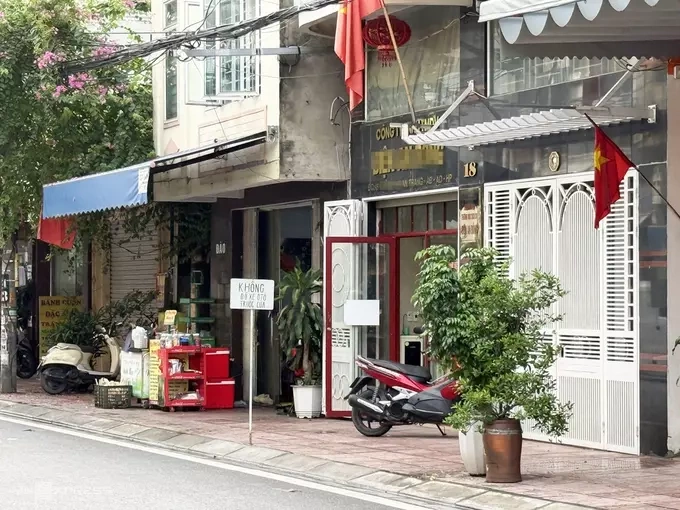
To guard his entrance, Tung eventually hauled massive potted plants onto the pavement—an aggressive move he acknowledges is against the law. “Even when drivers leave a phone number on the windshield, they often don’t pick up, or they take hours to show up,” he said.
Across Vietnam’s major cities, disputes between street-front homeowners and car owners are becoming both more frequent and more heated. According to a Read survey, data from iHanoi, the capital’s civic reporting app, shows nearly 380 active complaints regarding illegally parked cars disrupting daily life.
Drivers, however, see the situation from a different perspective, arguing they commit no violation when parking on streets without prohibition signs.
Cong Thanh, a ride-hailing driver in Hanoi, acknowledges that many drivers show poor courtesy by obstructing traffic or private entrances. Yet he points out that driver behavior stems from a severe infrastructure shortage. With designated lots scarce and often located far away, parking along streets with no explicit prohibition signs remains permitted under the Road Traffic Law.
“Many homeowners simply assume the stretch of pavement in front of their gate belongs to them,” Thanh said. “They take it upon themselves to ban drivers or even damage private property.”
 |
|
Residents on An Trang Street in Hai Phong’s An Hai Ward placed large potted plants and warning signs along the sidewalk in early July to discourage drivers from parking in front of their homes. Photo by Quynh Nguyen |
According to Diep Nang Binh, head of Tinh Thong Law Office, road surfaces and sidewalks fall under state management. The law does not explicitly forbid parking in front of residential homes unless the area features formal prohibition signs, impedes general traffic, or completely seals off a property’s sole exit. “Determining whether a violation has occurred depends on the exact parking position and the actual degree of obstruction,” Binh explained.
Tran Huy Anh, an architect and standing committee member of the Hanoi Association of Architects, believes the core issue is a stark structural imbalance: private vehicle growth has vastly outpaced urban infrastructure.
Data from Hanoi’s Department of Construction and Police Department indicates the capital now hosts nearly one million cars and six million motorbikes. The city’s vehicle fleet grows by 4% to 10% annually, whereas traffic infrastructure expands by a meager 0.3% per year. Out of 1,960 public parking facilities planned through 2030, Hanoi has brought just 72 into service.
Anh noted that municipal planning has heavily favored overpasses and underpasses while leaving parking infrastructure neglected. Citing a central Hanoi ward home to 20,000 cars and 200,000 motorbikes, he pointed out that legal parking facilities satisfy barely 15% of demand, forcing the remaining 85% to rely on informal or makeshift spaces.
To fix the bottleneck, urban experts urge city authorities to incentivize private investment in smart and underground parking structures rather than issuing temporary parking permits on street surfaces. “Without a tailored strategy to balance active traffic, static infrastructure, and vehicle volume—supported by enforceable sanctions—these disputes will only spread and cause greater societal harm,” Anh warned.
 |
|
Residents on Hanoi’s Yen Hoa Street put up signs on July 15, 2026 warning drivers not to park in front of their gates. Photo by Quynh Nguyen |
Assoc. Prof. Nguyen Hong Thai, a transport policy expert at the University of Transport and Communications, recommends stepping up police patrols and aggressively towing offending vehicles. At high-conflict zones, municipal authorities should conduct reviews to erect no-parking signs, paint curb warnings, and make displaying a phone number mandatory for parked cars.
Pending infrastructure improvements, attorney Binh advises homeowners to prioritize dialogue over vigilante tactics to avoid breaking the law. A January 2026 survey by Read revealed that 70% of readers attempt to contact drivers directly to ask them to move, 24% notify the police, and 6% resort to self-help measures like wheel locks or spray paint.
After her 30-minute ordeal on the curb, Vu Xuan ordered a custom “No Parking” sign to hang on her gate. “Filing complaints on iHanoi and hanging this sign are about the only options left,” she said.