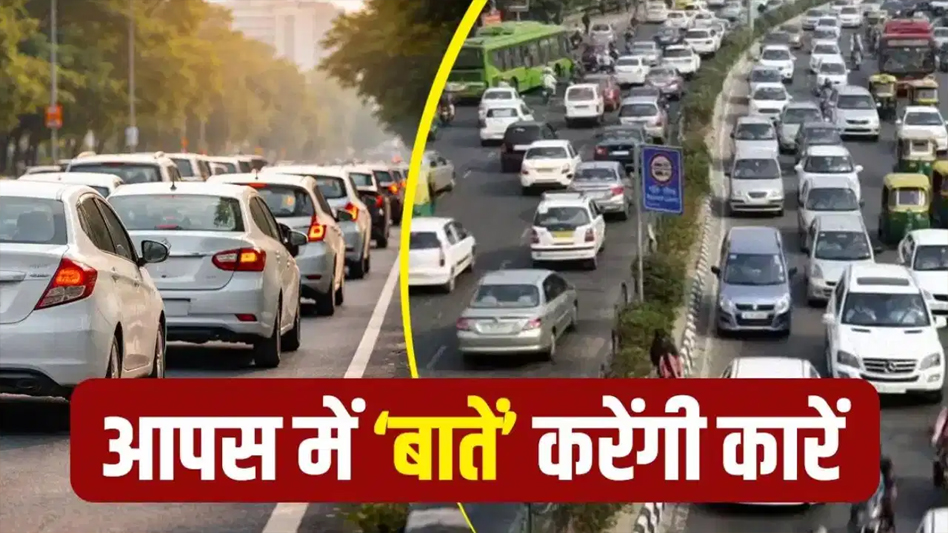
Desk: The Indian government is taking a major step to reduce road accidents and make driving safer. The government is preparing to introduce a new technology that will allow vehicles to communicate with each other. This technology has been named the V2V communication system.
The Ministry of Road Transport and Highways (MoRTH) has proposed implementing the system. To this end, the ministry has issued a draft notification amending the Central Motor Vehicles Rules, 1989. If implemented, new vehicles will be able to share information directly with each other in the coming years. This could potentially prevent many major road accidents.
V2V, or vehicle-to-vehicle communication, is a technology that allows two or more vehicles on the road to continuously share information wirelessly. This technology allows vehicles to transmit vital information such as speed, location, direction, braking status, and acceleration to each other in real time. If the vehicle in front suddenly applies its brakes, is traveling in the wrong direction, or is about to encounter an accident, the vehicle behind will receive immediate warning. This allows the driver to be alerted in time, significantly reducing the likelihood of an accident.
The government will not implement this technology all at once, but rather plans to implement it in two phases. This rule will apply to L, M, and N category vehicles manufactured from October 1, 2027, that will be equipped with V2V systems. Such vehicles will have to comply with the AIS-230 standard. From October 1, 2028, it will be mandatory to install V2V communication systems in all new vehicles in these categories, and all vehicles will have to be manufactured according to the AIS-230 standard. The government says that implementing this rule in a phased manner will give companies and other parties sufficient time to adopt the new technology. This means that in the future, everything from bikes to cars, SUVs, buses, and trucks could be equipped with this technology.
The ministry has selected the 5.875 GHz to 5.925 GHz frequency band for V2V and other intelligent transport systems (ITS). Fortunately, the Department of Telecommunications (DoT) has exempted the use of this frequency band from licensing requirements until June 2026. This will make it easier for automakers to adopt this technology.
Many new cars today come equipped with Advanced Driver Assistance Systems (ADAS). These systems utilize cameras, radar, and sensors to assess surrounding conditions. However, V2V technology goes a step further. It doesn’t rely solely on sensors, but instead receives information directly from other vehicles. This means that if a vehicle suddenly stops around a bend or there’s a danger ahead, a V2V system can alert the driver even if it’s not in their sight.