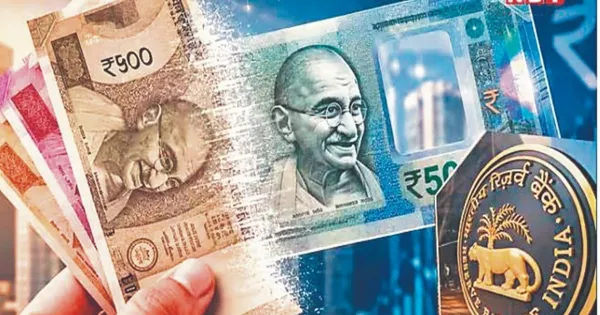
India’s economy is going through a transitional period, where the digital payments revolution is advancing at an unprecedented pace, while the importance of cash remains undiminished. The Unified Payments Interface (UPI) has simplified, accelerated, and made the payment system accessible, yet the demand for cash in the country continues to grow.
According to the Reserve Bank of India’s (RBI) annual report, the value of currency in circulation is projected to reach approximately ₹41.23 lakh crore by March 2026, an increase of approximately 12 percent compared to the previous year. The currency-to-GDP ratio has also increased to 12.1 percent. This clearly indicates that despite the expansion of the digital economy, cash remains a vital necessity in the Indian economy.
At this juncture, the RBI’s move towards adopting polymer or plastic notes is considered extremely important. Recently, RBI Note Printing Private Limited (BRBNMPL) invited global tenders for the supply of opacified polymer substrate sheets. This represents not just a technical process, but a potential historic shift in the Indian currency system. If successful, the coming years could see significant changes in the structure, security, and durability of Indian currency.
In fact, the use of cash in India is not just a means of payment, but also a part of economic confidence and social behavior. Cash still plays a major role in rural areas, among small businesses, the agricultural sector, and the unorganized economy. A large section of the country’s population still considers cash transactions more convenient and reliable. With the increasing demand for cash, the cost of printing and maintaining notes has also steadily increased.
In the financial year 2024-25, approximately ₹6,372 crore was spent on printing Indian currency notes. Although this expenditure decreased to approximately ₹4,875 crore in FY 2025-26, the amount remains substantial. Every year, a large number of notes become unusable due to tearing, soiling, moisture damage, and excessive use. New notes have to be printed to replace these notes, placing a significant financial burden on the government and the RBI. In a vast country like India, where billions of notes are in circulation, increasing currency durability becomes an economically crucial issue. In this context, polymer notes have emerged as an effective alternative.
It is worth noting that polymer notes are manufactured from a special type of plastic-based material. While regular paper notes are made from special cotton-based paper, polymer notes are printed on a highly robust and flexible plastic substrate. Their most significant advantage is their longevity. According to experts, polymer notes have a lifespan two to four times longer than traditional paper notes. They are relatively less affected by water, moisture, dust, oil, sweat, and repeated folding.
This feature becomes even more important given India’s climatic conditions. Heat, humidity, monsoons, and dust are common in most parts of the country. Paper notes deteriorate relatively quickly in such environments. Polymer notes can offer a long-term solution to this problem. Another important advantage of polymer notes is security. Counterfeit currency has long been a challenge to India’s economic security.
According to an RBI report, approximately 2.3 lakh counterfeit notes were detected in the banking system during 2025-26. Although this number is very small compared to the total number of notes in circulation, it still has a negative impact on the national economy and financial security. Polymer notes can be equipped with several advanced security features that make them extremely difficult to counterfeit.
These include technologies such as transparent windows, special holograms, micro-printing, advanced security threads, metallic security markings, and color-changing ink. Experiences from countries like Australia, Canada, and the United Kingdom show that the introduction of polymer notes has significantly reduced counterfeit currency. For a country like India, where incidents of cross-border counterfeit currency have been reported from time to time, this benefit could be extremely significant.
Experts believe that India could initially test polymer technology on smaller denomination notes like 10 and 20 rupees, as these are the most widely circulated and wear out the fastest. If the test is successful and the cost-benefit analysis yields positive results, it could be gradually expanded to 50, 100, and other denominations. A phased strategy will minimize risks and allow necessary improvements to be made in a timely manner.
If the RBI and the government implement this plan in a phased manner, keeping in mind environmental balance, technological self-reliance, and public awareness, India can join the ranks of leading countries that have successfully adapted their currency systems to future needs. Undoubtedly, plastic notes could prove to be not just a novelty for the Indian economy, but also a significant milestone in financial modernization. (These are the author’s personal views.)