The Siliguri Corridor, also known as the “Chicken’s Neck,” is considered the most sensitive part of India’s geographical and strategic security. Located in West Bengal, this strip of land, just 22 kilometers wide, connects the entire Northeast with the rest of the country. China has always had its eyes on this region because, in the event of a war, this narrow route could be cut off and a strategy could be implemented to isolate all eight Northeastern states from the country.
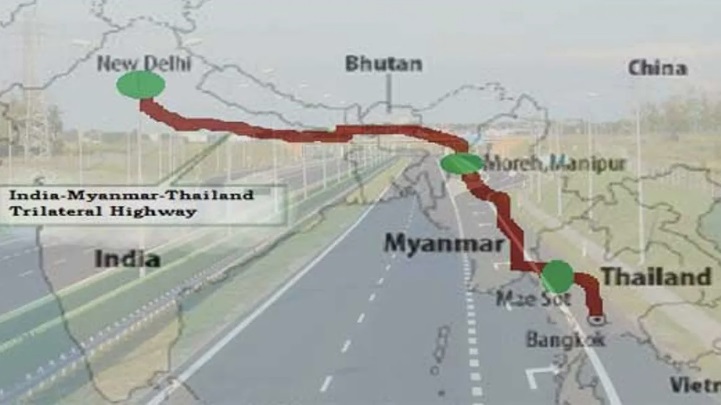
To fully address this geopolitical weakness, India has begun implementing the India-Myanmar-Thailand (IMT) Trilateral Highway Project under its Act East Policy. This approximately 1,400-kilometer-long highway begins in Moreh, Manipur, and extends through Myanmar to Mae Sot, Thailand. This is not just a road project, but a powerful strategic and commercial alternative to the Chicken Neck, connecting India directly to Southeast Asian countries (ASEAN) by land.
Goal 1: Eliminate strategic dependence on the Chicken Neck and provide an alternative land route
The IMT project’s greatest benefit to India lies in its national security. This highway will be a game-changer for India in the event of any military crisis or natural disaster along the Siliguri Corridor. If the Chicken Neck route is ever disrupted, India can easily transport supplies and logistics to its northeastern states via Myanmar and ASEAN countries. Furthermore, India’s Kaladan Multi-Modal Transit Transport Project (Kaladan Project) and the IMT Highway together create a protective shield that ensures Northeast India’s connectivity with the mainland under all circumstances.
Target 2: Economic and Social Transformation of Northeast India
The eight states of the Northeast have long lagged behind mainstream economic development due to geographical isolation and lack of infrastructure. With the full operation of the IMT Highway, Manipur, Nagaland, Assam, Mizoram, and Arunachal Pradesh will be directly connected to international trade networks.
Northeast India will no longer be merely a gateway to Southeast Asia, but will also emerge as a major logistics and manufacturing hub. This will create millions of new employment opportunities for local youth, provide an unprecedented boost to tourism, and help eliminate insurgency in the region forever.
Target 3: Direct Access to the ASEAN Market and a Major Boom in Trade
A large portion of trade between India and ASEAN countries has so far relied solely on sea routes, which are both time-consuming and cost-intensive. Through the IMT Trilateral Highway, India will now be able to deliver its goods directly and quickly by road to Thailand, Myanmar, and further to Vietnam, Laos, and Cambodia.
Improved road connectivity will boost exports of agricultural products, pharmaceuticals, automobile spare parts, and electronic goods manifold. This highway will provide new impetus to the India-ASEAN Free Trade Agreement (FTA) and establish India as a major player in the global supply chain.
Target 4: A befitting response to China’s bullying in Myanmar and the Malay Peninsula
In Southeast Asia, China has been conspiring to encircle India by investing heavily in Myanmar and Thailand under its Belt and Road Initiative (BRI) and String of Pearls policy. China’s presence in Myanmar poses a challenge to India’s security in the Bay of Bengal.
Through the IMT project, India has played a major role in infrastructure development, bridge renovation, and road widening in Myanmar. India’s soft-power and infrastructure development model has emerged as the most promising alternative to China’s “debt-trap” policy. This is reducing the dependence of countries like Myanmar and Thailand on China and strengthening India’s strategic influence in the region.
Target 5: Masterplan to Expand to Cambodia, Laos, and Vietnam (CLMV)
India’s plans are not limited to Thailand alone. According to strategic experts, the IMT Highway is proposed to be further expanded to Cambodia, Laos, and Vietnam (CLMV countries). This expanded network will be linked to the Greater Mekong Sub-Region (GMS) connectivity.
This means that an Indian truck traveling from Manipur will be able to directly reach Vietnam’s ports on the Pacific Ocean coast. This connectivity will not only facilitate trade but also provide India with an opportunity to build a strong diplomatic alliance with these countries against China’s aggressive stance in the South China Sea.
Target 6: Revitalizing Energy Diplomacy, Tourism, and Cultural Ties
The IMT Highway is not just a transit route, but also a route for energy security and cultural renaissance. Myanmar and Thailand are major sources of natural gas and minerals. Future plans are underway to establish oil and gas pipelines and power grid interconnections along this corridor.
In addition, connecting India’s Buddhist circuit (such as Bodhgaya, Sarnath) with historic Buddhist monasteries in Myanmar and Thailand will provide an unprecedented boost to spiritual tourism. Ancient historical and cultural ties between the two countries will be revived, strengthening people-to-people contacts.