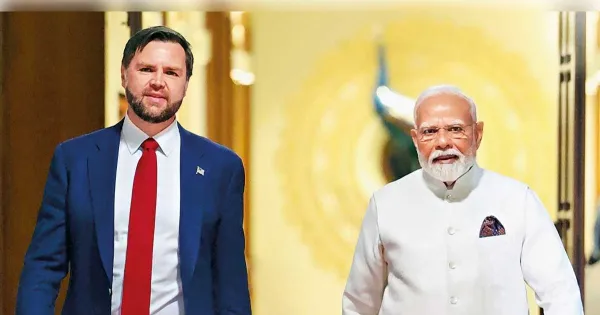
New Delhi: The US Vice President has spoken to PM Modi by phone. PM Modi shared this information on the social media platform X. In a post on X, PM Modi stated that he received a phone call from US Vice President JD Vance. During the call, the two leaders discussed India-US cooperation. PM Modi also congratulated JD Vance and his wife on the birth of their son.
PM Modi shared the information on X.
PM Modi wrote on X, “Received a phone call from US Vice President JD Vance. We discussed ways to further strengthen the India-US Comprehensive Global Strategic Partnership in key areas. Warmly congratulated him and the ‘Second Lady’ on the birth of their son and extended best wishes to the entire family.”
Bill passed in US Senate
It should be noted that this conversation between the two leaders took place at a time when the US Senate passed a bill with bipartisan support. This bill could give President Donald Trump the authority to impose tariffs of up to 100% on goods coming from countries (such as India and China) that continue to import oil and gas from Russia. The argument behind this is that such trade helps sustain Moscow’s economy and raise funds for its military operations in Ukraine.
The Senate overwhelmingly approved
the Lindsey O. Graham Sanctioning Russia and Iran Act by a vote of 86-11. Named after the late Republican Senator Lindsey Graham (one of its main authors), the legislation aims to increase economic pressure on Russia and Iran, while also targeting countries that have significant energy trade ties with Moscow. Under the legislation’s provisions, the US President would be authorized to impose tariffs of up to 100% on imports from the world’s top five buyers of Russian crude oil or natural gas.
Reducing Support to the Russian Economy
In addition to targeting foreign energy buyers, the law outlines new sanctions against Russian President Vladimir Putin, senior political and military officials, financial institutions, energy projects, and entities linked to Russia’s war effort. The law also expands US sanctions on old and re-flagged oil tankers, which Russia allegedly uses to evade global sanctions and maintain revenue from energy exports. Its broader goal is to cut off financial flows that support Russia’s economy and military campaigns.
Tariffs may be imposed on buyers of Russian oil.
This law empowers the US President to impose tariffs of up to 100% on goods imported from the top five buyers of Russian oil or natural gas. Along with China, India is one of the largest buyers of Russian crude oil in the world. The move is aimed at presenting a choice to energy-importing countries: either they continue to buy Russian energy at subsidized rates or maintain their access to the lucrative US market. Let us tell you that after the Russia-Ukraine conflict broke out in 2022, India had increased the purchase of Russian crude oil at subsidized rates to meet its national energy needs during the turmoil in the global market.