

0
Hoodlums heckled policewomen even after protest ended.
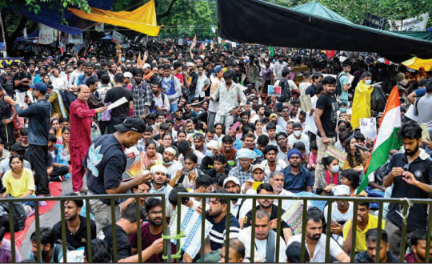
Days after Delhi witnessed large-scale student mobilisation over the NEET-UG paper leak, the protest entered a new phase following the resignation of Union Education Minister Dharmendra Pradhan. Soon after the resignation, the CJP announced that the students’ key demands had been met and called off the agitation, prompting the NEET aspirants and students to vacate the protest site at Jantar Mantar. However, even after the protest was officially withdrawn, a large number of people continued to gather at the venue. Their continued presence has drawn the attention of security agencies that are now trying to determine who these individuals are, whether they have any connection with the original student movement, and what purpose they are serving by remaining at the site.
The issue has gained significance amid allegations that these individuals, who are not connected with the NEET movement or the education sector, have continued to remain at Jantar Mantar and have engaged in provocative acts directed at police and security personnel. Instances of misconduct, including the eve-teasing of women police personnel, were witnessed by this reporter on Saturday evening. Furthermore, these elements continued to bad mouth the Prime Minister, the Central government and the Delhi Police. Despite these provocations, Delhi Police personnel continued to exercise restraint, while repeatedly urging those present to vacate Jantar Mantar since the protest had been called off. Through continuous public announcements, the police were informing the gathering that Metro stations had reopened and that with the protesters’ demands having been met, they should disperse peacefully. However, a section of those present refused to leave the protest site and remained at Jantar Mantar until the time this report was filed.
It has to be mentioned that the character of the gathering at the CJP protest had changed considerably since social activist Sonam Wangchuk was shifted to hospital. Security agencies say the composition of the crowd at Jantar Mantar evolved over the past several days. As the sit-in continued over a prolonged period, officials say the composition of the crowd began changing noticeably, especially at night, leading security agencies to intensify surveillance at the protest site.
Sources familiar with the arrangements told Read that the daytime gathering largely comprised NEET aspirants, students preparing for competitive examinations, parents, teachers, coaching institute representatives and volunteers associated with the protest. Senior leaders from several Opposition parties also visited the venue. However, after sunset, as this group left, another group would continue to remain at Jantar Mantar through the night. Sources say that these sections included anti-social elements and the local cadre of some Opposition parties—those who had been involved in confrontations with the Delhi Police and the Rapid Action Force (RAF). According to these sources, such incidents gradually shifted the public attention away from the original objectives of the student-led movement.
Speaking on the condition of anonymity, a person familiar with the developments told Read that rowdy groups from Faridabad, Seelampur, Jaffrabad and neighbouring localities would begin arriving at Jantar Mantar around 8 p.m. and remain there until late into the night. The source alleged that some among them were involved in acts of misconduct during the demonstrations and received support from local political workers.
Officials and sources also alleged that some members of the overnight crowd engaged in activities such as consuming alcohol and narcotic substances and were involved in stone-pelting at security personnel during episodes of violence. Read could not independently verify these claims.
The protest site has also witnessed the active participation of student organisations affiliated with Left parties, including AISA and SFI. These parties and some others established dedicated spaces within the venue. While these organisations continued to support the agitation, sources claim they were busy advancing their own political narratives alongside the broader student movement.
The logistics sustaining the prolonged sit-in have likewise come under scrutiny. Food, drinking water and other relief supplies continued to arrive regularly at the protest site, with deliveries reportedly entering through the Tolstoy Marg side of Jantar Mantar. According to sources, these supplies were being organised by supporters from different parts of the country as well as from overseas. Some local accounts claim that a significant amount of the food deliveries originated from southern India, particularly Kerala and Tamil Nadu. Other unverified claims suggest that financial or logistical assistance was being extended by individuals based in Dubai and Qatar. There are also allegations that certain Church-backed organisations contributed to food distribution. Read has not independently verified any of these claims.
Alongside these arrangements, Gurudwara Bangla Sahib and several other gurdwaras provided langar and other humanitarian assistance to the protesters. Several voluntary organisations also established medical camps at the venue, offering first aid, medicines and basic healthcare facilities.
‘FREE FOR ALL’
A senior security analyst told Read that the protest site had effectively become “a free-for-all space” where the organisers no longer appeared to exercise effective control over the thousands of people assembled there.
“Sonam Wangchuk did the right thing by distancing himself from the protest. If any unfortunate incident occurred, the leadership of the CJP could face legal accountability. It is unlikely that either the government or the courts would accept the argument that the organisers had no control over those present,” the analyst said.
Drawing a comparison with the Anna Hazare movement, the analyst added that the CJP agitation lacked a unified leadership capable of directing the crowd. “The Anna movement had recognised leaders whose instructions were respected by participants. That level of organisational discipline does not appear to exist at Jantar Mantar today,” the analyst observed.
With the protest officially called off following the Education Minister’s resignation, the focus is increasingly shifting towards the changing composition of the gathering at Jantar Mantar. Security agencies believe that distinguishing between the largely student-led daytime demonstrations and the overnight crowd could prove crucial in identifying those responsible for recent incidents of violence and determining whether the nature of the protest changed over the course of the agitation.

Comments are closed.