
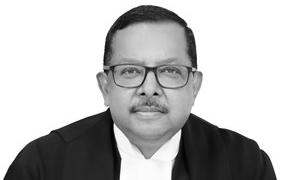

Supreme Court judge Justice Ujjal Bhuyan on Saturday (July 25) raised concerns over the growing criminalisation of peaceful expression, questioning arrests over acts that are not offences under law and cautioning that space for democratic dissent in India is steadily narrowing.
Speaking at the National Law Institute University (NLIU) in Bhopal, Justice Bhuyan said the space for expressing dissent in India was steadily shrinking and warned that the constitutional right to free speech and peaceful protest was increasingly coming under strain.
Biryani arrests
Referring to the recent arrest of 14 Muslim men who spent nearly three months in jail after consuming chicken biryani while breaking their Ramzan fast on a boat in the Ganga, Justice Bhuyan questioned the legal basis for their detention.
Also read: ‘Rs 370 biryani’ joke costs youth his job, raising several questions for society
“I am sure consuming chicken biryani is not an offence. There is no law prohibiting consumption of chicken over the Ganga river, they were arrested for that very reason and they had to remain in jail for three months. Can people be arrested and denied bail for three months for such an activity? Citizens are watching, people are watching,” he said.
Justice Bhuyan said the incident reflected a broader pattern in which citizens increasingly faced criminal proceedings for exercising rights guaranteed by the Constitution.
“It will not be an exaggeration to say that public space for expressing divergent opinion is shrinking in India. Right to express one’s views and right to demonstrate peacefully are fundamental freedoms of citizens. Debate and dissent are the essence of democracy. Unfortunately, even formal activities are criminalised,” he said.
Gaza protest houses
He also questioned judicial responses to demonstrations on international humanitarian issues, recalling a July 2025 Bombay High Court order refusing permission to the Communist Party of India (Marxist) to hold a protest at Mumbai’s Azad Maidan against the alleged genocide in Gaza.
“I found it very amusing that when in Bombay, Shivaji Park, a group of people wanted to demonstrate in solidarity with the people of Gaza, permission was not granted by the government. They moved the High Court, and the learned judge said, ‘Don’t you have any issues in India? Why do you have to go that far to agitate?'” Justice Bhuyan said.
Also read: How Tamil Nadu cops cracked down on inter-state bucket ganja racket
The High Court had observed that citizens should focus on domestic issues and remarked that protesting over Gaza was not an act of patriotism. Justice Bhuyan questioned the reasoning behind such observations, saying the judiciary should be careful not to discourage peaceful democratic expression.
He further observed that although higher courts often grant bail in such cases, the relief is frequently granted only after prolonged incarceration. In several instances, he noted, stringent bail conditions imposed by courts effectively discourage legitimate protest and free expression.
Judiciary under scrutiny
Justice Bhuyan also expressed concern over what he described as the increasing tendency to invoke stringent criminal laws for trivial matters, including public demonstrations, social media posts and even memes, warning that such practices undermine personal liberty.
Calling for greater judicial introspection, Justice Bhuyan said courts are not above criticism and encouraged lawyers and law students to examine judicial decisions critically rather than treating them as beyond question.
Referring to recent Supreme Court judgments, including the verdict on reservation for Economically Weaker Sections (EWS), he said unquestioning praise does little to strengthen the institution. Public confidence in the judiciary, he added, rests not on self-congratulation but on the willingness of judges to remain accountable to constitutional values and reasoned criticism.

Comments are closed.