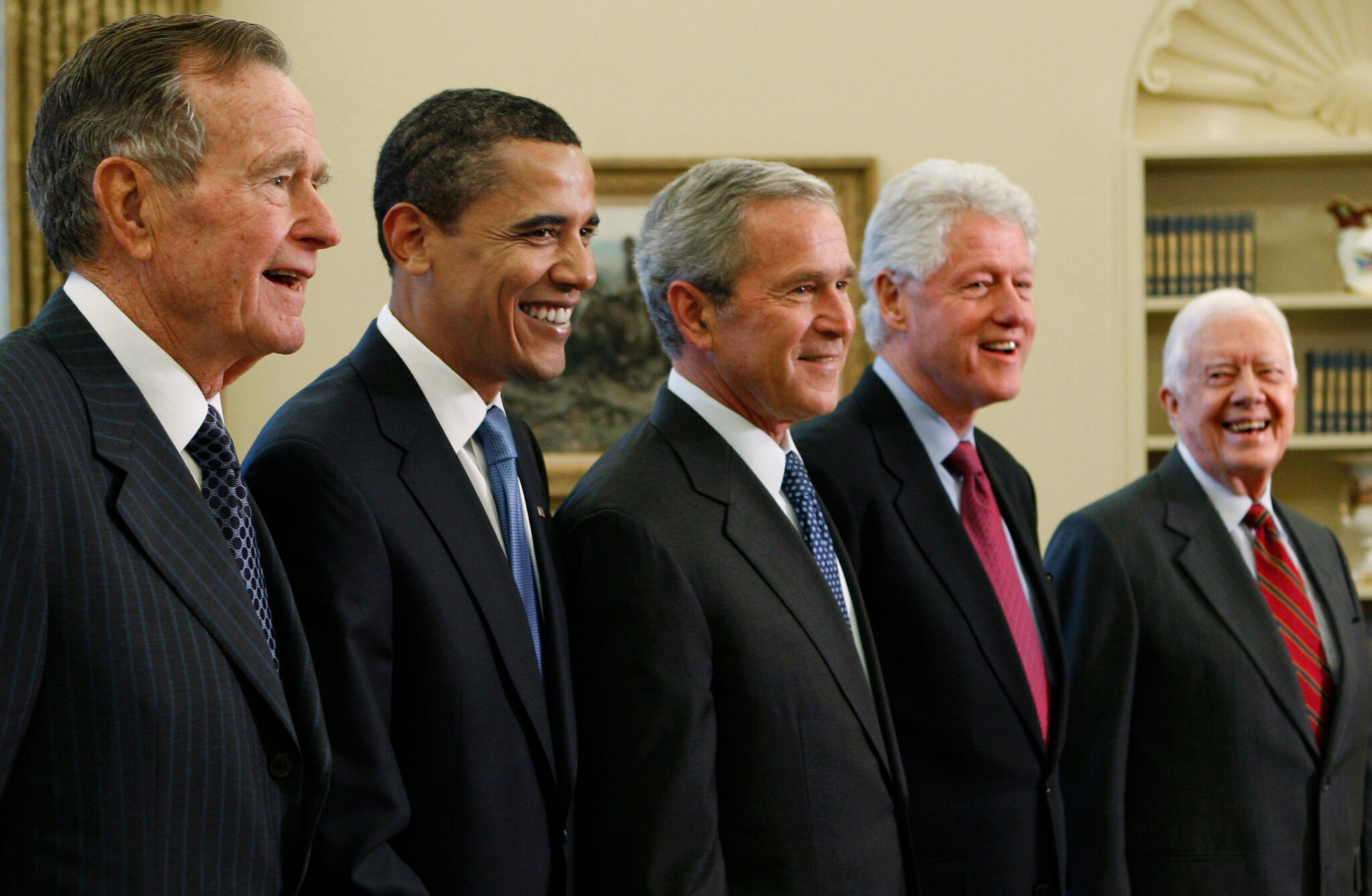
Bush, Clinton and Obama Explore Presidential Power Without Naming Trump/ TezzBuzz/ WASHINGTON/ J. Mansour/ George W. Bush, Bill Clinton and Barack Obama contributed historical essays examining past presidents for America’s 250th anniversary. Although Donald Trump is not directly discussed, several essays address power, constitutional limits, institutional loyalty and democracy. The nonpartisan In Pursuit project covers 43 presidents and 30 first ladies through essays published weekly into December.
Quick Look
- The In Pursuit project marks America’s 250th anniversary.
- George W. Bush wrote about George Washington.
- Barack Obama examined Abraham Lincoln.
- Bill Clinton contributed an essay about Theodore Roosevelt.
- Trump and Joe Biden were excluded because their presidencies were considered too recent.
- Bush praised Washington for willingly surrendering power.
- Retired Gen. Stanley McChrystal emphasized choosing “law over loyalty.”
- Former U.S. Archivist Colleen Shogan is curating the series.
- Trump fired Shogan without explanation in February 2025.
- Contributors also include John Roberts, Hillary Clinton and Michelle Obama.
- The essays have received more than 1 million views on Substack.
- A documentary about the series is scheduled to air on PBS in October.

Deep Look
Former presidents become essayists for America’s anniversary
WASHINGTON — Former Presidents George W. Bush, Bill Clinton and Barack Obama have joined historians, authors and public figures in examining the nation’s presidents and first ladies for a project commemorating America’s 250th anniversary.
The In Pursuit series asked each contributor to write about a president or first lady while avoiding partisan or ideological arguments.
Donald Trump goes unmentioned in the essays by the three former presidents. Yet some of the subjects they explore — presidential power, democratic institutions, constitutional limits and personal loyalty — carry clear relevance during Trump’s second administration.
The essays cover 43 presidents, excluding Trump and former President Joe Biden, and 30 first ladies. New installments are being released chronologically each week through December.
Organizers concluded that the presidencies of Biden and Trump were too recent to receive a meaningful historical assessment. That decision also allowed the project to avoid some of the most divisive passions surrounding contemporary politics.
Colleen Shogan seeks lessons without partisanship
The project is curated by Colleen Shogan, the former archivist of the United States whom Trump fired without explanation in February 2025.
Shogan instructed contributors to avoid overtly partisan or ideological approaches.
“Everybody took those instructions and that guidance very seriously,” she told The Associated Press.
Shogan said the project was designed so that all Americans would “feel welcome to be able to read these lessons and essays and learn something from them.”
The series does not ignore historical failures or controversies. Instead, it seeks to examine the accomplishments and shortcomings of presidents and first ladies so readers can apply those lessons to modern American life.
The mission, Shogan said, “is to surface the lessons from the past 250 years of American history, so that we can learn from those lessons, from both our successes and our failures, so we can plan for the present and the future. It’s what has been described as debriefing the American story.”
Bush praises Washington for surrendering power
Bush launched the presidential portion of the series on Presidents Day with an essay about George Washington.
Without mentioning Trump, Bush focused on Washington’s willingness to surrender authority — first when he resigned as commander in chief of the Continental Army and later when he left the presidency after two terms.
Washington established the two-term tradition long before it became a constitutional requirement. Bush presented those decisions as defining demonstrations of humility and restraint.
“Our first president could have remained all-powerful,” Bush writes, “but twice he chose not to. In so doing, he set a standard for all presidents to live up to.”
Bush continued: “George Washington’s humility in giving up power willingly remains among the most consequential decisions and important examples in American politics.”
The essay attracted heavy engagement after its publication on Substack.
Its focus on the peaceful surrender of power has modern resonance because Trump resisted accepting his 2020 election defeat and has discussed the possibility of a third presidential term despite the Constitution’s two-term limit.
McChrystal argues for ‘law over loyalty’
Retired Gen. Stanley McChrystal contributed an essay about Ulysses S. Grant, the Union general who later became president after the Civil War.
McChrystal portrayed Grant as a leader with “an absolute commitment to principles larger than personal ambition.”
Before entering the White House, Grant resisted pressure on military leaders to “align with political factions and be loyal to a person rather than the Constitution,” McChrystal wrote.
That discussion also carries contemporary implications at a time when Trump has repeatedly demanded loyalty from officials serving in his administration.
The “temptation to bend institutions toward personal power is not unique to Grant’s era,” McChrystal writes. “Our future still depends on whether our leaders choose law over loyalty.”
McChrystal’s essay became another widely read installment because of the parallels readers could draw between Grant’s era and present political debates.
Clinton examines Theodore Roosevelt’s complicated legacy
Bill Clinton’s contribution focuses on Theodore Roosevelt and his campaign to expand the meaning of “we the people” by confronting powerful corporate interests.
Clinton also examines Roosevelt’s exclusionary positions toward Black and Indigenous Americans, reflecting the project’s broader effort to discuss presidential failures alongside achievements.
That approach contrasts with Trump’s calls for federally supported museums and cultural institutions to emphasize patriotic interpretations of American history.
The series frequently confronts contradictions within presidential legacies, presenting American history as a record containing both success and failure rather than a uniformly celebratory narrative.
Obama writes about Abraham Lincoln
Barack Obama contributed an essay about Abraham Lincoln, placing the nation’s 16th president within a collection featuring political leaders, historians, judges, filmmakers and other prominent writers.
Chief Justice John Roberts wrote about William Howard Taft, the only person to have served both as president and chief justice of the United States.
Hillary Clinton examined Eleanor Roosevelt, while Michelle Obama wrote about Jacqueline Kennedy.
Other contributors include Republican political strategist Karl Rove on William McKinley, documentary filmmaker Ken Burns on Franklin D. Roosevelt and presidential historian Michael Beschloss on Lyndon B. Johnson.
The diverse list reflects the project’s attempt to bring together contributors from different political and professional backgrounds.
Nonpartisan alliance organizes the project
In Pursuit is being presented by More Perfect, a nonpartisan alliance of dozens of presidential centers, academics and organizations dedicated to strengthening democracy.
The organization has provided Shogan with a place to continue her work as an archivist following her removal from the National Archives.
Shogan said she has never received an explanation for her firing. Congress also apparently has not been formally informed of the reason, despite a legal requirement that lawmakers be notified. The law does not specify when that notification must occur.
The National Archives serves as the central repository for federal records, ranging from historically significant documents to the routine materials generated by government agencies.
Its leader has considerable discretion over which records are preserved, displayed and made available to the public.
“That is a position that used to be a nonpartisan position, much like the Librarian of Congress, the secretary of the Smithsonian,” Shogan said. “And I took that very seriously and acted the entire time when I was archivist in a nonpartisan way.”
The White House did not respond when asked why Trump dismissed Shogan or whether the administration planned to inform Congress.
Trump’s history with the National Archives
Trump has long expressed resentment toward the National Archives because it notified the Justice Department about his alleged mishandling of classified documents after leaving office at the end of his first term.
Shogan was not working at the agency when that referral occurred.
Her dismissal nevertheless came as Trump moved to reshape federal institutions and remove officials from positions traditionally viewed as nonpartisan.
Shogan’s role in In Pursuit allows her to continue examining how history is preserved, interpreted and presented to the public outside the federal government.
Public response suggests demand for unslanted history
Shogan said the public response to the series has been overwhelming and may demonstrate a broad appetite for historical analysis free from an obvious partisan slant.
The essays have accumulated more than 1 million views on Substack.
The In Pursuit podcast has recorded approximately 160,000 audio downloads and nearly 64,000 YouTube views. A documentary about the series is scheduled to air on PBS in October.
Readers are encountering essays not only about celebrated presidents such as Washington, Lincoln and Franklin Roosevelt but also about less prominent and often unsuccessful figures.
Forgotten presidents receive fresh examination
Former New York Rep. Steve Israel wrote about Millard Fillmore, describing him as “a historic punchline — best remembered, ironically, for being so forgotten.”
Yale history professor David W. Blight examined Franklin Pierce, presenting him as a pro-slavery president and “permanent victim” of Washington’s alcohol-heavy political culture.
Blight recounts Pierce’s victory as the Democratic nominee in the 1852 presidential election, when he defeated Whig candidate and Mexican War veteran Gen. Winfield Scott.
Although Pierce had also served in the war, Whig critics attacked him as the “hero of many a well-fought bottle.”
Through such portraits, the project seeks to draw lessons from the full range of American leadership rather than concentrating exclusively on the country’s most admired presidents.
More on US News