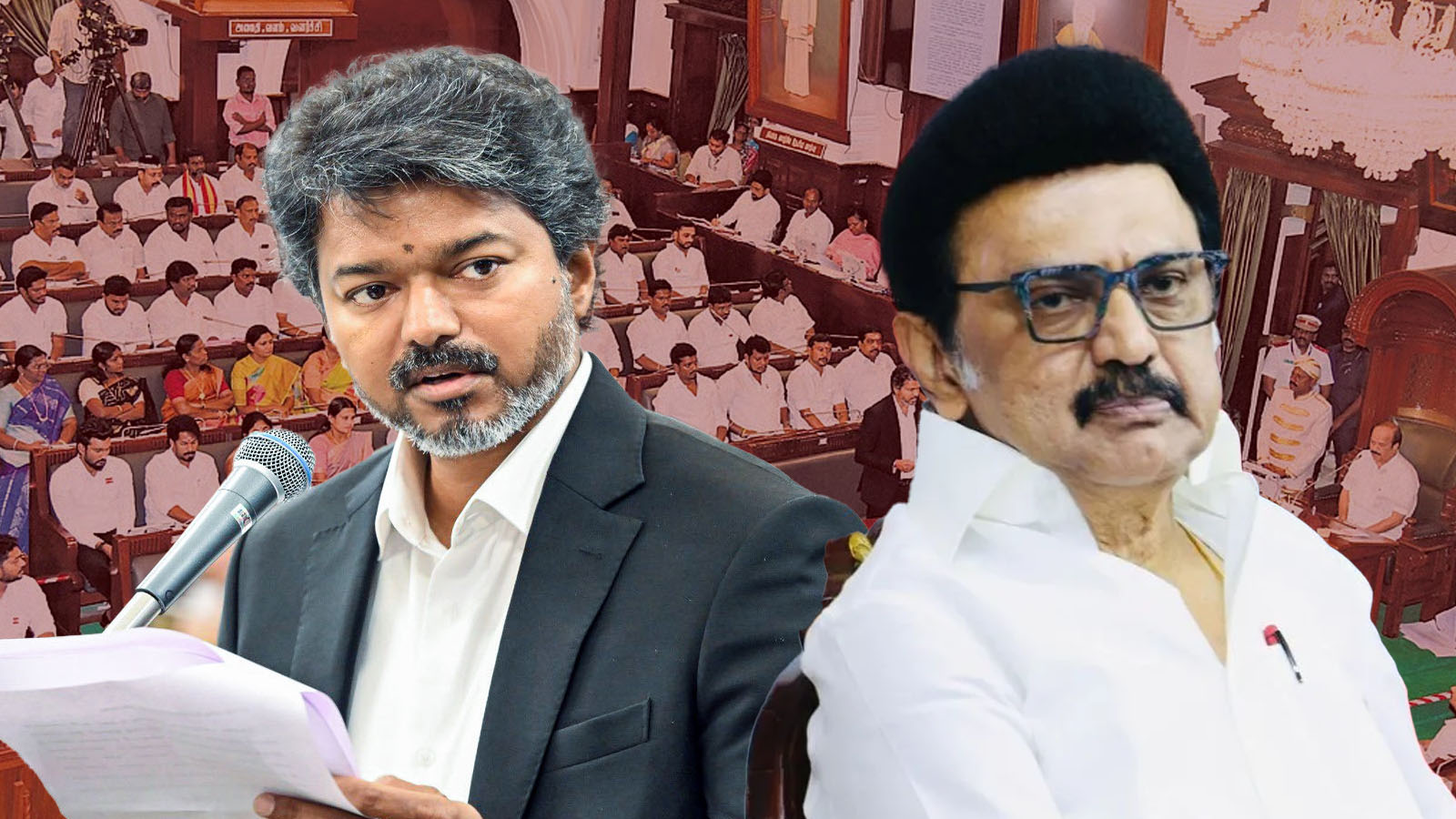
Tamil Nadu’s political landscape was sharply divided on Saturday (August 8) over the contentious issue of parliamentary delimitation, with Chief Minister Vijay’s TVK government rallying its allies for an outright rejection of any redrawing of constituencies, while the DMK stuck to its long-standing demand for a “fair” exercise that protects the state’s representation.
TVK allies unite against delimitation
In a consultation meeting convened by Chief Minister Vijay at the Kalaivanar Arangam in Chennai, 19 MPs from the TVK alliance passed a unanimous resolution declaring delimitation “unnecessary” and “an injustice” to Tamil Nadu. The gathering, held from 3 pm to 5 pm, was boycotted by 37 of the state’s 57 MPs, including those from the DMK, AIADMK, DMDK and MNM.
Also read | DMK shapes its ‘support’ for Delimitation Bill around a single point: seat freeze
The meeting was attended by 12 Congress MPs (nine from the Lok Sabha and three from the Rajya Sabha), including Tamil Nadu Congress Committee president Manickam Tagore, Vishnu Prasad, Vijay Vasanth, Jothimani, P Chidambaram and Praveen Chakravarthy. VCK leader Thol. Thirumavalavan and Ravi Kumar, MDMK’s Vaiko, IUML’s Nawaz Kani, and one MP each from the CPI and CPI(M) also participated. Congress MP Sudha was the only invited ally who stayed away.
The resolution adopted at the meeting asserted that delimitation would inflict “a great injustice on the Tamil people” and that the state’s current 39 Lok Sabha seats must be protected at all costs. TN Minister CTR Nirmal Kumar told reporters afterwards that the Centre was attempting to push the measure “through the back door”. He added that the Vijay government would move a special resolution in the Assembly opposing it, responding to the request of alliance MPs.
DMK questions TVK’s meeting
DMK leaders, however, dismissed the exercise as both redundant and politically motivated. Party parliamentary group leader Kanimozhi Karunanidhi pointed out that the DMK’s position had been clear since the previous all-party meeting: any delimitation must be based on the 1971 census figures, extended by another 30 years beyond 2026 through a constitutional amendment, and must not reduce Tamil Nadu’s share of seats below the present 7.18 per cent. “We are not against delimitation per se,” she said, “but it must not become a punishment for the social and economic progress Tamil Nadu has achieved over the last five decades.”
Kanimozhi accused the TVK government of using the meeting as a diversion. “While the entire state is agitating over the Cauvery issue and demanding an all-party meeting on the Mekedatu dam, the government remains silent. Yet it rushes to convene a meeting of MPs on delimitation that no one asked for. This is political theatre aimed at distracting the public,” she charged, challenging the chief minister to depute representatives to hand over the Assembly resolution on Mekedatu to the Union Jal Shakti Minister.
DMK spokespersons sharpened the criticism. TKS Elangovan questioned the need for the meeting when the TVK’s own stand remained unclear. “Last time every Tamil Nadu MP opposed the bill. What is Vijay’s party’s position? Without an agenda and without stating whether they stand with the state’s MPs, how can we participate?” Saravanan Annadurai went further, calling the decision to invite individual MPs to the meeting rather than political parties “anti-constitutional” and accusing the TVK of falling prey to Congress’s “duplicitous politics.”
Senior DMK MP A Raja criticised the gathering, saying it was “a farce organised by people who do not even understand what delimitation means.”
TVK govt rebuts diversion charge
The TVK government defended the meeting. TN Minister KG Arunraj rejected the diversion charge, arguing that Cauvery and delimitation were “two eyes” of the same state interest. “When the previous DMK government held a similar meeting it was fine; when we do it, it becomes wrong. On issues that affect the people there should be no party differences,” he said. Another minister, Rajmohan, described the boycott by DMK and AIADMK as “the beginning of a new friendship” between the two rivals and accused the DMK of avoiding a clear position on whether it would accept a reduction in Tamil Nadu’s seats.
Also read | Vijay govt moves resolution urging Centre for fairer devolution of taxes
PMK leader Anbumani Ramadoss, whose party has been supporting the TVK government from outside, questioned the purpose of the meeting. “When the Centre has not even reintroduced the bill, why this urgency? Is this being held at Congress’s behest to test the DMK’s stand?” Manickam Tagore retorted that Anbumani’s remarks suggested pressure from the BJP or the Prime Minister and challenged him to clarify whether he would support the Centre’s delimitation move.
Even CPI(M) state secretary P Shanmugam, whose party attended the meeting, questioned the rationale: “If an all-party meeting on Cauvery is useless, as Minister Nirmal Kumar claims, then why is one needed only on delimitation?”
Political fault lines deepen
VCK leader Thirumavalavan sought to bridge the differences, saying he believed DMK and AIADMK shared the same opposition to delimitation even if they stayed away. MDMK MP Durai Vaiko warned that some opposition parties appeared to have reached a “secret understanding” with the BJP on the issue.
The episode has highlighted divisions within Tamil Nadu’s political class just as the national debate on post-2026 delimitation intensifies. While the TVK and its Congress-led allies have drawn a hard line against delimitation, the DMK continues to insist on a constitutionally guaranteed, population-controlled formula that preserves the South’s political representation. With the Centre yet to table any revised draft, the differences in Chennai are likely to remain part of the wider debate over delimitation, federalism and inter-party coordination in the months ahead.