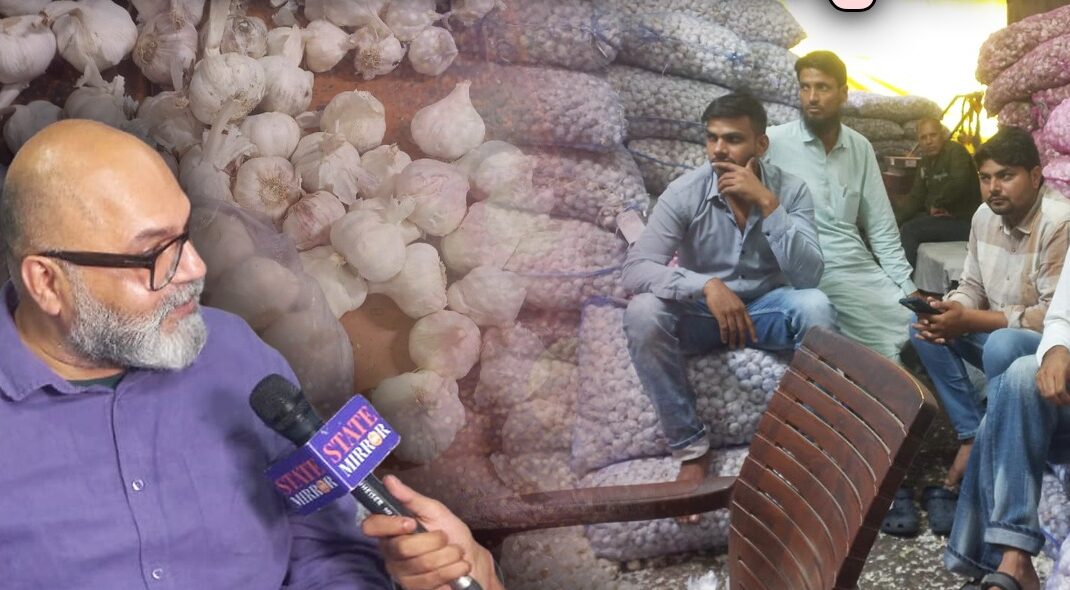
Garlic, a daily kitchen staple, hasn’t just been in the news for its taste and health benefits. The Chinese garlic being sold in the market has sparked heated debate among farmers, traders, and consumers. The question is: when India bans the import of garlic from China, how are shipments reaching different parts of the country? Furthermore, Chinese garlic is being claimed to be a potential source of cancer and many other diseases for those who consume it.
Jitendra Khurana, a major garlic trader in Delhi’s Azadpur Mandi and a leading wholesaler in the country, has long raised this issue. He claims that despite the ban, Chinese garlic is being imported into the Indian market via Nepal, Bangladesh, and the Northeast. He calls this not only a threat to farmers’ businesses, but also to the health of consumers and the country’s agricultural economy.
Khurana claims to have over 2 million farmers across the country connected to him through various networks. He is also campaigning against Chinese garlic, raising awareness among farmers about organic farming. He says it’s important for consumers to understand the exact product they are purchasing from the market.
When was Chinese garlic banned?
The biggest confusion surrounding the import of Chinese garlic concerns the date of the ban. Many sources claim the ban was imposed in 2014, but available government records indicate the ban on garlic imports from China has been in effect since September 6, 2005.
According to the government, garlic samples from China were found to contain fungi such as Embellisia alli and Urocytis cepulae, both considered harmful to plants. Imports were banned due to similar quarantine risks. Therefore, it would be inaccurate to attribute this solely to foodborne illness.
How is it in the Indian market even after the ban?
This is the most pressing question in this entire controversy. According to the official response, the Customs Department and the Directorate of Revenue Intelligence (DRI) take action to prevent the smuggling of banned goods. Despite this, reports of Chinese garlic being seized from various border areas have continued to emerge.
In 2023-24, Customs and the Directorate of Revenue Intelligence (DRI) seized 546 metric tons of Chinese garlic. In 2024-25, this amount was reported to be 507 metric tons. Khurana claims that in 2025, 5,000 trucks of Chinese garlic were smuggled into Indian markets. This does not mean that this amount reached the country, but rather that these are the consignments seized by investigating agencies.
Jitendra Khurana alleges that Chinese garlic is being imported into India using routes through Nepal, Bangladesh, and the northeastern states. During a meeting with Union Commerce Minister Piyush Goyal, he claimed that approximately 5,000 trucks of garlic were being dumped in India. This figure is his own claim, and therefore cannot be considered officially certified.
Jitendra Khurana’s family has been involved in the garlic and onion trade for four generations. His ancestors, Hukum Chand Khurana and the late Dharamveer Khurana, started the business in Azadpur Mandi. Now, his son, Sarvagya Khurana, is also involved in the same field.
Jitendra Khurana says that Union Commerce Minister Piyush Goyal was also met regarding this issue. He expressed serious concern about the dumping of Chinese garlic in Indian markets and the dangers it poses. Subsequently, investigative agencies have seized the garlic. He stated that the government will take effective steps in this direction so that the interests of Indian farmers and traders are not affected.
What is the real concern about health?
The health effects of Chinese garlic are the most talked about on social media and in the market, with claims that it contains toxic chemicals, bleach, heavy metals, fungus, and pesticides.
But caution is necessary here. Available government materials offer no evidence that consuming all Chinese garlic causes cancer, liver, or kidney disease. Therefore, it would be scientifically inaccurate to label all garlic produced in one country as carcinogenic.
If pesticide residues, heavy metals, or other contaminants exceed the permissible limits in a particular batch, they must be confirmed through laboratory testing. This is why it is important to distinguish between fact and allegation in health claims.
Then why the fear about Chinese garlic?
Khurana and others raising the issue are primarily concerned about the product entering the country illegally and whose entire supply chain is not monitored.
He questions, “If a consignment doesn’t go through the official import process, how can its quality, source, storage, and chemicals be checked?” This is why he urges consumers to focus on the source and quality of garlic, rather than on its decorative appearance.
How to identify Chinese and local garlic?
It’s not always easy to spot the difference between the two in the market, but some general pointers can help.
1. Identify by size: Chinese garlic cloves are usually large and uniformly sized. Indian garlic cloves are smaller and come in varying sizes.
2. Look at the color: Chinese garlic often has a bright white outer layer. Indian garlic can be white with a slight pink or purple tint.
3. Clove structure: Chinese garlic often has fewer and thicker cloves. Indian garlic has many smaller cloves clustered together.
4. Pay attention to the stalks: Indian garlic may have more prominent stalks and root markings. Chinese garlic usually appears cleaner and more machine-processed.
5. Aroma and Flavor: Indian garlic generally has a stronger and more pungent aroma and flavor. Chinese garlic can have a milder aroma. Furthermore, Indian garlic may exhibit a light pink, purple, or earthy natural color. It’s also not advisable to immediately assume that a product that appears extremely white and shiny is foreign, as Himachal Pradesh, Kashmir, and other mountainous regions also produce large, high-quality garlic. Therefore, judging by size alone is not a good idea.
Why are farmers suffering losses?
The biggest concern for garlic farmers is price. If low-priced, banned or illegal products enter the market, domestic production could be under pressure. However, Chinese garlic is being sold in the Indian market at a higher price, not a lower price, even though it is harmful to health.
Farmers cultivate garlic in several states, including Madhya Pradesh, Rajasthan, Uttar Pradesh, Himachal Pradesh, and Jammu and Kashmir. Traders say the influx of cheap foreign goods into the market could hinder local farmers from getting a fair price for their produce.
Jitendra Khurana argues that India has the capacity to meet its domestic needs. Therefore, the produce of our farmers should be prioritized over foreign goods coming through restricted routes.
Emphasis on organic farming
Jitendra Khurana also advocates for farmers to adopt organic farming. His advice includes using cow dung and cow urine in their fields. If farmers conduct soil testing, cultivate crops as needed, and utilize natural resources judiciously, the quality of their produce can be improved. However, the benefits of each organic farming method vary depending on the farm, soil, and crop.
What steps has the government taken so far?
The plant quarantine system, the Customs Department, and the DRI work to prevent the illegal import of Chinese garlic. The government has directed all relevant plant quarantine stations to prevent illegal imports.
Additionally, border surveillance has been increased, suspicious shipments inspected, and seizures have been initiated. FSSAI and state food safety departments have also been directed to monitor food safety complaints.
What does Jitendra Khurana claim?
Khurana says he has received threats and even been attacked for campaigning against Chinese garlic. He suspects individuals involved in the garlic trade are behind this.
Big claim made about celebrities too
Khurana says that people perceive a beautiful, large, and shiny product in the market as superior. He claims that this is why such garlic can reach even the homes of high-profile individuals and celebrities.
However, to label any individual or group as a major buyer of Chinese garlic requires separate, concrete market data. This cannot be considered a proven fact based on mere perception.
Khurana’s big allegation on China
Jitendra Khurana doesn’t believe this issue is limited to the garlic trade alone. He alleges that China is trying to influence India’s agricultural economy and compromise people’s health through such products, rather than through direct warfare.
This is his political and business analysis. Independent evidence would be needed to establish it as established fact.
What precautions should customers take while purchasing?
When buying garlic, don’t judge by its bright white color alone. It’s a better choice to buy from a local farmer, a trusted seller, or a reliable supplier.
Check the product’s color, stem, texture, smell, and taste. It’s not fair to assume every bulb that appears excessively white is foreign, and it’s also unfair to assume every large garlic is bad.
The most important thing is to rely on certified supply chains and government inspection systems to identify banned products rather than relying solely on domestic surveillance.
What is the question about Chinese garlic?
At the root of the controversy over Chinese garlic are three major questions: how do shipments reach India despite the ban, how effective is their monitoring, and how much impact does it have on Indian farmers.
Government records do show that shipments of banned Chinese garlic have been seized. However, it would be inaccurate to assume that all of its health risks are scientifically proven. Meanwhile, Jitendra Khurana claims to be continuously campaigning to raise awareness among farmers and consumers about this issue.
Why don’t online companies buy Chinese garlic?
Hemraj Sharma, another garlic trader, says that online companies like Blinkit, Swiggy Instamart, and BigBasket cannot knowingly buy and sell banned Chinese garlic. Garlic imports from China have been banned in India since September 6, 2005. Such companies must comply with food safety and legal supply chain regulations. Finding banned or illegally imported garlic in their supply chain could lead to legal action, confiscation, and licensing risks.
Additionally, companies typically procure from authorized Indian farmers, mandis, and licensed suppliers to ensure product traceability and quality.