

The race will benefit the country economically in the long term, as higher tourist numbers and greater global exposure would attract more investment to the country and encourage the organization of other world-class events, Deputy Prime Minister Ahmad Zahid Hamidi said Monday, as reported by local newspaper Daily News.
“The substantial costs involved are being borne by Bahrain. The economic impact goes beyond tourist arrivals, as the event will receive extensive global media coverage and reach billions of viewers worldwide.”
Formula 1 and the Fédération Internationale de l’Automobile (FIA) announced on Sunday that Malaysia will host the Bahrain GP at the Sepang International Circuit (SIC) from Oct. 2-4, 2026, subject to final agreements and official approval, including sign-off by the World Motor Sport Council.
The race will take place between the Azerbaijan and Singapore Grands Prix. It will serve as a one-off replacement for the Bahrain GP which has been suspended due to regional conflicts.
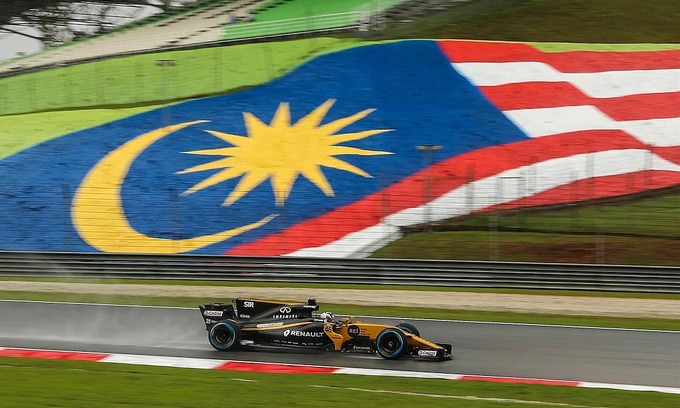
A car is seen at the 2017 Formula 1 Petronas Malaysia Grand Prix. Photo via Formula 1 |
Analysts find Malaysia a reasonable host country for the race, given the fact that the SIC has been chosen the venue for F1 a total of 19 times between 1999 and 2017.
Former Sepang International Circuit chief executive Datuk Razlan Razali said the one-off race made strategic sense.
“I think it makes sense for Malaysia to be the chosen track. If you look at the commentary on the situation with other alternative tracks, including Portimao, at the end of the day, Malaysia is the most cost-effective circuit,” he said, as cited by Malaysia state-owned newspaper Named.
“This is good for Malaysia regardless of whether it is the Bahrain GP or whoever is organising it, all Malaysians can enjoy this one-off event.”
Razlan said staging the Bahrain GP in Malaysia on relatively short notice was unlikely to create major operational challenges, noting that the SIC would require no significant modifications for Formula 1, while any infrastructure upgrades would depend on Bahrain.
“The SIC is managed and operated to the highest standards at all times, especially our track […] The FIA would need to conduct an inspection first, as we are not currently homologated for F1 but I don’t see any major technical issues.”
Asked whether the event could pave the way for Formula 1’s permanent return to Malaysia, Razlan said the prospect remained “very remote” because of the high costs of hosting the championship, unless Prime Minister Datuk Seri Anwar Ibrahim decides to pursue the idea during the race weekend.
He said the race would likely support domestic tourism, although the limited lead time before the event could reduce the number of international visitors, as Formula 1 fans typically plan their trips at least six months in advance.
“Nevertheless, I’m also confident that diehard F1 fans from all over the world who crave the race at the SIC will make an effort to come. So how much impact we will have, we will only know when the time comes,” he said.
Razlan added that the race would create opportunities for local suppliers and food and beverage businesses, expressing confidence that Malaysians would attend despite ticket prices.
“It is Bahrain’s job to sell, advertise and promote. From what I gather, this is subject to the final details.
“There is not much that Malaysia and the SIC have to do; I think it is a straightforward rent-the-track. Of course, it makes sense for them to appoint local contractors and suppliers if needed, as well as the local workforce for the weekend,” Razlan said.
Meanwhile, Motorsports Association of Malaysia president Tan Sri Mokhzani Mahathir welcomed Formula 1’s return to Sepang, albeit under the Bahrain GP banner, saying it would be especially meaningful for younger motorsport fans who missed the championship after it left Malaysia following the 2017 season.
Mokhzani said the hospitality, tourism, airline and F&B sectors are expected to benefit from the event, noting that foreign visitors typically account for around 30% of spectators at Formula 1 and MotoGP races.
He also said Malaysia stands to gain from hosting the race one week before the Singapore Grand Prix.
“A lot of people will stay on in this part of the world, benefiting both countries. I do believe that most will be in Malaysia because it’s less expensive than across the border,” Mokhzani told Named.
He added that Malaysia’s financial exposure would be substantially lower because Bahrain would bear the costs.
“Well, you can imagine if somebody else is paying for it, our return on investment, whatever that might be, is going to be sky high,” he said.
Mokhzani said Malaysia has the infrastructure and experience to stage an event of Formula 1’s scale and does not expect the compressed preparation period to create significant logistical issues.
“I don’t think it is a problem at all. Malaysia is always ready to host international-class events of this size. We have five-star hotels everywhere in Kuala Lumpur, Putrajaya and around that area. So hosting this event is not going to be a problem,” he said.
Former Formula 1 driver Alex Yoong said the championship’s return to Sepang should be viewed as more than a one-off event, citing its potential to strengthen Malaysia’s broader motorsport ecosystem.
While acknowledging the tourism and business opportunities the race could generate, he said it should also drive greater investment in grassroots motorsport and driver development.
“We have a world-class track, and, as someone who raced in F1 and has spent much of my career developing motorsport in Malaysia and the region, it would be great to see a Southeast Asian circuit back on the F1 calendar,” he said, as quoted by Named.
Yoong added that he hopes the event will revive support across Malaysia’s motorsport ecosystem, from sim racing and karting to professional championships, while encouraging greater investment in developing local talent.
Comments are closed.