
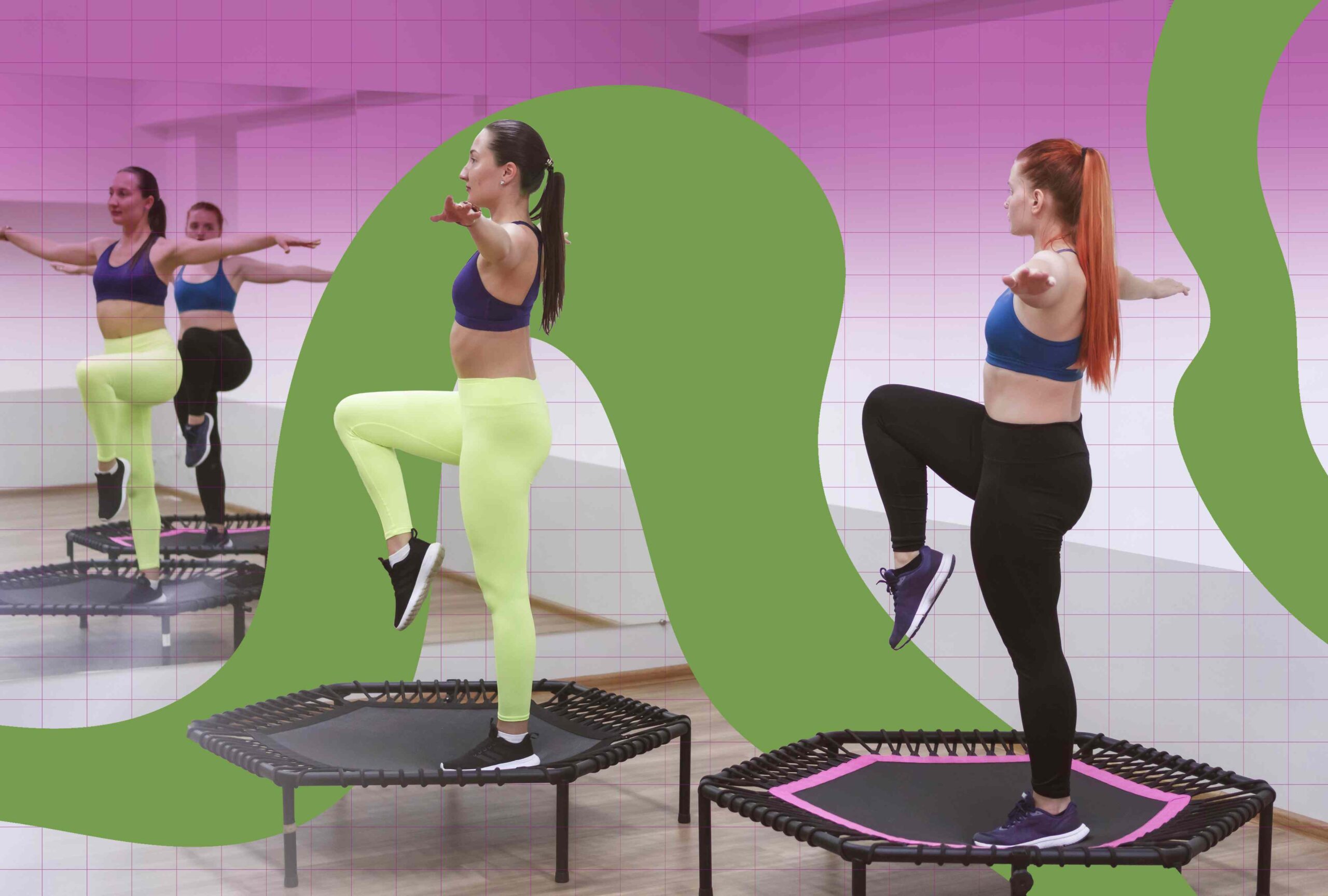

Here’s how my “silly little workout” helped me find my joy—and run a mile in under 9 minutes.
Reviewed by Dietitian Katey Davidson, M.Sc.FN, RD, CPT
Key Points
- Rebounding improves balance, coordination and cardiovascular fitness.
- Its low-impact design is gentler on joints than many cardio workouts.
- The best exercise routine is one you enjoy and want to keep doing.
If you’d told me a few years ago that I’d be bouncing on a mini trampoline and calling it exercise, I would have laughed. It looked silly to me, and I wouldn’t have considered it a “real workout.” You see, I was someone who took exercise seriously. I started weightlifting more than a decade ago and became a personal trainer shortly after. Strength training wasn’t just my routine, it was my identity.
So it came as a surprise—even to me—when I signed up for a rebounding class in early 2025. I half expected to feel ridiculous, but within minutes of stepping onto the mini trampoline, I was grinning. The class was much harder than I anticipated, challenging my coordination, balance and cardiovascular endurance all at once. That combination of challenge and fun kept me coming back and made me realize that rebounding isn’t silly at all.
In fact, I’ve become an advocate for rebounding because of the surprising benefits I experienced. Here’s why it might be something you want to try, too.
What Is Rebounding?
Rebounding is a form of exercise performed on a mini trampoline. Depending on how you approach it, it can be a gentle way to get moving or a genuinely challenging workout that tests your balance, coordination and cardiovascular fitness. The springy surface absorbs much of the force that would otherwise land on your joints, setting it apart from higher-impact cardio, such as running.
“It’s an introduction to low-impact activities so that patients can return to running and jumping,” says Sydney Darrah, PT, D.P.T. “Rebounding is also an option as a higher-level balance activity on an unstable surface beyond foam.”
For some people, it’s a stepping stone back to more intense movement. For others, it’s a way to push their balance further than solid ground allows.
My Personal Experience
For me, rebounding ended up being about more than exercise. I’d been taking life too seriously for a long time—I just didn’t know it. Between work and everything else, movement had become one more thing to manage, another item to check off my list. I was disciplined and consistent, and from the outside, it probably looked like I had it all figured out. But somewhere along the way, exercise had stopped being something I enjoyed and started being something I simply did. I didn’t realize how much joy I’d lost until I found it again on a mini trampoline.
I noticed the rebounding class on my gym’s schedule, alongside other classes, such as Pilates, yoga, cycling and boxing. I’d scroll past it and feel a little silly for even considering it. Me? The weight lifter? Bouncing on a trampoline? Hardly.
But I kept noticing something that finally got my attention: The class was always full, with a waiting list every single time. If this many people kept showing up for it, I figured there had to be something to it. So I finally added my name and waited for a spot to open up.
When it came time for class, I was nervous in a way I hadn’t been about a workout in years. Then the music started. It was loud and thumping—the kind that makes it impossible to stand still. Something within me shifted, and I stopped worrying about whether I looked ridiculous and started moving. It felt less like a workout and more like dancing. I was clumsy and completely out of my element, but I was smiling the entire time. For the first time in longer than I’d like to admit, exercise felt like play. I’d found the joy again, and I hadn’t even known it was missing.
I signed up for the next week’s class, and then the one after that. Before I knew it, rebounding quickly became the workout I looked forward to most. That’s not to say I was any good at it—early on, I could barely keep up. The routines are choreographed, so it felt a lot like learning a dance, and I spent those first several weeks a step behind, watching everyone else and trying to catch up.
But I kept showing up, and after about six weeks, something clicked. The moves started to feel natural. I wasn’t just keeping up anymore—I was anticipating what came next. Here’s the interesting thing: that mental effort may come with its own payoff. One study of women found that six weeks of rebound exercise progressively improved cognition, likely because constantly adjusting to the movement keeps the brain engaged.
There’s another reason that coordination took time to build: Rebounding challenges your balance in a way that workouts on stable ground don’t. “The trampoline is an unstable surface with some give that forces your stabilizers and your hip muscles to be engaged more continuously,” says Because Wu, PT, DPT. That constant, subtle adjustment is part of what makes rebounding as much of a balance workout as a cardio workout. In a 2019 study of older women with low bone density, a 12-week mini-trampoline program significantly improved balance, functional mobility and gait while reducing participants’ fear of falling.
A year later, I’m still rebounding. I loved my weekly class so much that I bought a mini trampoline for my home, and now I do my own routines on the days I can’t make it in. Somewhere along the way, rebounding also became my most consistent form of cardio—something I’d struggled to stick with for years. I’ve never been a fan of the monotony of the treadmill, and while I often walk outside, it’s mostly for leisure and mental clarity rather than a true cardio challenge.
Rebounding gave me the more intense workout I’d been missing, but in a form I genuinely enjoyed. I worked up to about 45 minutes twice a week, and I started to notice the difference outside of class, too. After three months, I ran a mile in under nine minutes. I hadn’t been training to run at all, which told me the cardiovascular fitness I was building on the trampoline was carrying over into other areas of my life.
Research is starting to back this up. For instance, in a small 12-week study of postmenopausal women, a mini-trampoline program improved aerobic fitness and increased bone density. Other research suggests that rebounding may improve quality of life, vertical jump performance, overall strength and cardiorespiratory fitness. It’s a reminder that low impact doesn’t have to mean low intensity.
Tips for Getting Started
Rebounding is beginner-friendly, but a few fundamentals will help you feel steady and avoid injury.
- Start on Stable Footing. If balance is a concern, choose a rebounder with a support bar and keep both feet on the mat. Wu recommends beginning with a “health bounce”—a gentle push into the mat without your feet leaving the surface. “Feet should be hip-width apart, knees slightly bent and core should be engaged,” she says. Those fundamentals help you stay balanced and protect your back.
- Ease into It. Wu suggests starting with 5 to 10 minutes, two to three times a week, then gradually working up to 30 minutes three to five times a week. Letting your body adapt is part of the process.
- Watch Your Form, Not Just Your Intensity. Because rebounding feels easy on the joints, it’s tempting to push harder before you’re ready. Beginners most often forget to soften their knees, engage their core and keep their feet hip-width apart—small habits that make a big difference.
- Know When to Hold Back. Rebounding isn’t right for everyone. Wu advises those with significant balance issues, unstable joints (especially in the spine), severe osteoporosis or frequent dizziness to avoid it. If you have pelvic floor concerns, start gently and check in with a professional if you notice any leaking or a feeling of heaviness.
- Start at Home. You don’t need a studio to bounce. A quality rebounder is compact, budget-friendly and easy to use at home, and there are plenty of free routines on YouTube if you’d rather follow along. Paid streaming memberships offer a wider library of guided classes for every level.
My Overall Take
For me, rebounding turned out to be so much more than the silly workout I once thought it was. It’s a form of cardio workout that challenges your balance and coordination while remaining gentle on your joints. But the benefit that kept me coming back wasn’t something I could measure—it was the joy.
Rebounding reminded me that movement is allowed to be fun—and that maybe we could all use a little more silliness and a little less taking life so seriously. The lesson I learned? The most effective workout isn’t always the hardest one. Often, it’s simply the one that makes you want to come back tomorrow.

Comments are closed.