
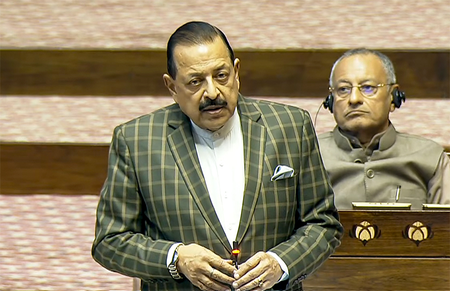

In a decisive move to restore faith in India’s public examination system, Union Minister Dr. Jitendra Singh on Monday introduced the Public Examinations (Prevention of Unfair Means) Amendment Bill, 2026 in the Lok Sabha.
The proposed law is a sharp upgrade to the landmark 2024 Act, designed to deliver faster investigations, quicker trials and significantly harsher punishments for those who leak question papers, organise cheating rackets or resort to unfair means.
“Recent incidents of question paper leakages and organised malpractices have shaken the confidence of millions of aspirants,” the Ministry of Personnel, Public Grievances and Pensions noted. The new Bill aims to change that by turning the legal screws tighter than ever before.
Under the amendments, anyone caught using unfair means will face a minimum of five years in prison (extendable to ten years) and a maximum fine of ₹50 lakh — up from the earlier three-to-five years and ₹10 lakh.
Service providers found guilty will see their maximum fine jump from ₹1 crore to ₹5 crore and face an eight-year ban from conducting any public exam. Managerial staff of such firms will also attract five-to-ten years’ imprisonment and fines up to ₹5 crore.
For organised examination crimes — the most serious category — the minimum jail term rises to seven years (up to ten years) and the maximum fine soars to ₹10 crore.
Speed is the other big focus. A new Section 12A mandates that investigations must be completed within two months. Courts of Session will be designated as Special Fast Track Courts to conduct day-to-day trials, which must finish within three months of the charge sheet. Special Public Prosecutors will be appointed for these courts. Appeals to the High Court will have to be filed within 30 days and, as far as possible, disposed of within three months (Section 12B).
The Central Government will also have the power to hand over any case to a dedicated Special Task Force.
The original Public Examinations (Prevention of Unfair Means) Act, 2024 — which covers exams conducted by UPSC, SSC, Railway Recruitment Boards, IBPS, National Testing Agency and other central bodies — already made all offences cognizable, non-bailable and non-compoundable. The 2026 amendments build on that foundation to make deterrence faster and stronger.
By combining iron-fisted penalties with a stopwatch on justice, the government hopes to protect the dreams of honest, hardworking candidates and rebuild public trust in one of the world’s largest and most competitive examination systems.
Comments are closed.