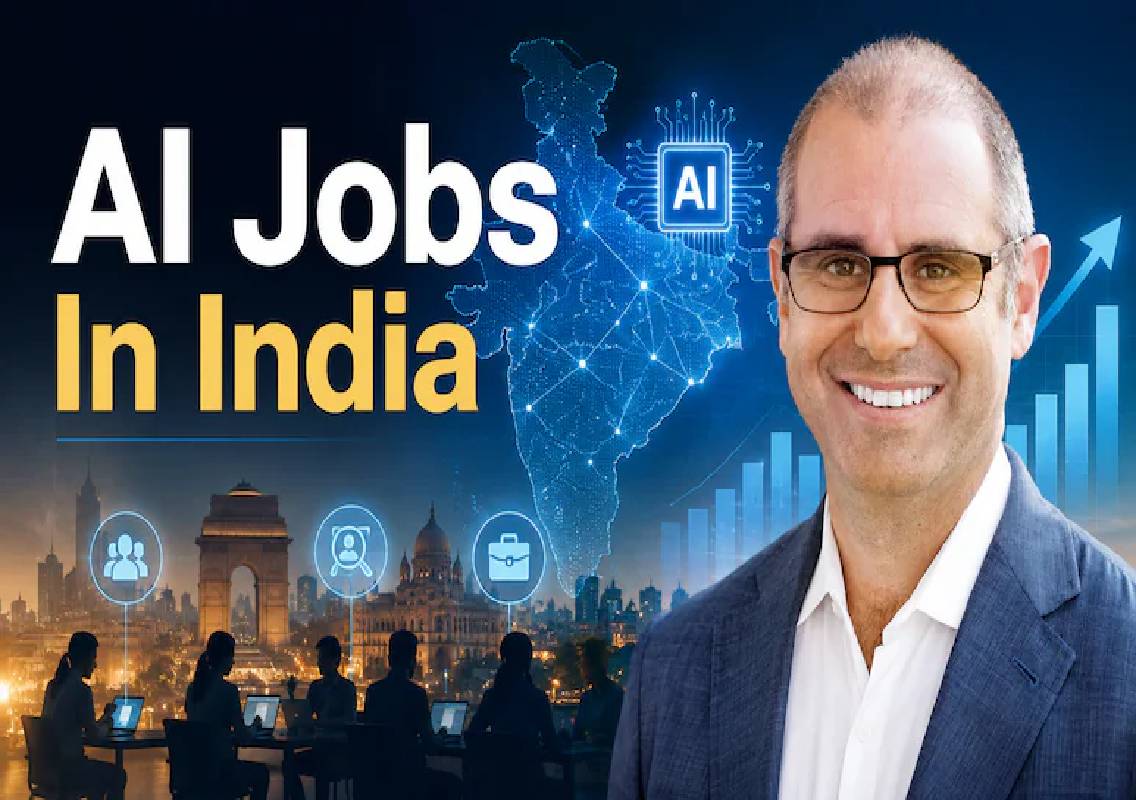
New Delhi: India’s artificial intelligence job market is witnessing strong growth, with AI engineering roles increasing 51% year-on-year, according to LinkedIn CEO Dan Shapero. The development comes even as global hiring remains below pre-pandemic levels, with Shapero saying higher interest rates, rather than artificial intelligence, appear to be a bigger factor behind the broader slowdown in recruitment.
Shapero made the comments during his first visit to India as LinkedIn CEO, in an interview with The Economic Times. His remarks underline the changing nature of India’s technology employment market, where demand is increasingly shifting towards artificial intelligence, engineering, data and other specialised skills.
While concerns remain that AI could replace human workers, LinkedIn’s data suggests that the technology is also creating new employment opportunities. AI is not simply eliminating existing roles; it is changing the skills companies require and generating demand for professionals capable of developing, deploying and managing AI-based systems.
AI engineering jobs see sharp growth
According to Shapero, AI engineering jobs in India are growing 51% annually. The sharp increase reflects the growing adoption of artificial intelligence across businesses and the need for technical professionals who can build and operate AI systems.
AI engineering covers a wide range of work, including machine learning, model development, AI infrastructure, data processing and the integration of AI into business applications.
The growth also reflects India’s changing position in the global technology industry. The country has traditionally been a major destination for software development, IT services and business-process operations. Increasingly, however, companies are using Indian teams for higher-value engineering, research and development and AI-related work.
LinkedIn’s labour-market data has previously shown strong growth in demand for AI engineering skills in India. A LinkedIn economic graph report published earlier this year recorded a 54% year-on-year increase in job postings requiring AI engineering skills in India in January 2026.
The latest 51% figure cited by Shapero further highlights the strength of the trend.
Global hiring slowdown not mainly caused by AI
One of Shapero’s key observations was that AI should not be blamed for the broader global slowdown in recruitment.
Global hiring remains slower than it was before the pandemic, but LinkedIn’s data does not indicate that artificial intelligence is the primary reason.
Instead, Shapero pointed to higher interest rates as a more significant factor affecting hiring decisions.
Higher borrowing costs can make companies more cautious about investment and expansion. Businesses may delay recruitment, reduce discretionary spending or prioritise productivity improvements when economic conditions remain uncertain.
This distinction is important because the rapid development of AI has generated widespread concerns about job losses.
While automation is changing many occupations, the data suggests that the employment impact is more complicated than a simple replacement of humans by machines.
AI is creating new roles
The expansion of AI is generating demand for professionals with specialised technical skills.
Companies need engineers to develop AI applications, maintain infrastructure, work with data and integrate models into existing products.
AI-related roles can also emerge in areas that did not traditionally have strong technology requirements.
Financial services, healthcare, manufacturing, retail and logistics companies are increasingly incorporating AI into their operations. This creates demand for professionals who understand both technology and specific business functions.
The result is a labour market where traditional job titles may remain unchanged while the skills required to perform those jobs evolve.
Skills required for jobs are changing
Shapero said the skills required for jobs in India are changing by around 12% every year.
This means workers may need to continuously update their knowledge even if their job title does not change.
For example, a software engineer may increasingly be expected to work with AI-assisted coding tools. A marketing professional may need to understand generative AI. A financial analyst may be expected to use AI-powered research and data-analysis tools.
The transformation is therefore not limited to people applying for specifically labelled “AI jobs”.
AI skills are increasingly becoming relevant across a much wider range of professions.
India’s share of US overseas R&D hiring rises
Another significant trend highlighted by Shapero is India’s growing role in overseas research and development.
According to data cited in his interview, India’s share of overseas R&D hiring by US companies increased from 27% in 2019 to 41% in 2025.
The increase suggests that India is becoming increasingly important to global companies looking for engineering and research talent.
For decades, India’s technology sector was strongly associated with IT services and outsourcing.
The growing R&D share indicates a broader shift towards product development, advanced engineering and innovation.
This could create opportunities for Indian professionals working in areas such as AI, cloud computing, cybersecurity, software architecture and advanced data engineering.
Data centre jobs have also expanded
AI growth is also creating demand beyond software engineering.
Shapero said hiring for data centre-related jobs has tripled over the past decade.
Data centres are a critical part of the AI ecosystem because sophisticated AI models require significant computing power and storage.
As companies deploy more AI applications, demand for computing infrastructure also rises.
This creates employment opportunities in areas including data centre engineering, operations, networking, power management, cooling systems and infrastructure security.
LinkedIn’s research on the global data centre workforce also found strong employment growth in the sector, with at least 600,000 new jobs created globally in 2025.
The growth demonstrates that AI’s employment impact extends beyond people directly building AI models.
India sees rise in entrepreneurship
Shapero also highlighted an increase in entrepreneurship on LinkedIn.
The number of LinkedIn members identifying themselves as founders has more than doubled, rising 104% year-on-year, according to data cited in the interview.
The rise suggests that India’s technology ecosystem is not only generating employment through established companies but also encouraging individuals to build businesses.
AI tools can lower some of the costs associated with starting a company.
Small teams can use AI for tasks such as software development, customer support, content creation, research and administrative work.
This could allow entrepreneurs to build products with fewer initial employees than would have been necessary in the past.
Small businesses are hiring more
The AI-driven shift is also visible among smaller companies.
Shapero said hiring from small businesses on LinkedIn has increased by more than 250% over the past few years.
AI can help smaller businesses operate with limited resources by automating repetitive tasks and improving productivity.
At the same time, access to AI tools can allow smaller companies to compete for talent and build technology products without the large workforce traditionally associated with technology businesses.
The trend could have implications for India’s startup ecosystem, particularly as AI tools become more affordable and accessible.
AI could make smaller teams more productive
According to Shapero, artificial intelligence can allow individuals and smaller businesses to accomplish more with fewer resources.
This does not necessarily mean fewer jobs.
Instead, it could mean that the nature of jobs changes.
A small team equipped with AI tools may be capable of producing the output that previously required a larger workforce. At the same time, companies may use the productivity gains to expand into new markets, develop additional products or create new functions.
The ultimate employment impact will therefore depend on how businesses use the productivity gains created by AI.
LinkedIn is using AI in recruitment
AI is also transforming the recruitment industry itself.
LinkedIn has expanded its use of AI agents through products such as Hiring Assistant, which is designed to reduce administrative work for recruiters.
The technology can help recruiters identify suitable candidates and manage parts of the hiring process, allowing them to spend more time on higher-value activities.
Shapero said LinkedIn’s Talent Solutions agentic products have crossed a $450 million annual revenue run rate and continue to grow rapidly.
The development shows how AI is changing not only the jobs companies are hiring for but also the process through which those employees are recruited.
Recruiters may focus more on strategic work
Traditional recruitment involves considerable administrative activity.
Recruiters may spend significant amounts of time reviewing applications, searching for candidates, scheduling interviews and managing communication.
AI tools can automate parts of these processes.
This could allow recruitment professionals to focus more on understanding business requirements, assessing candidates and improving the overall hiring experience.
However, human judgement remains important, particularly when evaluating leadership qualities, cultural fit and complex professional experience.
AI may therefore become an assistant to recruiters rather than simply replacing them.
The biggest risk is failing to adapt
Shapero’s warning for workers is significant.
He said the biggest risk for employees and companies is not AI itself but failing to adapt to the changes it is bringing.
The observation reflects a growing shift towards skills-based employment.
Workers who learn to use AI tools effectively could become more valuable because they can combine human expertise with machine-assisted productivity.
On the other hand, professionals who refuse to update their skills could face greater competition as companies adopt new technologies.
What Indian workers need to focus on
The changing job market places greater emphasis on continuous learning.
Professionals do not necessarily need to become AI researchers.
Instead, they may benefit from understanding how AI applies to their particular field.
For engineers, this could involve machine learning, AI infrastructure, data engineering or AI-assisted development.
For non-technical professionals, it could mean learning how to use generative AI tools for research, analysis, communication or workflow automation.
The ability to work alongside AI could become an important part of employability.
AI skills are spreading beyond major technology hubs
The growth of AI employment is also occurring alongside the expansion of India’s technology ecosystem beyond its largest cities.
Bengaluru, Hyderabad, Pune, Chennai and other established technology centres continue to attract major engineering investments.
At the same time, AI-related opportunities are increasingly appearing in smaller cities as remote work, digital infrastructure and distributed teams make it easier for companies to access talent outside traditional technology hubs.
This could eventually broaden the economic benefits of India’s AI expansion.
India’s IT hiring market is showing signs of recovery
The AI hiring boom comes as India’s broader IT employment market shows signs of improvement.
The Naukri JobSpeak Index reported that IT hiring in India increased 6% year-on-year in July 2026 after declining 3% in June. Overall white-collar hiring also increased 5% year-on-year during the month.
The data suggests that the technology employment market is gradually recovering after a period of caution.
However, the recovery is not necessarily a return to the broad-based hiring patterns seen in previous years.
Companies are becoming more selective and increasingly prioritising specialised skills.
AI could change the meaning of an engineering job
The rapid expansion of AI engineering positions could also change what companies expect from engineers.
An engineer may increasingly need to understand not only programming but also AI models, cloud infrastructure, data pipelines, model evaluation and security.
This could result in more multidisciplinary roles.
Professionals who combine technical expertise with an understanding of business problems may have an advantage because they can translate AI capabilities into practical products and services.
The shift is already visible as companies move from experimenting with AI to deploying it in real-world operations.
India’s opportunity in the global AI economy
The strong growth in AI engineering hiring presents a major opportunity for India.
The country already has a large technology workforce and a substantial base of engineering talent.
If Indian professionals continue to develop advanced AI capabilities, the country could attract more global R&D operations and higher-value technology projects.
The increase in India’s share of US overseas R&D hiring suggests that this transition is already underway.
The challenge will be ensuring that the education and training ecosystem keeps pace with rapidly changing industry requirements.
Education and reskilling will become crucial
The speed at which skills are changing means traditional education alone may not be enough.
Universities and technical institutions will need to update curricula to reflect developments in AI, cloud computing, cybersecurity and data engineering.
At the same time, working professionals may need to invest in continuous learning throughout their careers.
Companies also have a role to play by providing reskilling and upskilling opportunities.
The future workforce is likely to include people who have changed their skill sets multiple times during their careers.
AI does not necessarily mean mass unemployment
The latest LinkedIn data offers a more nuanced picture of AI’s effect on employment.
AI can automate certain tasks, but new technology can simultaneously create new roles.
The emergence of AI engineering jobs, data centre employment and AI-related recruitment services demonstrates how new categories of work can develop alongside automation.
This does not eliminate the risk of displacement for workers whose tasks can be automated.
Instead, it suggests that the labour market may undergo a significant transition.
The key question may therefore be whether workers can move from declining tasks and roles into emerging areas of demand.
What companies are looking for
As AI adoption increases, companies are likely to value professionals who can combine technical knowledge with adaptability.
Programming remains important, but employers may increasingly look for people who understand how to apply technology to business problems.
Communication, analytical thinking, domain expertise and the ability to work with AI tools could become increasingly valuable.
This could also change hiring practices.
Rather than focusing exclusively on academic qualifications or years of experience, companies may increasingly evaluate candidates based on demonstrated skills.
The road ahead for India’s job market
India’s employment landscape is likely to remain closely tied to the pace of AI adoption.
If businesses continue investing in AI, demand for engineers, data specialists and infrastructure professionals could remain strong.
At the same time, traditional roles will continue to evolve as AI becomes integrated into everyday workflows.
The result could be a job market with fewer purely routine roles and greater demand for professionals who can manage technology, solve complex problems and make decisions.
Conclusion
India’s AI hiring market is showing strong momentum, with LinkedIn CEO Dan Shapero saying AI engineering jobs are growing 51% year-on-year. He also said India’s skills requirements are changing by around 12% annually, highlighting how quickly the country’s employment landscape is evolving.
The growth comes alongside a broader shift in India’s role in the global technology ecosystem. India’s share of overseas R&D hiring by US companies rose from 27% in 2019 to 41% in 2025, while data centre-related hiring has tripled over the past decade.
At the same time, the global hiring slowdown does not appear to be primarily driven by AI. Shapero pointed instead to higher interest rates as a more significant factor affecting recruitment.
For Indian professionals, the message is clear: AI is not simply changing which jobs exist; it is changing the skills needed to perform many existing jobs. Workers and companies that adapt to this shift could benefit from the growing demand, while those that fail to update their skills may face increasing pressure in an increasingly competitive employment market.