
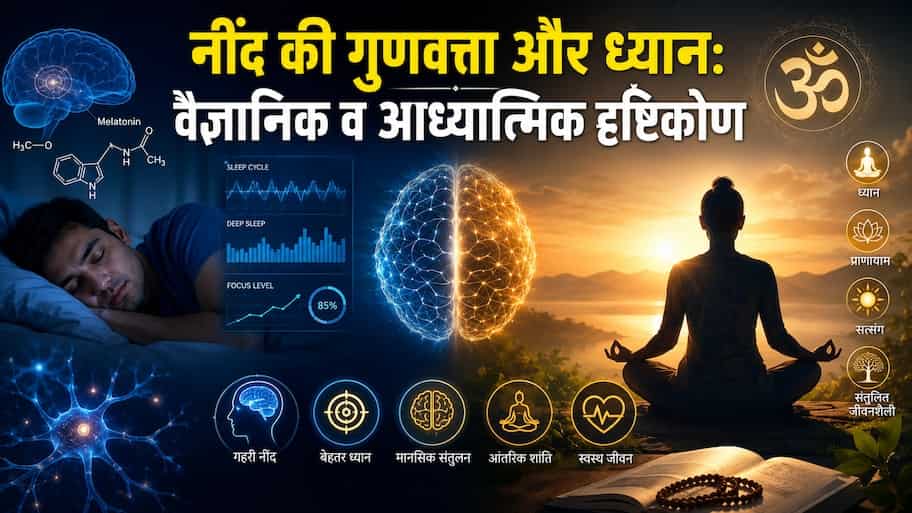
Not medicine, understand this ‘scientific mathematics’ of sleep and meditation: Know the 4 states of consciousness and 3 surefire rules to get rid of insomnia.

The most precious and beautiful gift that nature has given to humans is sleep. Sleep is not only a means of removing physical fatigue of the day, but it is a huge dimension of giving new life to our consciousness and life energy. In today’s busy life, getting a calm and peaceful sleep seems to be no less than a big challenge for people suffering from mental stress, anxiety and depression. To overcome this problem, we have to deeply understand the scientific and spiritual aspects of sleep and meditation. When we reach a state of ‘mindful relaxation’, it refreshes us from within and leads to deep sleep. There are mainly four sources of energy in our life – food, sleep, breathing and surrounding environment. Of these, sleep is the strongest medium to recharge our energy.
4 States of Consciousness and the Amazing Spiritual Secret of ‘Turiya’
Sleep is not only a source of energy but also a very important state of our consciousness. According to Indian philosophy, our consciousness passes through 4 states every day—Jagran (waking), Swapna (dreaming), Sushupti (deep sleep) and Turiya. We are completely aware of the first two states i.e. waking and dreaming. But in the state of deep sleep, our awareness ends. If a person can remain alert from within even during deep sleep, he experiences the fourth state of consciousness i.e. ‘Turiya’. Turiya is the state where complete relaxation and complete alertness exist simultaneously. This divine state can be achieved only by regular practice of meditation.
The 3 levels of our body: the science of the gross, subtle and ‘causal body’
To understand the root cause of insomnia and fatigue even after sleep, it is important to know the 3 levels of the body mentioned in the scriptures:
Physical Body: This is the body we can see and touch. It is made up of five elements and rests on blood, flesh, bone, marrow etc.
Subtle Body: It is made up of thoughts, feelings and imaginations. When we are dreaming, our subtle body is active. For this reason, in dreams we can see colors, smell fragrances and feel touch without using our physical senses.
Causal Body: This is the third and deepest level of our body, which is simply a form of pure energy. When we are in deep sleep (Sushupti), we are connected to our causal body. This is why the body is the main source of our entire energy, enthusiasm and vitality. This is the reason why after waking up from deep sleep we feel completely energetic.
Why does fatigue persist even after adequate sleep?
Often people complain that even after sleeping for 8 hours, they feel lethargic and tired. The reason for this is the hidden hyper-activity in our subtle body. The stress, anxiety, and overthinking of the day create chaos in our subtle bodies, causing most of the sleep time to be spent in nightmares or persistent dreams instead of going into deep relaxation. In such a situation, we are not able to come in contact with the ‘causal body’ and the body does not get the required energy. Meditation proves to be the most effective way to eliminate this mental burden and confusion of dreams.
What is meditation? Know the 3 golden rules of meditation
In simple words, meditation is ‘conscious relaxation’. Meditation does not mean closing your eyes and forcibly thinking about something or achieving something, but connecting with your ‘causal body’ i.e. the ultimate emptiness which is an inexhaustible storehouse of energy. There are 3 basic rules for meditating:
First rule – Effortlessness: Doing any work requires effort, but rest does not require any effort. There is no force or effort in meditation, one just has to become calm.
Second rule – Desirelessness: While sitting in meditation, there should be a feeling in the mind that ‘I don’t want anything at this time’.
Third Rule – Nothingness: To accept that ‘I am nothing at this moment’. Neither rich, nor poor, nor knowledgeable, nor ignorant. When you adopt these three rules, meditation starts happening automatically.
The Neuroscience of Sleep: Melatonin, Brain Waves, and Relaxation Mode
Even from a scientific point of view, meditation is very helpful in improving our sleep quality. Meditation increases the secretion of a hormone called ‘melatonin’ in the body, which controls our sleep cycle. Additionally, meditation activates ‘Alpha’ and ‘Theta’ waves in the brain, which leads the mind into deep relaxation. Through meditation, the stress-inducing hormone ‘Cortisol’ is reduced and the body’s ‘Parasympathetic Nervous System’ becomes active, due to which the mind becomes calm and one gets deep sleep easily.
Easy and surefire ways to get rid of the problem of insomnia
If you also keep tossing and turning till late at night or are a victim of insomnia, then ‘Yoga Nidra’ and ‘Guided Meditation’ can prove to be a boon for you.
Meditation before sleeping at night: Meditation done just 15 to 20 minutes before sleeping calms your nervous system and stops the whirlwind of thoughts going on in the mind.
Bhramari Pranayama and breathing exercises: When the level of ‘life force’ increases in the body through Pranayama, negative thoughts automatically go away. Bhramari Pranayama helps in eliminating insomnia by relaxing the nerves of the brain.
Meditation cleans the garbage accumulated throughout the day in the subconscious mind. Regular meditation practice not only helps you fall asleep faster and deeper, but also wakes you up the next morning with new energy, enthusiasm and freshness.

Comments are closed.