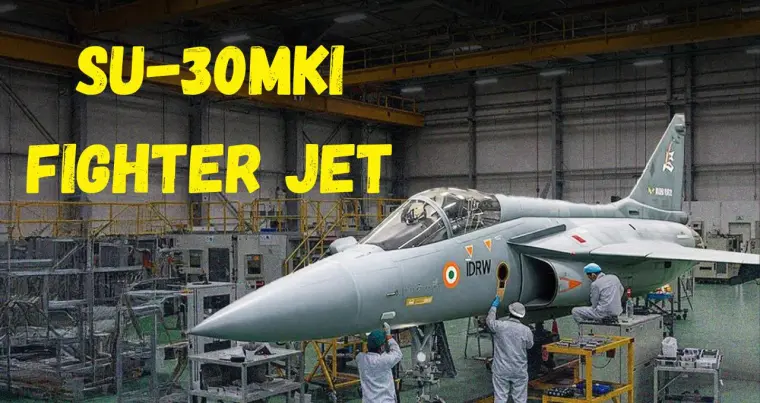
Hindustan Aeronautics Limited (HAL) is set to restart production of Su-30MKI fighter aircraft at its Nashik plant. The public sector company plans to hand over the first new fighter jet to the Indian Air Force by the next financial year.
Su-30MKI Fighter Jet: India is taking another important step towards strengthening its air power and defense production capacity. Hindustan Aeronautics Limited (HAL) is preparing to resume production of Su-30MKI fighter aircraft at its plant in Nashik. According to the plan, the Indian Air Force may receive the first new aircraft in the financial year 2027-28, while a total of 12 new Su-30MKIs are targeted to be produced by 2029.
There is a plan to include about 50 percent indigenous content in these new aircraft. This step is considered important in terms of India's 'Self-reliant India' initiative and its strategy to promote domestic manufacturing in the defense sector.
Order worth ₹11,000 crore for 12 new Su-30MKIs
The Indian Air Force had decided to procure new aircraft to compensate for the 12 Su-30MKI aircraft lost in accidents. For this, a contract worth about Rs 11,000 crore was signed with HAL in December 2024. These 12 aircraft are to be manufactured at the Nashik plant. According to reports, about 50 percent of the components and systems used in these aircraft will be manufactured in India. This can also provide opportunities for large-scale production and technological development to domestic defense companies.
HAL has previously been manufacturing Russian-origin Su-30MKI aircraft for the Indian Air Force under license production. The manufacturing of indigenous Tejas fighter aircraft is also done at the Nashik plant.
The existing Su-30MKI fleet will also undergo a major upgrade.
Along with the production of new aircraft, there are also plans to modernize the existing Su-30MKI fleet of the Indian Air Force. The estimated cost of this comprehensive upgrade program is said to be around Rs 60,000 crore. DRDO will have a technical role in the upgradation. Apart from this, there are also plans to acquire various equipment and systems from Indian private sector companies.
Its objective is to bring the combat capability, sensor capability and electronic security of the existing fighter aircraft in line with modern standards. This upgrade program may proceed in two major phases.
New radar and avionics in the first phase
In the first phase, it is planned to install modern avionics and radar systems in Su-30MKI. New sensors and radar could give the aircraft a better ability to detect aerial and other potential targets from longer ranges. Apart from this, modern electronic warfare systems will also be included in the aircraft. Such systems help in identifying enemy radar, electronic signals and potential threats and, if necessary, deal with them through electronic jamming.
There are also plans to install Infrared Search and Track (IRST) system in the aircraft. This technology may be useful in detecting and tracking certain aerial targets without active radar signals.
Modernization of flight control system in the second phase
The second phase of the upgrade will focus on modernizing the flight control system of the Su-30MKI. This can help improve the handling capabilities of the aircraft and the control system for the pilot. The existing Su-30MKI fleet comprises a large number of aircraft and is expected to remain in service as the core combat capability of the Indian Air Force for a long time. In such a situation, their modernization is important for the long-term operational needs of the Indian Air Force.
The Su-30MKI is a heavy and long-range twin-engine, multirole supersonic fighter-class aircraft. Its maximum takeoff weight is said to be around 38,800 kg. The aircraft can carry up to 9,640 kg of fuel and up to 8,000 kg of weapons and other payloads. Due to its ability to carry heavy weapons, Su-30MKI is counted among the important strike platforms of the Indian Air Force. It is also capable of carrying heavy supersonic cruise missiles like BrahMos.