Virendra Pandit
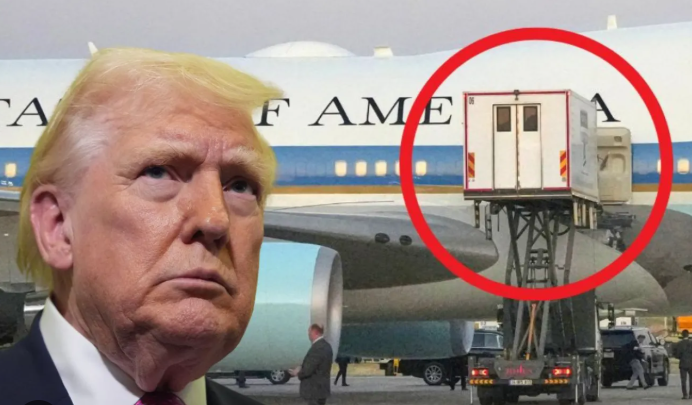
New Delhi: President Donald Trump, who, in his latest claim on Monday, boasted that the US Navy now had “100 per cent control” of the Strait of Hormuz, was actually so scared of a potential Iranian bid on his life in July that he secretly flew out of Turkey in a smaller aircraft and not in his official Air Force One.
Trump had taken the newly-renovated Qatari-donated jet to Ankara for the Nato summit but he unexpectedly used an older Air Force One when departing the country, a move that prompted questions about the newer plane's security, the media reported on Tuesday.
After he boarded the old Air Force One in front of cameras in Ankara, he was secretly shuttled by an airport catering truck to a smaller plane, an Air Force C-32A.
According to The Washington PostTrump departed on a secret military flight from Turkey last month but the White House claimed he was flying aboard Air Force One, an extraordinary move prompted by an Iranian assassination threat.
The trip to Nato was the first international travel for the new plane, whose speedy upgrades triggered questions over its cost and security, and took place as hostilities escalated with Iran, which borders Turkey.
The deception operation was triggered by a credible threat to Trump, the Post reported. A similar operation had taken place in 2000, when President Bill Clinton used an unmarked executive jet to fly into Pakistan while sending his formal Air Force One as decoy.
On this occasion, the journalists who thought they were traveling with Trump on the older Air Force One, which was effectively used as a decoy, reported being advised to keep their window shades in the press cabin closed. The Post said aside from reporters, some White House staff also believed that the President was on board.
When asked later by reporters why they had to keep their shades shut during the flight, Trump said it was because they were “probably on a dangerous flight.” He went onto say: “But if I go, you go. Right?”
When asked for comment on the revelation of a secret flight on a third plane, the White House Communications Director Steve Cheung said: “As the President has said recently, there are many enemies of America who have their sights on him, and we use every tool at our disposal to address those threats.”
Hormuz
On Monday, Trump claimed that the US Navy now has “100 per cent” control of the Strait of Hormuz after clearing mines from the key waterway, as tensions with Iran remain high over conditions for reopening the route.
His latest remarks came as Tehran demanded compensation for war damage and other concessions before agreeing to fully restore shipping through the strait.
Speaking to reporters in the Oval Office on Monday, Trump said the US Navy had cleared the Strait of Hormuz of mines and was now in complete control of the waterway.
“It's open now,” Trump said, adding that the US was “the only one that has control of the Strait of Hormuz right now.”
He described the US military position as a “steel wall” and said occasional Iranian attempts to place mines had not affected Washington's control.
“They will, on occasion, drop a mine, and we find the mine,” Trump said.
The US has maintained a naval blockade of Iranian ports since mid-April. However, Iran has asserted that the strait will not be fully reopened unless Washington meets several of its demands. Tehran has also been holding discussions with Oman over arrangements for shipping through the waterway, but Iranian officials have indicated that these talks would not amount to a complete reopening.
Iran's conditions
Mohammad Bagher Zolghadr, secretary of Iran's Supreme National Security Council, said on Saturday that Iran wants the US to lift its naval blockade and sanctions, withdraw American forces from the region, pay compensation for war-related damage and release frozen Iranian assets. The council also demanded an end to US attacks on Iran's regional allies.
Trump's demands
Trump responded to Iran's demands for war reparations by proposing that Tehran should instead compensate the US.
In a Truth Social post early Tuesday, he said Iran's demand had given him “an interesting idea.”
He said that Iran should pay for Americans killed or injured in roadside bombings and other attacks that Washington has linked to Tehran. He also said compensation should cover Iranian protesters who, according to Trump, have been killed by the Iranian regime over the past five decades.
“We're going to ask for money for the damage they've done over a 50-year period,” Trump said at the White House.
He said the proposed payments would cover deaths among civilian protesters as well as US forces in the region. “So, if there's damages to be paid, I think Iran should pay those damages,” Trump said.
Iran pushes back
Iran has also rejected US claims that sanctions are putting its economy under severe pressure.
Iranian Foreign Ministry spokesperson Esmaeil Baqaei responded on Tuesday to US Treasury Secretary Scott Bessent's statement that American sanctions were “suffocating” Iran.
Baqaei said Washington turns to sanctions when diplomatic efforts fail and then increases them when they do not produce the desired result.
He described the approach as less of a “policy” and more of a “compulsive addiction.”
The Hormuz standoff
The disagreement has left the two sides taking sharply different positions on the Strait of Hormuz.
Washington sees its naval presence as a way to ensure access to the waterway, while Tehran considers the US military presence and blockade the main barriers to restoring normal shipping.
Iran has repeatedly said it will not reopen the strait as long as the US continues its blockade of Iranian ports.
The uncertainty has kept tanker traffic through the waterway below normal levels, adding to concerns in global energy markets.