When newly appointed members of a State Public Service Commission (SPSC) visited the Union Public Service Commission (UPSC) to understand its operations, they expected a standard briefing on administrative procedures. Instead, the visit sparked an unexpected reality check.
Following a senior UPSC official’s presentation, a newly appointed member — who had recently served as an MLA — raised a well-intentioned but misguided question: “The area I come from is not very developed. I want to know how I can help candidates from my area for selection in the state services.”
Also read: Jharkhand bandh: BJP shuts state over police action on job aspirants
Taken aback, the UPSC official delivered a sharp and uncompromising response: “If you want to help people of your area, then I would urge you to resign as a member and go back to politics and become an MLA again. But, as an SPSC member, you cannot differentiate between candidates on the basis of where they come from.”
The ex-MLA continued to serve as a member of the SPSC.
The Jharkhand imbroglio
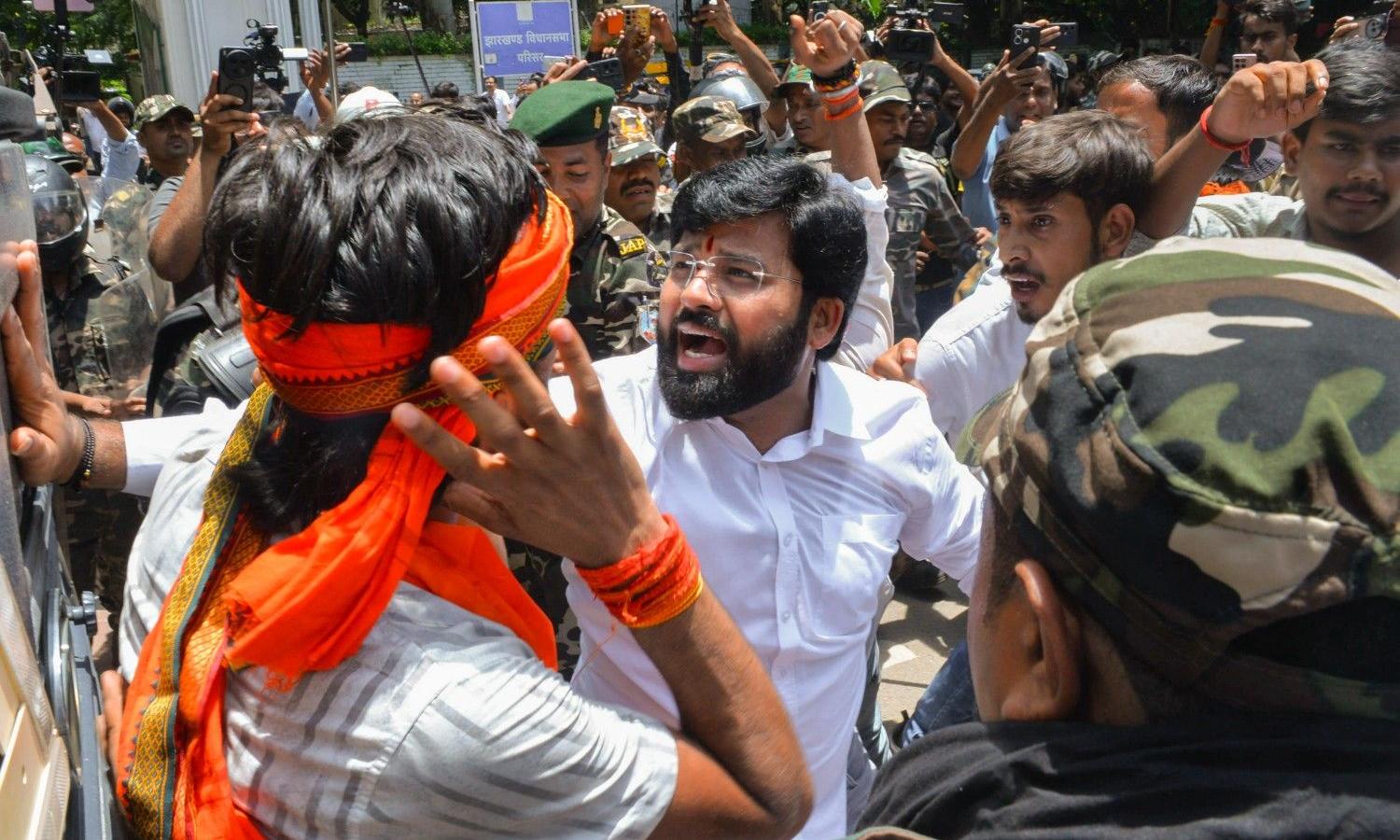
Against the backdrop of growing allegations of irregularities in the 14th combined civil services preliminary exam conducted by the Jharkhand Public Service Commission (JPSC), this revealing anecdote highlights a deeper systemic flaw. It underscores an urgent need for structural reforms in how members are appointed to both state public service commissions and the UPSC.
Also read: BJP workers block Ranchi roads, burn tyres over police crackdown on students
Former JPSC chairman L Khiangte, a retired IAS officer, who was once chief secretary of Jharkhand, resigned from his post when JPSC preliminary exam candidates started their protest over irregularities in the exam. He was subsequently arrested by the state police.
Three other members of the Commission — Ajita Bhattacharya, Anima Hansda, and Jamal Ahmed — resigned from their posts as police summoned them for questioning. Bhattacharya, before being appointed as a JPSC member, was a college principal. She is also the wife of Supriyo Bhattacharya, general secretary of the ruling Jharkhand Mukti Morcha (JMM).
The larger picture
“The Jharkhand protests should lead to structural reforms in appointments to SPSCs and the UPSC,” a former IAS officer, who has served in the UPSC, told The Federal.
“A police probe is fine. The guilty should be punished, but if the process to appoint members of Commissions is not purged, we should be prepared for another instance of irregularity in the conduct of the exam coming to fore.” The officer spoke on the condition of anonymity.
Also read: Jharkhand protest: Students lathi-charged, teargassed; ex-JPSC chairperson arrested
The officer added Commission posts, particularly at SPSCs, are being disbursed to reward loyalists — serving or retired bureaucrats, relatives of party workers or party workers themselves — of the ruling parties from across the political spectrum.
Blueprint to fix Public Service Commissions
♦ Enforce strict, transparent qualification norms for all members
♦ Adopt court-backed independent search committees for appointments
♦ Impose strict statutory caps on commission member strength
♦ Ban political loyalists and bureaucrats from backdoor entries
Often, these appointments are challenged in the Supreme Court and quashed, too. Yet, political parties relentlessly look to appoint loyalists as SPSC members. Their insistence leads to speculation that they could be trying to influence future bureaucratic appointments. Afterall these Commission members sit in interview boards to select bureaucrats.
Constitutional provisions
The UPSC and SPSCs are constitutional bodies formed under Article 315. And, Article 316 of the Constitution provides for the appointment and term of office of members of commissions.
And herein lies a critical issue. Article 316 doesn’t specify any educational or professional qualifications for members of the UPSC and SPSCs, but adds a rider that nearly half the members of the Commissions shall be persons who have held “office” for 10 years at least. There is no cap either on the number of members of these Commissions.
UPSC members are appointed for six years but cannot serve once they cross 65 years of age. SPSC members can serve for 6 years or until they reach 62 years. Once appointed, the removal of such members is not easy, and this was originally done to provide them with constitutional protection.
Article 317 says the Chairman or any other member of a Commission can be removed by the President (in case of UPSC) and by the Governor (in case of SPSC) on the ground of misbehaviour only, after the Supreme Court holds an inquiry after getting a Presidential reference in this regard under Article 145. But, the members or chairpersons can be suspended once the reference has been made to the apex court.
Saini case in Haryana
The lack of a specific set of qualifications for SPSC appointments has led to disputes that often reach the high courts or even the Supreme Court.
For example, in December 2004, just before the Haryana Assembly elections, the outgoing Om Prakash Chautala government appointed Mehar Singh Saini as the Chairman of the HPSC and eight others as members. The next Congress government made a Presidential reference in this regard following complaints with regard to recruitments by the Commission. A police probe was also initiated, but following a Supreme Court inquiry, the Commission members facing allegations had to go.
SPSC posts are often disbursed to reward loyalists — serving or retired bureaucrats, relatives of party workers or party workers themselves — of the ruling parties from across the political spectrum.
In the Saini case, the apex court said: “This unfortunate episode teaches us an important lesson that before appointing the constitutional authorities, there should be a thorough and meticulous inquiry and scrutiny regarding their antecedents. Integrity and merit have to be properly considered and evaluated in the appointments to such high positions.
“It is an urgent need of the hour that in such appointments, absolute transparency is required to be maintained and demonstrated. The impact of the deeds and misdeeds of the constitutional authorities (who are highly placed), affect a very large number of people for a very long time, therefore, it is absolutely imperative that only people of high integrity, merit, rectitude and honesty are appointed to these constitutional positions.”
The Punjab precedent
Saini’s case is not the only example. A few years later, in Punjab, the appointment of Harish Rai Dhanda, an Akali Dal member, as PPSC chairman (by the then Akali Dal dispensation in July, 2011) was challenged in the Punjab & Haryana High Court.
In this case, since Dhanda had not taken the oath as the PPSC chairman, the High Court quashed the appointment on a Public Interest Litigation (PIL). It also issued guidelines to govern future appointments. It said a search committee headed by the Chief Secretary must invite applications and then form a panel of eligible candidates. Their background checks should done to find out the pendency of any civil or criminal matter against them. Then short-listed names should be presented to a committee consisting of the Chief Minister, Speaker of the Legislative Assembly, and Leader of Opposition.
But the High Court order was challenged in the Supreme Court and, in a landmark judgment, the top court upheld the quashing of Dhanda’s appointment. So now, Punjab more or less follows the court-directed procedure to appoint members.
Yet, the practice of appointing party loyalists to SPSCs is rampant across other states.
What happened in Uttar Pradesh
In Uttar Pradesh, the Samajwadi Party (SP) government led by Akhilesh Yadav was left red-faced as its appointment of Anil Kumar Yadav to the UPPSC was quashed by the Allahabad High Court in 2015.
A Division Bench of the High Court comprising the then Chief Justice DY Chandrachud (later CJI) and Justice Yashwant Verma (later removed) held that the appointment was “ultra vires” of Article 316 of the Constitution and illegal and arbitrary. The court said Anil Kumar Yadav, a college teacher by profession, was appointed “without application of mind, ignoring suitability and availability” of other candidates.
Listing out improprieties in the selection process, the court said his bio-data was sent to the state government through fax from an office of the Samajwadi Party. Also, his character certificate was issued from the office of the Mainpuri District Magistrate (DM) on a Sunday after “a special messenger” brought a letter from the state’s Chief Secretary telling the DM to complete the process by Monday.
ARC calls for national consensus
Courts are not alone in taking action against errant administrations. The Administrative Reforms Commission (ARC) has also recommended reforms in this regard.
The second ARC, in its 15th report, said steps should be taken to ensure that persons of high standing, intellectual ability and reputation are selected as chairman or members of the SPSCs. It debated the issue of variable strength of SPSCs, too. As of now, like the Kerala PSC has 21 members, including the chairperson, but a larger state like Uttar Pradesh has six members and a chairperson.
The ARC said there was a need to evolve a consensus among states on the issues of SPSC appointment, also capping the number of members. And these issues can be debated or discussed at the membership of the Commission, through discussions/deliberations at the Inter-State Council.
But, as the Jharkhand example shows, executives of no political hue are not ready to walk the talk. Result? The larger structural issues continue to plague the Commissions.