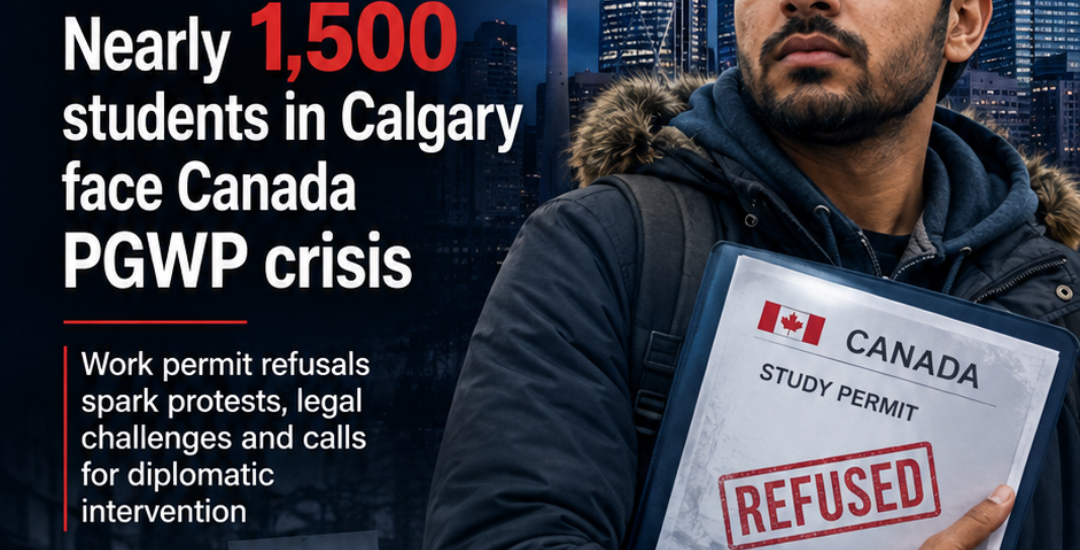
A growing immigration dispute in Alberta has left hundreds, and potentially more than 1,500 international graduates, many of them from Punjab, uncertain about whether they will be allowed to work in Canada after completing their studies. Punjab NRI Affairs Minister Dr. Ravjot Singh told the Punjab Vidhan Sabha on August 7 that nearly 1,500 students in Calgary have been affected by Post Graduation Work Permit refusals, prompting the Punjab government to seek intervention from India’s External Affairs Minister S. Jaishankar.
The controversy centres heavily on graduates of programs connected with Alberta’s Portage College and delivered through former partner institutions, including the Canadian Institute of Osteopathic Therapy in Calgary and Campbell College. Portage College itself currently describes a number of programs brokered through third party institutions such as CIOT Calgary and Campbell College as “non-credit programs.” Local reporting initially documented roughly 480 graduates connected to Portage College and CIOT who were challenging refusals, while more recent Indian reporting has placed the broader group of affected Indian students at between 1,500 and 2,000, primarily from Punjab and Haryana.
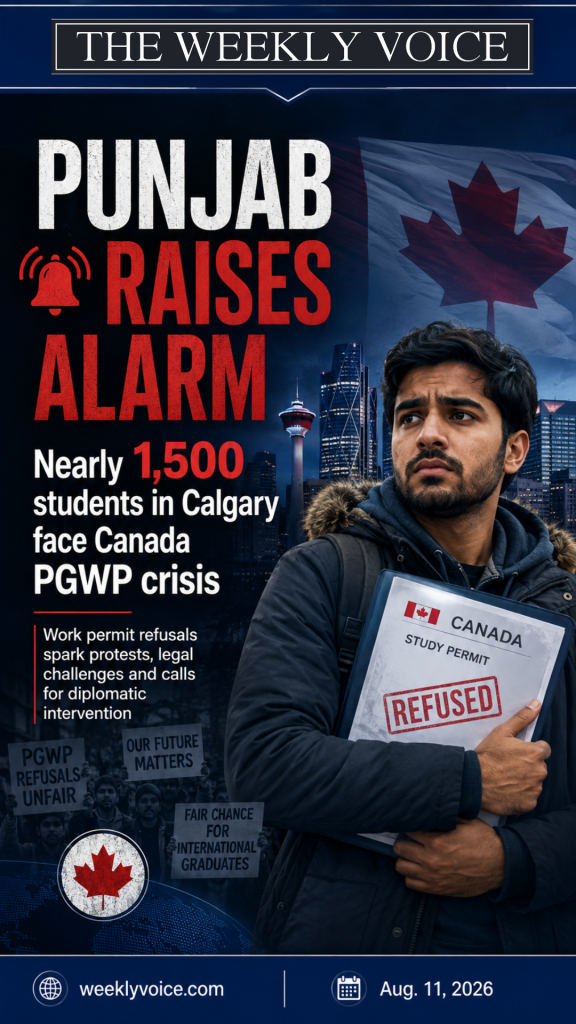
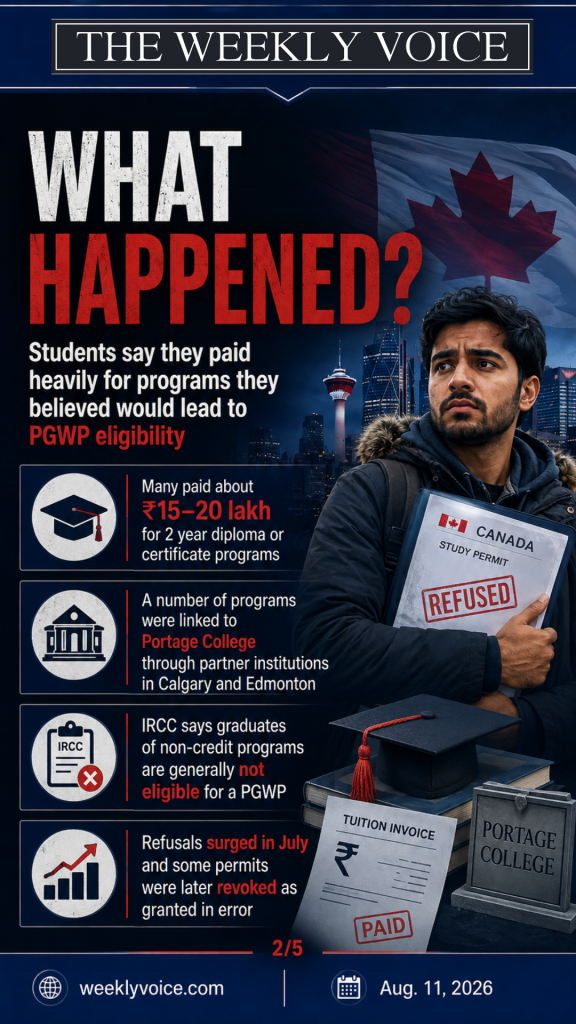
For many families, the financial stakes are enormous. Singh said students had spent close to ₹20 lakh each to pursue their Canadian education after being led to believe that completing their two year programs would allow them to qualify for post study work permits. Separate reporting on students connected to the Portage College and CIOT programs has put tuition costs at approximately CAD 32,000 over two years. For families in Punjab that borrowed money, sold assets or used years of savings to finance a Canadian education, the PGWP was not simply another immigration document. It was widely viewed as the bridge between graduation, Canadian work experience and potentially permanent residence.

The dispute exploded after Immigration, Refugees and Citizenship Canada updated its PGWP eligibility webpage on June 24, 2026. The current federal guidance explicitly states that a graduate is not eligible for a PGWP after completing a “non-credit program of study,” with an exception for qualifying flight school programs. The same page also states that graduating from a designated learning institution does not by itself guarantee PGWP eligibility and sets separate rules for programs delivered through curriculum licensing arrangements between public institutions and private colleges.
Students argue that this wording appeared only after they had already enrolled, paid their tuition and, in many cases, completed most or all of their studies. Some graduates told LiveWire Calgary that they began their programs in early 2024 believing they satisfied the PGWP rules applicable to them. Around 50 students from the group were reportedly approved before hundreds of similar applications began receiving refusals. The Indian Express has also reported at least one case in which a PGWP that had already been issued was subsequently revoked after immigration officials said it had been granted “in error.”
IRCC, however, disputes the argument that a new rule was introduced in June. In a statement provided to LiveWire Calgary, the department said there had been “no changes to the eligibility criteria” and that the June website update was intended to clarify longstanding requirements concerning non-credit study. According to IRCC, applicants must complete a qualifying program leading to a degree, diploma or certificate from an eligible designated learning institution. That creates the central legal and policy question now surrounding the case: whether the students were genuinely eligible under the rules that applied when they enrolled, or whether the programs were never eligible and earlier approvals or representations created an expectation that immigration law itself did not support.
Portage College has acknowledged that graduates from certain non-credit programs have received PGWP refusals but says immigration decisions belong exclusively to IRCC. As recently as August 6, the college said it was continuing to seek clarification from federal authorities. Portage has also urged affected graduates to retain study permits, acceptance letters, transcripts, completion documents, refusal letters and correspondence with IRCC, and to obtain independent advice from a licensed immigration lawyer or regulated immigration consultant.
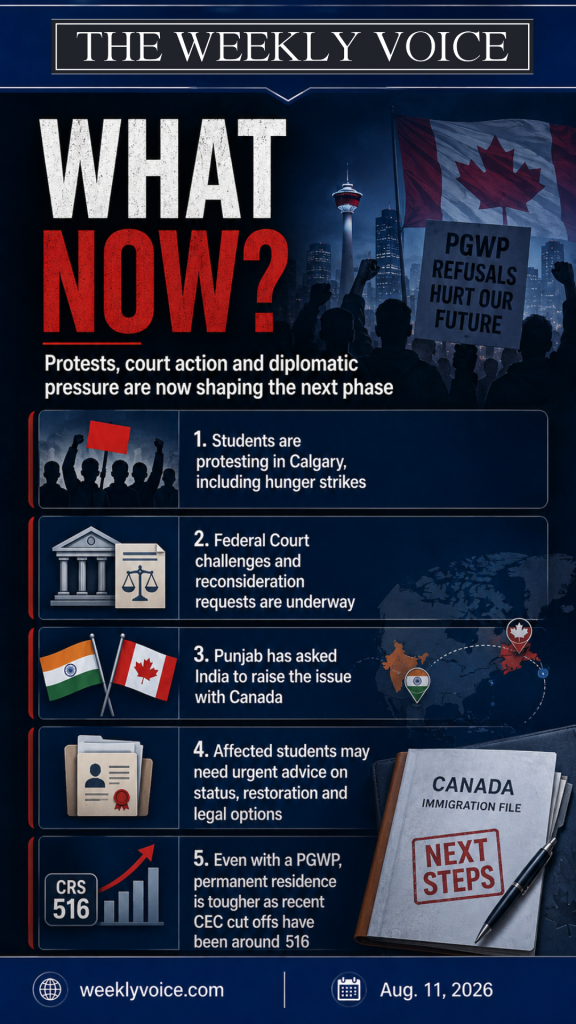
The uncertainty has spilled onto the streets. Hundreds of graduates have taken part in demonstrations in Alberta, and some students in Calgary began a hunger strike while demanding that the federal government reconsider the refusals. Recent international education reporting estimated that approximately 500 Portage College graduates had participated in rallies across Alberta. Prime Minister Mark Carney was questioned about the controversy in late July and said he was not familiar with the specific case, while emphasizing that established immigration processes have to be followed.
The issue has now reached India’s political system as well. Ravjot Singh said the Punjab government has written to Jaishankar asking the Government of India to raise the matter with Canada through diplomatic channels. He also said many students have already begun Federal Court proceedings and that Punjab could explore facilitating common legal representation in an effort to reduce the financial burden. Singh appealed to Canadian MPs of Punjabi origin to raise the matter regardless of political affiliation.
For students who have already received a refusal, time may be particularly important. IRCC says a graduate who was authorized to work while waiting for a PGWP decision must stop working once notified that the application has been refused. There is no conventional statutory appeal process for most temporary residence refusals. Depending on the circumstances, applicants may seek reconsideration, submit another application where legally available, or pursue judicial review in Federal Court. The Federal Court states that an immigration judicial review application generally has to be filed within 15 days when the matter arises in Canada, compared with 60 days for matters arising outside Canada.
Immigration status is a separate issue from challenging the refusal itself. Federal guidance says restoration may be available in certain circumstances within 90 days after temporary resident status is lost, but eligibility depends on the individual case. Someone who loses authorization to work generally cannot simply continue working while a reconsideration or restoration issue is being addressed. Students receiving refusal or revocation notices therefore need to examine both their PGWP challenge and their underlying legal status in Canada immediately.
Even for graduates who eventually obtain a PGWP, Canada’s pathway from international student to permanent resident has become significantly more competitive. In the August 5 Canadian Experience Class Express Entry draw, IRCC invited 3,000 candidates and the lowest Comprehensive Ranking System score was 516. The previous CEC draw on July 21 also required 516 points, while the July 7 round required 517. A Canadian education and several years of Canadian work experience therefore no longer guarantee that a former international student will score highly enough to receive a permanent residence invitation.
That broader reality is why the Portage College dispute is resonating far beyond Calgary. For thousands of families in Punjab, Brampton, Mississauga, Surrey and other communities tied closely to Canada’s international student system, the issue is about more than one college or one work permit category. Families made major financial decisions based on an understood sequence: study in Canada, graduate, obtain a work permit, gain Canadian experience and compete for permanent residence. Each stage of that pathway has become more restrictive and less predictable.
Canada has the right to determine who qualifies for a temporary work permit or permanent residence. At the same time, the Portage controversy raises an equally important question about transparency. When international students can spend tens of thousands of dollars and years of their lives completing a program, only to discover at graduation that the government, the institution and the students appear to have fundamentally different understandings of what that program entitled them to pursue, the system has a serious information problem regardless of how the individual court cases are ultimately decided.
For affected families, the immediate priority should be documentation and qualified legal advice rather than relying on social media claims. Refusal letters, application records, study permits, original admission documents, program descriptions, transcripts and any correspondence concerning PGWP eligibility may become important in determining what options remain. With court and immigration deadlines potentially running quickly, delaying action can itself reduce the options available.
This article provides general information and is not legal advice. Immigration status, reconsideration and Federal Court options depend on the facts of each individual case.