Kumar Krishnan, senior journalist
The movement of students and candidates against alleged irregularities in competitive examinations in Jharkhand is no longer limited to just canceling the examination or demanding an investigation. This has become a question of broken trust between the government, administration and the youth. For the youth who has been preparing for a government job for years, the alleged rigging in the examination is not just an administrative error, but an injustice to his hard work and future. Therefore, the demand for a transparent, fair and time bound recruitment system cannot be rejected.
Amidst the pressure of the movement, the Jharkhand government has decided to cancel the 14th JPSC preliminary examination and the backlog examinations of 2023 and 2025. Former JPSC President L. After Khiangate's resignation, the resignations of three other members of the commission have also been accepted. There has been talk of CID and ED investigation into alleged irregularities, fast track court for speedy disposal of cases and completion of investigation in 90 days. For long-term improvement in the examination system, a proposal has also been made to form a committee of experts from IIM Ranchi, IIT-ISM and XLRI.
The government claims that about 98 percent of the demands of the students have been accepted. Then why is the movement continuing? The answer lies in the demand for a CBI investigation. This is where the biggest wall of communication stands between the government and the agitating students. Students want CBI inquiry into disputed exams including JSSC-CGL. The government argues that the CGL examination is related to the judicial process and appointments have also been made after its results, hence the state government cannot cancel it on its own. On the other hand, students also have to understand that CBI investigation is not the only criterion of impartiality. If the investigation by an independent body is done under judicial supervision, with clear timelines and there is a provision for making its report public, then that option can be considered. The success of the movement lies not only in getting maximum demands met, but in achieving a solution that will make the future system credible.
Accepting an allegation as true and conducting an impartial investigation into the allegation are two different things. This is the difference that the democratic movement will have to understand to maintain its moral strength. Canceling the exam is not the end of the solution. The age of the candidates who have prepared for years is increasing. Many candidates may have also lost opportunities for other jobs. Therefore, when will the new examination be held, what will be the relaxation in age limit, what will be the syllabus and how will the interests of old candidates be protected – the government should give clear and written answers to these questions.
The resignation of the Chairman and members of JPSC also cannot be considered as the final destination of accountability. Stepping down and being held responsible for any irregularity are two different things. The investigation will have to clarify whether any irregularities occurred or not, if any, at what level and who is responsible for it. The guilty officer, the middleman or any influential person – the law should reach everyone, but the police action in this entire episode also raises serious questions. Dissent is not a crime in democracy. Protesting against the government, raising slogans and taking out peaceful marches are part of civil rights.
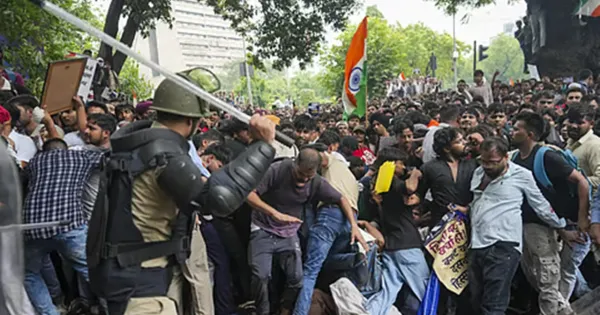
Jharkhand government has taken many important steps. Now he will have to prove that these steps are not just to calm the movement, but to change the recruitment system. Students will also have to prove that their movement is not just for canceling the exams, but for a reliable and transparent system. The assembly has been surrounded, detention and police action has also been taken. Now the next path should not be of sticks and barricades, but of dialogue. The Chief Minister should talk directly to the students. The government should give timely written assurance and the students should maintain their strength of non-violence and discipline.
Because the real question is not whether the students reach the assembly or not. The real question is whether the next competitive examination in Jharkhand will be such that no student will have to come to the assembly road again to trust the result? If the answer is yes, then today's crisis can become an opportunity to improve the system. If the answer is no, then the crisis will not end even after the movement ends. Investigation of examination malpractices is necessary, but even more important is the restoration of trust on which both democracy and the recruitment system rest. Opinions are the personal views of the author)