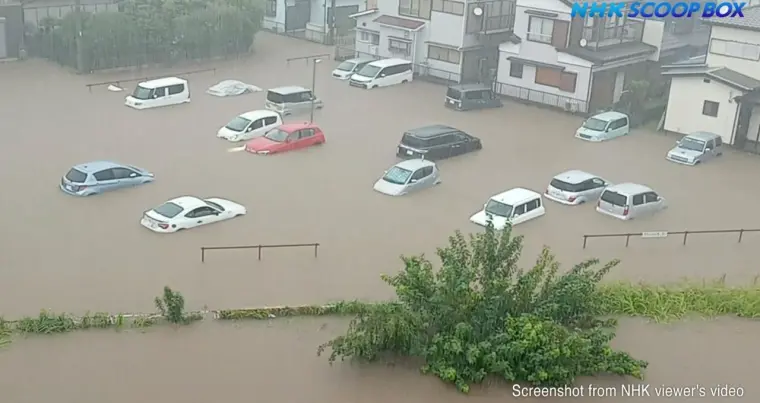
Record rainfall in Chiba Prefecture of Japan has caused massive destruction due to floods and waterlogging. At least four people died in the accidents, while one person is missing. Thousands of passengers were stranded and more than 26 thousand houses lost power.
Tokyo: Record-breaking heavy rains have caused widespread devastation in the eastern part of Japan. Floods, landslides and waterlogging affected roads and railway lines, while thousands of passengers were stranded. According to officials, at least four people have died and one more person is feared dead.
Most devastation in Chiba
The most serious impact of heavy rain was seen in Chiba Prefecture adjacent to Tokyo. After torrential rains late Thursday night, flood-like conditions were created in many areas. The Meteorological Department issued the highest level warning of heavy rain for the Chiba region for the first time.
More than 360 mm of rain was recorded in some areas within 24 hours. Chiba city received 115 mm of rain in just one hour, which is a new record there. At the same time, 97 mm of rain was recorded in Sakura city in one hour, which broke the previous record there.
Due to continuous rain, low lying areas were rapidly filled with water. Houses, cars and even railway tracks were submerged in flood waters. At many places, water along with mud and debris spread on the roads, severely affecting normal life.
Four people died, one missing
At least four people lost their lives in rain- and flood-related incidents, according to disaster management officials in Chiba Prefecture. The dead included a man in his 60s or 70s who was found floating on a road flooded by floodwaters.
A 66-year-old woman was trapped inside her submerged car. Later he was found dead. The third person was found unconscious on the road, while the age and gender of the fourth deceased could not be immediately confirmed.
Officials have feared that another person is also dead, while a sixth person has been reported missing. Amid rescue and search operations, officials have appealed to people to stay away from the affected areas.
Passengers stranded in stations and relief centers overnight
Hundreds of passengers got stranded at Chiba Station and many other stations as railway services were disrupted due to rain. After train services were halted, passengers were sent to temporary relief centers and government buildings to spend the night.
Many people in Chiba city spent the night in temporary shelters set up in government buildings. There people were provided foil blankets to be used in emergency situations.
Japan’s Ground Self-Defense Force also took part in the relief operation. The army sent buses to evacuate about 4,000 people who had spent the night at Soga railway station. Soga Station is an important transit point for travelers heading to Tokyo and the area is also used for Tokyo Disney.
More than 26 thousand houses lost electricity
Power supply in Chiba Prefecture was also severely affected due to heavy rain and inclement weather. More than 26,000 homes were without electricity as of Friday morning.
Local businesses and daily activities were also affected due to power cuts and transportation disruptions. A woman from Ichikawa city, Chiba, told local media that the situation suddenly worsened and due to the power outage she is worried about whether her business will be able to operate normally in the coming days.
The administration has intensified efforts for relief and restoration of power in the affected areas.
Chiba Governor told extraordinary situation
Chiba Governor Toshihito Kumagai described the situation as extremely unusual on Friday morning. He said that he has faced many disasters in his public life, but has never seen such a situation before.
His statement reflects that the excessive rainfall in a short period of time posed a major challenge to the local administration and emergency services.
Due to rain, the risk of landslides had increased in many areas. The weather service continued to monitor the situation and downgraded the most severe warning issued for several municipalities of Chiba on Friday morning after the intensity of the rain decreased.
However, the Meteorological Department predicted rain again during the day, necessitating vigilance amid relief and rescue operations.
Heavy impact on road and railway networks
Record rainfall also affected Japan’s transportation infrastructure. Many roads were submerged in water and some railway tracks were also hit by floods. Train services had to be stopped at many places, affecting the travel of thousands of passengers.
After the flood waters receded, the administration started inspection of the affected roads and railway lines. The biggest challenge facing the authorities is to normalize transport services in a safe manner.
Pictures and videos published in local media showed muddy water pooled around houses, submerged cars and flooded railway lines. In some areas, people had to come out of their homes and go to safe places.
Passengers stranded at Tokyo’s main airport too
The rain also affected air travel. Thousands of passengers were stranded overnight at one of Tokyo’s major airports. However, all scheduled flights were expected to operate normally on Friday.
Passengers faced additional problems due to disruption in transport routes leading to the airport and halting of train services. Many people had to spend the night in the airport premises itself.
Authorities and airline companies have advised passengers to check the latest status of flights and local transport services before travelling.
Another challenge of extreme weather in Japan
Japan has faced natural disasters like heavy rains, floods and landslides in the past. But record levels of rainfall in a short period of time in Chiba have once again highlighted the challenge of dealing with extreme weather events.
Recently, the impact of Typhoon Dolphin was also seen in the southern parts of the country. In such a situation, it has become important for the administration to constantly keep an eye on the changing weather conditions.
According to experts, when there is too much rain in a short period of time, the pressure on the drainage system in urban areas increases rapidly. Due to this, roads, railways and electricity networks can be affected and the risk of landslides also increases.
Relief and rescue operations continue
At present, local administration, police, fire services and Japan Self-Defense Force are engaged in relief and rescue operations in the affected areas. The priority is to evacuate people to safe places, search for missing people and restore electricity and transport services.
In view of the possibility of further rain from the Meteorological Department, the administration has asked people to remain alert. People living in areas prone to floods and landslides have been advised to follow the warnings of local authorities.
The devastation caused by record rainfall has affected life in Chiba and surrounding areas. With four people dead, many injured or missing, thousands of passengers stranded and thousands of homes without power, the administration’s focus is now on assessing the damage and getting the affected people back to normal life as soon as possible.