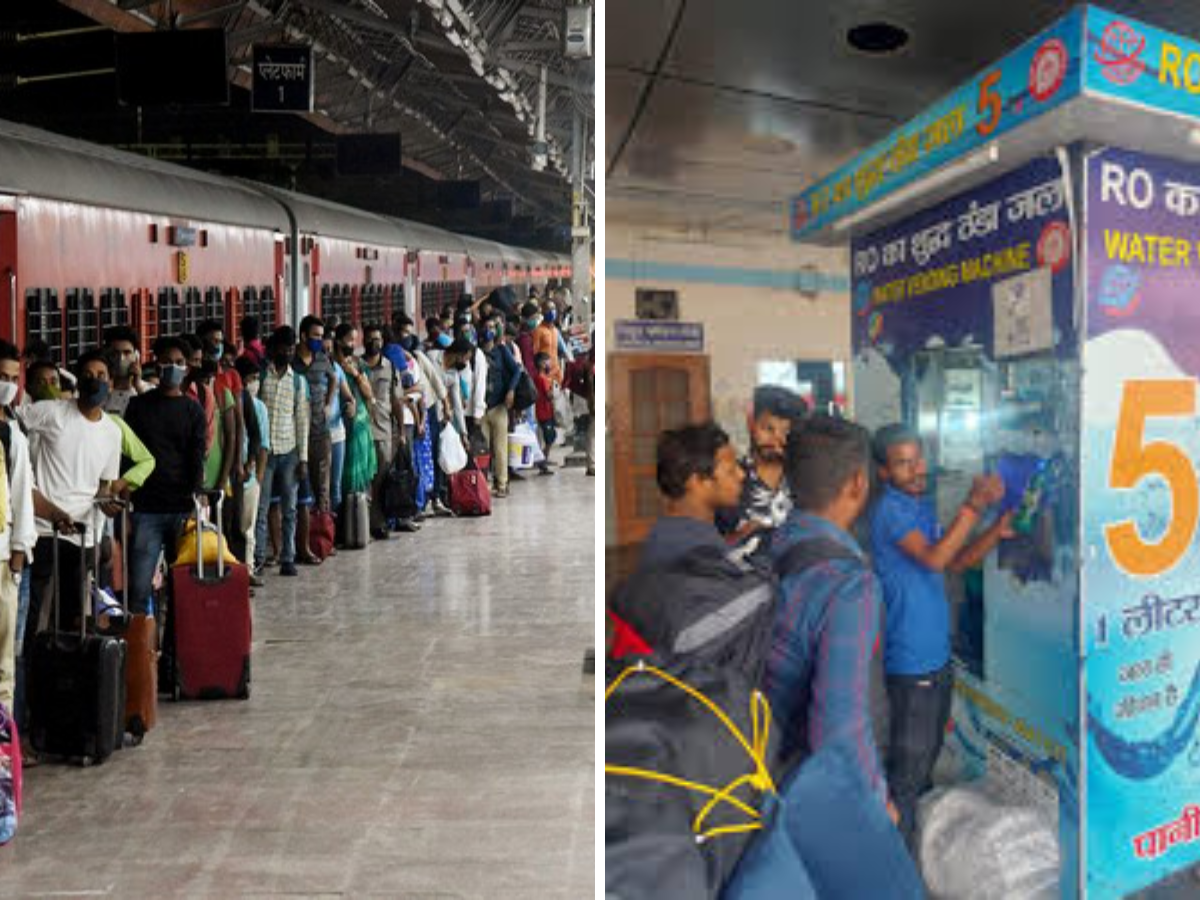
A recent report by the Comptroller and Auditor General of India (CAG) has raised serious concerns over the quality of drinking water available to passengers at railway stations across the country. The findings, tabled in Parliament on August 12, revealed the presence of E. coli bacteria in water samples collected from water coolers at several railway stations.
According to PTI, the CAG conducted an audit of passenger services at 512 non-suburban grade railway stations across different railway zones. The audit not only highlighted concerns over drinking water quality but also pointed to significant gaps in basic passenger amenities.
What Is E. Coli Bacteria & Why is it Harmful?
E. coli, or Escherichia coli, is a type of bacteria commonly found in the intestines of humans and animals. While many strains of E. coli are harmless, the presence of E. coli in drinking water is considered an important warning sign of faecal contamination. Contaminated drinking water can potentially carry disease-causing microorganisms and may lead to illnesses such as diarrhoea, stomach infections and other gastrointestinal problems. Therefore, detecting E. coli in drinking water indicates that the water may not be safe for consumption and requires immediate investigation and corrective action.
At Which Railway Stations Was E. Coli Found?
The CAG report found E. coli in water collected from water coolers at eight railway stations across four railway zones. According to the report, samples from water coolers tested positive for E. coli at Coimbatore and Palakkad Junction in Southern Railway. Hyderabad station in South Central Railway also recorded a positive sample. In Central Railway, E. coli was detected at Chhatrapati Shivaji Maharaj Terminus, Bhiwandi Road, Kalyan and Lonavala. Madhupur station in Eastern Railway was the eighth station where the bacteria was detected. The audit also found evidence of bacterial contamination in water supplied through taps on railway platforms. Samples collected from taps at 49 stations across eight railway zones during 2022-23, and from 56 stations across nine zones during 2023-24, showed the presence of total coliform bacteria, including E. coli.
Over 89% Stations Found Deficient in Basic Amenities
The CAG report also highlighted wider shortcomings in passenger facilities. Out of the 512 stations examined, 458 stations, or more than 89 per cent, were found to be deficient in providing Minimum Essential Amenities (MEA). The Railway Board had issued comprehensive guidelines in April 2018 specifying Minimum Essential Amenities, Recommended Amenities and Desirable Amenities for stations classified from NSG-1 to NSG-6. The guidelines required MEAs to be provided at all stations by August 31, 2018. However, the audit found substantial shortages in basic facilities. There was a shortage of latrines at 201 stations, urinals at 403 stations and drinking water taps at 2,035 stations.
The report also identified deficiencies at some of the country’s major railway stations, including Chhatrapati Shivaji Maharaj Terminus, Howrah, Sealdah, New Delhi and Mumbai Central. The shortcomings included inadequate seating, sanitation facilities, dustbins and electronic train information display boards. The findings have put the spotlight on the need for stricter monitoring of drinking water quality and better implementation of passenger amenity standards at railway stations.
Also Read: 11 Dead, Including 3 Children: What Triggered Israel’s Deadliest Lebanon Strikes Since Truce?
Shamshad Ali is a New Delhi–based journalist with over six years of experience spanning breaking news writing, on-the-ground reporting, and editing. When he isn’t chasing headlines, Shamshad is usually exploring new destinations, discovering hidden culinary gems, and striking up conversations with strangers. Many of whom turn out to be great sources, and even better friends. He can be reached at shamshadali.dar@gmail.com.
The post Is Railway Station Water Safe? CAG Finds E. Coli Bacteria; 89% Of Stations Lack Basic Amenities appeared first on NewsX.