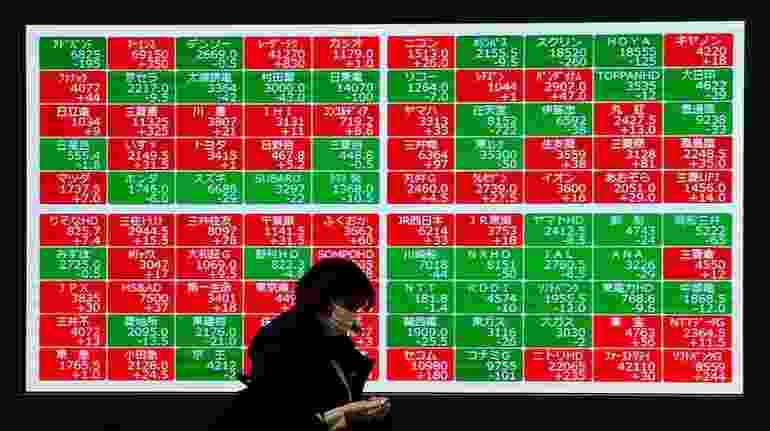
On the first trading day of the week, August 17, 2026, mixed and cautious trading is being seen in the major stock markets of the Asia-Pacific region. Amidst the stability in the US stock markets last week and the wait for global economic data, today the main focus of investors is on the macroeconomic data coming from Tokyo and Beijing. While Japan's benchmark index was seen trading under pressure in the early morning trading session, the markets of China, Hong Kong and Australia witnessed limited fluctuations.
According to market experts, this entire week, global investors are going to keep an eye on the upcoming 'FOMC Minutes' of the US Federal Reserve, Flash PMI data of various countries and Inflation data of major economies. Amidst all these global uncertainties, the growth rate data of the Japanese economy has most affected the Asian business sentiment on Monday morning.
Japan's GDP figures disappointed: impact on Nikkei and Yen visible
According to official preliminary flash data released by the Cabinet Office in Tokyo, Japan's real GDP during the second quarter (April-June) of 2026 on a quarter-on-quarter (QoQ) basis grew by just 0.3 percent An increase of ₹ has been recorded. This figure was well below the 0.5 percent growth estimate made by market analysts.
Key points of GDP report:
-
Huge decline in annual growth rate: Japan's GDP growth rate on annualized basis 1.1 percent whereas economists had estimated it to be around 2.0 percent.
-
Domestic Demand and Sluggish Consumption: Private consumption, which accounts for more than half of Japan's economy, remained flat at zero (0.0%) in the second quarter, much weaker than expected growth of 0.5%. This shows that amid rising inflation, Japanese families are showing great hesitation in spending.
-
Decline in Capital Expenditure (Capex): Capital investment by corporates in new machinery and factories recorded a contraction of 1.2 per cent (-1.2%), while the market was expecting a positive growth of 0.4%.
-
Profit booking in Nikkei 225: Tokyo Stock Exchange's main index falls due to weaker than expected growth rate Nikkei 225 It slipped 0.5% to 0.8% in the early session. Selling pressure was seen especially in shares of large companies manufacturing automobiles, electronics and industrial machinery. The Japanese currency Yen (JPY) was also seen fluctuating within a limited range against the dollar.
Condition of major Asian markets: Mixed trends in Hang Seng, Kospi and Shanghai
Apart from Japan, the trading outlook today remains largely limited and mixed in other major financial centers of Asia:
-
Hang Seng of Hong Kong: Hong Kong's Hang Seng index rose marginally by 0.3% to 0.5% on sporadic buying in tech companies and real estate stocks. Shares of Chinese e-commerce and tech giants supported the market from falling.
-
Shanghai Composite of China: There was a dull atmosphere in the Chinese mainland markets today. The Shanghai Composite Index appeared to trade at flat levels, with a slight range of 0.1%. Investors are in a waiting mode regarding the upcoming steps to be taken by the People's Bank of China (PBOC) to support economic liquidity.
-
Kospi of South Korea: South Korean market Kospi remained mildly bullish due to limited buying in shares of semiconductor and battery makers, although profit booking was seen at upper levels due to pressure from higher interest rates.
-
Australia's ASX 200: The Australian stock market today saw the index trading in the green with a gain of about 0.2% amid heavy flow of corporate earnings. Shares of mining and energy companies boosted the index.
What will be the impact on the interest rate strategy of Bank of Japan (BOJ)?
This weak performance of the Japanese economy has created a new and complex dilemma for the Bank of Japan (BOJ). The BOJ had been gradually moving toward normalizing its policy interest rates in recent months after ending decades of ultra-loose monetary policy and the era of negative interest rates.
The biggest challenge before the central bank is that while on one hand the inflation rate at the service and productive level in the country (GDP Deflator 2.6% YoY) still remains above the target, on the other hand the basic pace of the economy is slowing down. No improvement in private consumption and reduced investment by companies indicate that if the Bank of Japan raises interest rates further sharply in the upcoming September or October meetings, the economy could be on the verge of recession. After this weak GDP report, there is an increased possibility in the financial markets that the BOJ may now adopt a more cautious and 'wait and watch' stance regarding further rate hikes.
What are the signs for the Indian stock market and GIFT Nifty?
Amidst this mixed trading going on in the Asian markets, the initial indications for the Indian stock market (Sensex & Nifty 50) seem to be largely balanced:
-
GIFT Nifty Trend: GIFT Nifty traded on NSE International Exchange was trading almost steady and flat in the limited range of 25 to 35 points in the morning session, indicating a neutral or marginally positive start of Nifty on Dalal Street.
-
Movement of Foreign Institutional Investors (FIIs): The Indian market is also keeping a close eye on the uncertainty regarding interest rates in the Japanese market and the possible effects of 'yen carry trade'. If global funds pull out their money from Japan, they may look for safer investments in India and other emerging markets.
-
Dominance of domestic triggers: The Indian market is currently showing its ability to easily withstand global pressures on the basis of the last round of first quarter earnings season of companies, good progress of monsoon and strong cash flows of domestic retail investors (DIIs/SIPs).
This week's strategy for investors: Sectoral approach with caution is necessary
In view of this mixed trend across Asian and global markets, market experts and analysts recommend that traders and retail investors should avoid any unilateral aggressive bets.
In the coming days, inflation and manufacturing PMI data released from America, Britain, Europe and Japan will decide the direction of global currencies and bond yields. In such an environment, the safest and most prudent move would be to adopt a strategy of bottom-fishing in large-cap companies with strong fundamentals, government infrastructure-related sectors and defence-power stocks.