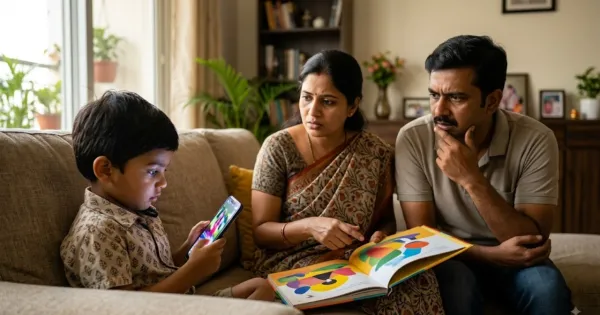
New Delhi: The habit of continuously watching videos on mobile phones and tablets can affect the development of young children. Health experts say that especially for children aged 2 to 5 years, more than an hour of entertainment-based screen time a day can adversely affect their language development and concentration. In recent years, there has been an increase in the number of cases of children being brought to hospital complaining of speech delays. Situations like excessive screen viewing and limited communication with parents have come to light in many cases.
Increasing concern due to rapidly changing videos
According to Dr Rahul Daral, senior resident pediatrician at Dr Baba Saheb Ambedkar Hospital, Rohini, excessive screen time, especially fast-paced videos like 'reels' and 'shorts', can affect the development of speech abilities and concentration in young children.
Dr. Daral told that in such videos new content appears every few seconds. Due to this, the child's brain constantly faces stimulating signals. As a result, they may lose interest in reading books, studies or activities that yield slow results.
However, the expert also clarified that reels or shorts alone cannot be held responsible for the lack of focus in children. Adequate sleep, physical activity, parenting style and home environment also play an important role.
Two and a half year old child used to watch mobile for 6-7 hours every day
A two-and-a-half-year-old child was brought to a government hospital in the national capital complaining of delayed speech. The child could only say “Mama”, “Papa” and a few words, whereas many children of his age had started speaking short sentences.
In the doctors' examination, the child's hearing, vision, nervous system and other aspects related to development were found to be normal. On taking detailed information, it was found that the child used to watch cartoons and short videos on mobile phone for about six to seven hours every day.
He even ate his food while looking at his mobile phone. He used to become irritable when the phone was removed. Doctors found that his development, primarily in the ability to speak, was relatively slow.
The parents reported that as both of them were working, the time for conversation and interactive play with the child had become quite limited.
There was improvement when mobile was reduced, conversation and games were increased.
Experts recommend completely stopping the use of screens for the child's entertainment and staying away from any kind of screen during meals. Along with this, parents were asked to spend at least an hour a day with the child playing interactive games, reading picture books and continuously talking during everyday activities.
Speech and language therapy was also started for the child. After these measures, significant improvement was seen in his development.
'Snatching the screen' is not the only solution
According to Dr. Rahul Daral, due to excessive screen time, time for activities like face-to-face conversation, storytelling, reading books and playing is reduced. These activities are very important for language learning in the early years.
He said that continuous screen scrolling activates the brain's 'reward system' again and again. This can cause children to become accustomed to immediate rewards and make activities like homework, studying, reading books, or practicing music less attractive.
Therefore, the solution to the problem is not just to take away the mobile from the child, but it is important to develop healthy digital habits at home.
How many screens for young children?
According to expert advice:
- Under 2 years of age: It is better to stay away from screens for entertainment.
- 2 to 5 years: Screen time for entertainment should ideally be kept to less than an hour daily.
- Older children: It should be ensured that screen time does not affect their sleep, studies, physical activity and time spent with family.
Parents should adopt these digital rules
Experts have advised children to adopt some easy habits. Meal times and the bedroom should be kept screen-free. Screens should be turned off at least an hour before sleeping. Children should be encouraged to play outside or do any physical activity for at least an hour every day.
Apart from this, parents should take time every day to tell the child a story, read a book and interact with him. The most important thing is that parents themselves set an example of balanced screen use, because children learn a lot by watching the people around them.