Trump Says No US-Iran Talks Planned, Claims Hormuz Is Open Despite Limited Traffic/ TezzBuzz/ WASHINGTON/ J. Mansour/ President Donald Trump said no talks with Iran are planned while claiming the Strait of Hormuz is “open and operating,” despite severely limited traffic and a reported attack on a departing ship. Iran says it will maintain control over shipping until the United States lifts its blockade, releases frozen assets, removes oil sanctions and ends military operations. Regional tensions also intensified as the Houthis claimed an attack on a Saudi refinery and Turkey urged Trump to pursue diplomacy.

Quick Look
- Trump said the United States has no planned talks with Iran.
- He claimed the Strait of Hormuz is “open and operating.”
- Trump said the U.S. blockade remains “in full force and effect.”
- He asserted that all water mines had been removed.
- A projectile struck a ship leaving the strait Tuesday.
- The ship’s engine room was damaged.
- UKMTO reported an unspecified crew casualty.
- Oman’s Coast Guard assisted the remaining crew.
- No environmental damage was immediately reported.
- Iran says the strait will remain restricted until its conditions are met.
- Tehran demands an end to the blockade and oil sanctions.
- Iran also wants frozen assets released.
- Iran and Oman are finalizing a plan to manage shipping.
- Trump reportedly threatened to bomb Oman if it obstructed U.S. policy.
- The Houthis claimed a drone strike on a Saudi Aramco refinery.
- Saudi Arabia did not immediately report damage.
- Recep Tayyip Erdogan urged Trump to pursue diplomacy.
- The 60-day U.S.-Iran negotiating period expired without a peace agreement.

Deep Look
Trump says no Iran talks are planned
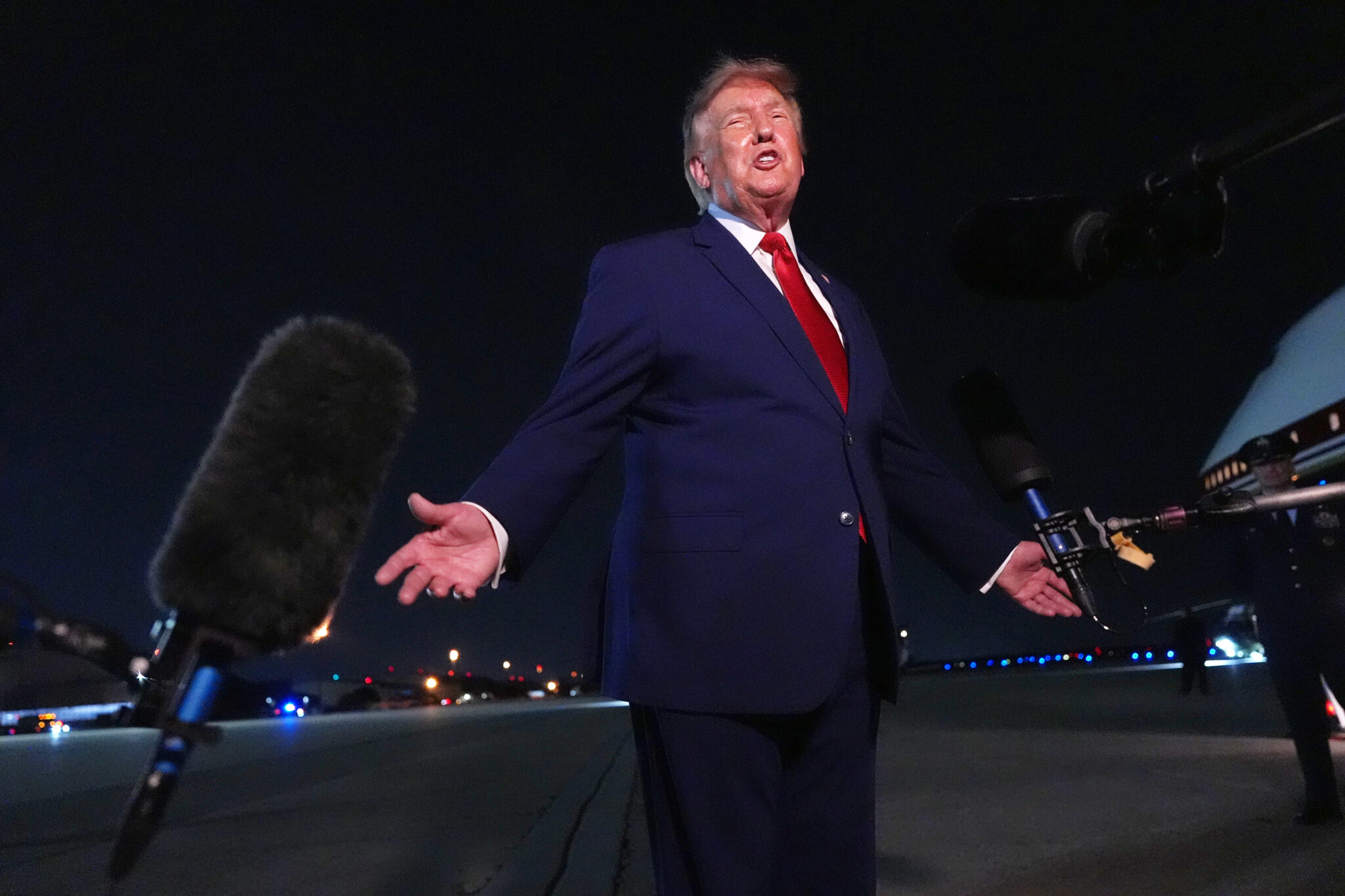
President Donald Trump said Tuesday that the United States has no negotiations scheduled with Iran after a 60-day diplomatic period expired without a peace agreement.
Trump nevertheless asserted that the Strait of Hormuz remains “open and operating.”
His statement conflicted with reports of severely limited shipping traffic and an attack on a vessel leaving the waterway early Tuesday.
Trump also said the American blockade remains “in full force and effect” and claimed that all water mines had been removed.
Ship struck while leaving Strait of Hormuz
An unidentified projectile struck a vessel as it sailed out of the Strait of Hormuz, according to the British military’s United Kingdom Maritime Trade Operations center.
The projectile damaged the ship’s engine room and “resulted in a crew casualty,” UKMTO said, citing information from the company’s security office.
Authorities did not identify the ship or disclose what it was carrying.
It was also unclear whether the crew member had been killed or wounded.
Oman assists ship’s crew
The Omani Coast Guard assisted other crew members following the attack.
Authorities opened an investigation, but no group immediately claimed responsibility.
The incident underscored the risks ships face while attempting to navigate the strait as Iran continues restricting maritime traffic.
The attack occurred while Tehran and Oman were finalizing a separate arrangement to manage passage through the waterway.
No environmental damage reported
Concerns have increased about oil leaking into the Persian Gulf and surrounding waters from vessels damaged during the conflict.
UKMTO said no environmental damage had been reported after Tuesday’s incident.
Dark oil residue has previously appeared on parts of the regional shoreline, though the source has not always been independently established.
Continued attacks on commercial vessels increase the risk of a larger spill in one of the world’s most important energy corridors.
Iran maintains control over shipping
Iran effectively closed the Strait of Hormuz after the United States and Israel attacked the country on Feb. 28.
Before the war, approximately one-fifth of globally traded oil passed through the waterway.
The United States is currently blockading Iranian shipping through the strait.
Iran, meanwhile, is restricting traffic by other vessels, leaving global energy markets vulnerable to further disruption.
Qalibaf lists Iran’s conditions
Mohammad Bagher Qalibaf, Iran’s parliamentary speaker and a negotiator in earlier discussions with Washington, said Tehran would maintain its restrictions until the United States met its demands.
“Until the United States fulfills its commitments under the agreement, including lifting the blockade, releasing frozen assets, lifting oil sanctions, ending threats and military operations on all fronts, and implementing the other conditions to which it committed, the Strait of Hormuz will not reopen,” he said.
His statement directly contradicted Trump’s claim that the strait was already operating normally.
Iran and Oman pursue separate agreement
With direct U.S.-Iran negotiations stalled, Tehran has held separate discussions with Oman over managing vessel traffic.
Iran said Monday that it was finalizing details for a joint statement with Oman.
The proposed agreement could establish specific routes for vessels entering and leaving the strait.
The United States has demanded that the waterway reopen before it lifts the blockade on Iranian ports.
Trump threatens Oman
Trump reacted angrily to Oman’s negotiations with Iran.
He reportedly told Fox News reporter Trey Yingst that the United States would bomb Oman if it “gets in the way.”
The threat targeted a Gulf country that has traditionally served as a diplomatic intermediary between Washington and Tehran.
Oman has continued discussing the shipping proposal with Iran despite Trump’s warning.
Egypt sees pathway to renewed negotiations
Egyptian Foreign Minister Badr Abdelatty met his Omani counterpart, Badr al-Busaidi, to discuss the regional crisis.
Egypt’s Foreign Ministry said Tuesday that an Iranian-Omani shipping agreement could help Washington and Tehran return to diplomacy.
The ministry said it could pave the way for a “comprehensive and permanent deal that addresses all concerns and enhances regional security and stability.”
The statement did not mention Trump’s threat against Oman.
Houthis claim Saudi refinery attack
Yemen’s Iran-backed Houthi rebels claimed they launched drones at an oil refinery in Saudi Arabia.
The facility is operated by Saudi Aramco, the kingdom’s state-owned energy company, according to the Houthi-controlled SABA news agency.
Saudi Arabia did not immediately comment, and there were no initial reports of damage.
The claim could not be independently confirmed.
Houthi attacks threaten another energy route
The Houthis have intensified attacks on Yemeni government forces, Saudi oil infrastructure and Saudi shipping in the Red Sea.
Saudi Arabia supports Yemen’s internationally recognized government.
The Red Sea has become an essential alternative route as shipping through the Strait of Hormuz remains restricted.
Escalating Houthi operations threaten to disrupt both major corridors simultaneously and widen the regional conflict.
Civilian and maritime casualties rise
At least 17 Yemeni civilians have been reported killed in government-controlled areas because of rebel attacks since Aug. 6, the United Nations said Monday.
Two casualties were reported in Houthi-controlled territory in late July.
Recent attacks included a Houthi missile strike on a camp for internally displaced people in Ma’rib province.
A separate Aug. 11 strike on a cargo vessel in the Bab el-Mandeb Strait killed four crew members and wounded several others.
Erdogan urges diplomacy
Turkish President Recep Tayyip Erdogan urged Trump to continue seeking a diplomatic solution during a telephone call late Monday.
The conversation took place as the 60-day period for reaching a U.S.-Iran peace agreement expired.
No extension was announced, and Washington and Tehran remained divided over the strait, sanctions, the blockade and the wider war.
“President Erdogan said it is important to make maximum use of diplomacy amid tensions between Iran and the United States,” Turkey’s presidential communications office said.
Turkey cites regional defense pact
Turkey is a NATO member that shares a border with Iran.
Earlier in August, Ankara signed a joint defense agreement with Saudi Arabia and Pakistan.
The pact states “that any armed attack against any one of the three states shall be regarded as an attack against them all.”
Erdogan told Trump that the agreement represented “a strong stance to ensure regional stability and security.”
Trump praises regional alliance
Trump welcomed the Turkish-Saudi-Pakistani defense arrangement.
“It shows how the Middle East is coming together, and how Countries will finally be able to defend themselves in a more meaningful way,” Trump said.
However, the expanding security alliance is emerging alongside widening instability across the Strait of Hormuz, the Red Sea and Yemen.
With no U.S.-Iran talks planned, the risk of further military and economic escalation remains unresolved.
More on US News