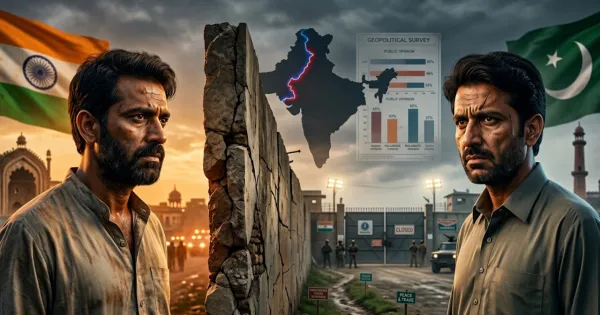
Digital Desk Lucknow Almost eight decades have passed since the separation of India and Pakistan, but the distrust and negative perception about each other among the common people of both the countries has now deepened even further. American think tank Pew Research Center conducted a survey regarding India-Pakistan relations in 2026 to know the views of the people of both the countries, but the truth that came out was quite surprising. Statistics show that a large number of people on both sides view the neighboring country as an enemy and in a negative light.
What was revealed in the Pew survey regarding India-Pakistan?
Pew Research Center conducted the survey based on face-to-face interviews with 3,566 youth in India between February and April 2026. This survey was conducted in 13 Indian languages. In Pakistan, between 8 April and 7 May 2026, 1,039 youth were interviewed in five Pakistani languages.
According to the survey, 73 percent of Pakistanis have a very negative opinion towards India, while 18 percent have a negative opinion to some extent. On the other hand, 65 percent Indians have a very poor opinion of Pakistan and 16 percent Indians have a somewhat negative opinion.
This means that in both the countries the number of people who have positive thoughts about their neighbors is still limited. In Pew Research's surveys since 2013, more than 20 percent of Indians have not shown a positive attitude towards Pakistan at any time. Even in Pakistan, the number of people having positive opinion towards India has ranged from single digit to 33 percent in different years.
The biggest wall is doubt about each other's intentions.
An important aspect of the survey is the different views of the people of both the countries towards their own and neighboring governments.
57 percent people in India believe that their government tries to improve relations with Pakistan. At the same time, 65 percent of Pakistanis do not consider India committed to improving relations.
Similarly, 61 percent of Pakistanis consider their government willing to improve relations with India, while 51 percent of Indians do not consider Pakistan to be committed to doing so.
That is, a similar pattern is visible in both the countries, people trust the intentions of their government, but doubt the intentions of the neighboring government.
After all, where is the root of ill-will?
Foreign affairs expert and retired JNU professor Dr. A.K. According to Pasha, there are many reasons behind this. He believes that earlier there used to be a strong lobby advocating for improving relations and peace in both the countries, but its influence has diminished over time.
According to him, the generation that witnessed the Partition firsthand is now very small and the new generation has had to grow up amidst a different kind of narrative about the neighboring country.
Another problem is that people in both countries sometimes avoid expressing their real opinions publicly. People, especially among youth and professional groups, may prefer to express their views in line with the prevailing national narrative to avoid controversy.
According to Dr. Pasha, in the current environment, talking about peace and dialogue sometimes seems more difficult than speaking the language of war. This situation further deepens the lack of trust at the public level between the two countries.
Businessmen see a way to improve relationships
Amidst this negative environment, there is hope regarding economic relations. Small businessmen and traders of Pakistan are said to be in favor of increasing trade between the two countries.
He argues that dialogue and trade relations with India may be necessary for Pakistan's economic progress. That is, even though there may be hesitation in the general perception to accept India as a friend, there is practical thinking regarding economic cooperation.
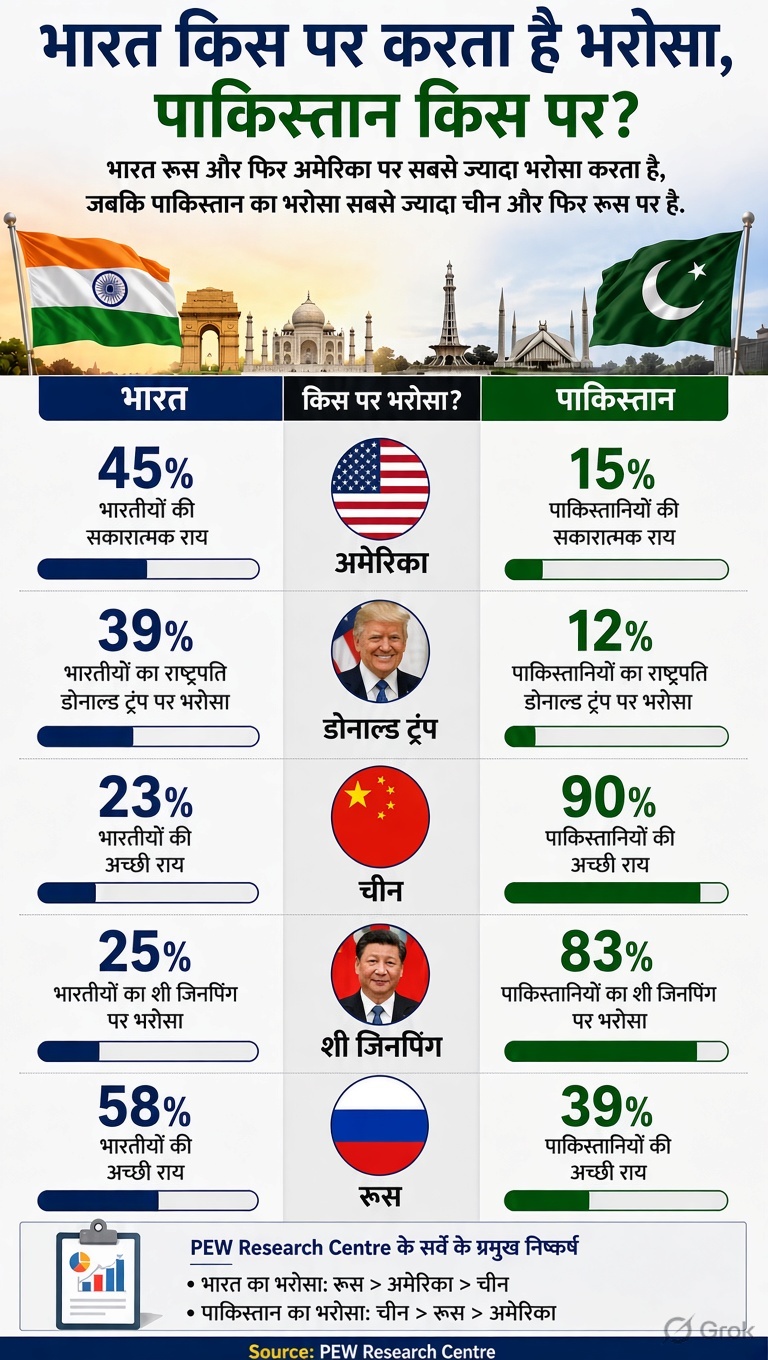
India and Pakistan have completely different views on China
The survey reveals a big difference in the thinking of the two countries regarding China. 21 percent of Indians consider China as the biggest threat, while 75 percent of Pakistanis consider China as their most important ally.
Pakistan has been receiving support, economic assistance and technical assistance from China in the United Nations. On the other hand, strategic concerns about China have existed in India for a long time.
According to Dr. Priyankar Upadhyay, foreign affairs expert and BHU professor, China has been seen as a major strategic challenge since the early days of India's independence.
Can the picture of India-Pakistan change?
The picture from the Pew survey is not encouraging at the moment. 91 percent of Pakistanis and 78 percent of Indians have a negative attitude towards each other. There is also a clear lack of trust on both sides regarding the intentions of the government of the neighboring country.
Despite this, economic cooperation definitely shows a possible path. The practical thinking of people associated with business and trade indicates that even amidst political differences, economic needs at the public level can create the ground for dialogue.
After all, the nearly 80-year-old gap will not be bridged by political statements alone. For this, trust, communication, people-to-people contacts and economic relations will have to be continuously strengthened. The question is whether the new generation of both the countries will be able to move beyond the old stigma and write a new story of relations?
Also read: From AI to Green Hydrogen… Such a collab between Japan and UP can change the future of students