Ranbir Singh, senior journalist
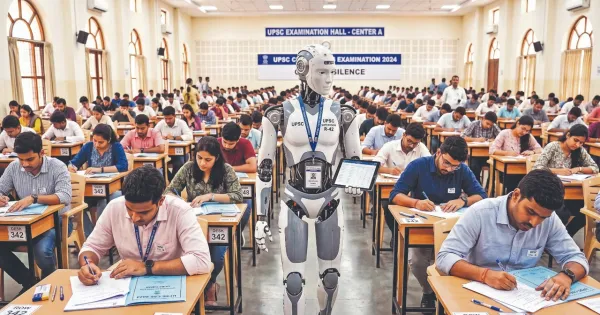
Regarding the National Eligibility Test controversy, experts say that AI was used to draft the questions. However, the National Testing Agency has denied the use of AI, while a ministry official cited ad-hoc i.e. careless setting of the paper. The use of AI to set examination papers is not so much a big deal as it is that we seem ready to get caught in a whirlpool whereby large language models of AI with access to extensive information sources or data bases will start testing human intelligence and sanity.
Taking the help of AI to set the paper is fine only symbolically, but from a broader philosophical perspective it violates the fundamental standards of morality and humanity. It is not so much important to determine the sequence of controversial exams as it is to set limits for the use of AI beyond which it can no longer determine how rational and aware we are.
The Ministry of Education, Government of India has started tightening the examination system of the National Testing Agency. Education Minister Pralhad Joshi had held a meeting with the Secretary of Higher Education Department, Director General of National Testing Agency and other senior officials on August 18. In this, the steps being taken to prevent such irregularities in future examinations were reviewed.
In the usual way, a panel of four-five experts sets the question paper. Experts raising doubts and allegations say that if there was a panel, it is strange how so many questions from previous years were selected and why new questions could not be coined. The answers to these questions were not available to the paper setters and examiners who designed the question papers and which were distributed to the examinees. National Testing Agency Director General Abhishek Singh has denied the use of AI and said that after the paper was set, 'human review' was done, that is, human review was done, but he remained silent on how the mistakes were not noticed.
A comprehensive examination of the question papers revealed that AI has been used to pre-arrange them, i.e. to create a model paper. Old subject experts associated with the National Testing Agency had said some time ago that AI was used not only in setting questions of UGC-NET but also in translating NEET-UG papers. He blamed the scale and nature of the errors on a lack of human checking. The paper setters could not even know that GS Ghuriye was a renowned social scientist of India.
The main question is who authorized the use of AI and what tools were used to write the questions? Were the questions examined by qualified experts, for which the agency had allegedly integrated AI into the preparation of the exam material, especially the translation? It appears that the agency officials were not able to declare the answer keys because the papers were designed in an ad-hoc manner or rather carelessly with the use of AI. After the irregularities came to light, questions are also being raised on the attitude of the National Testing Agency.
The Sociology exam was severely criticized. Candidates complained that names of internationally renowned scholars were misspelled. The terminology was confusing. The translations were strange and the questions did not match the prescribed syllabus. According to reports, George Ritzer was spelled as Putzer, Talcott Parsons as Parasov, GS Ghurye as Ghunye and Martha Nussbaum's name was also misspelled. A separate concern was raised regarding the large scale repetition of questions in the English paper.
The candidates alleged that out of 150, about 67 questions had been asked in the earlier UGC-NET examination. Some even claimed that the order of answer options was kept the same, which was lifted from the old one. Commerce candidates also pointed out that many questions were repeated from previous exams, including questions related to taxation, break-even analysis, capital structure and service marketing. How these questions were repeated is not known for certain.
It is important to clarify the extent to which automated systems were used in translation, organization and preparation for key national examinations and whether human academic review was properly conducted after the completion of that process. UGC-NET determines eligibility for teaching and research careers in universities in India, hence the credibility of the examination process is very important.
The new claims go beyond poor paper-setting and deepen the controversy as they raise questions about who approved the use of AI, what tools were used, whether every question was examined by qualified experts and why the National Testing Agency delayed canceling the exam despite the ministry's advice. Now the main question is not how so many mistakes were made in the three national level examinations, but how much of the examination process was handed over to machines and whether there were enough competent people to check what the machines generated with the help of Large Language Models.